AI Risk Management: Concrete Benefits and Hidden Limits
Formal risk frameworks reduce catastrophic failure rates but often increase deployment latency and obscure novel attack vectors that evade standard detection.

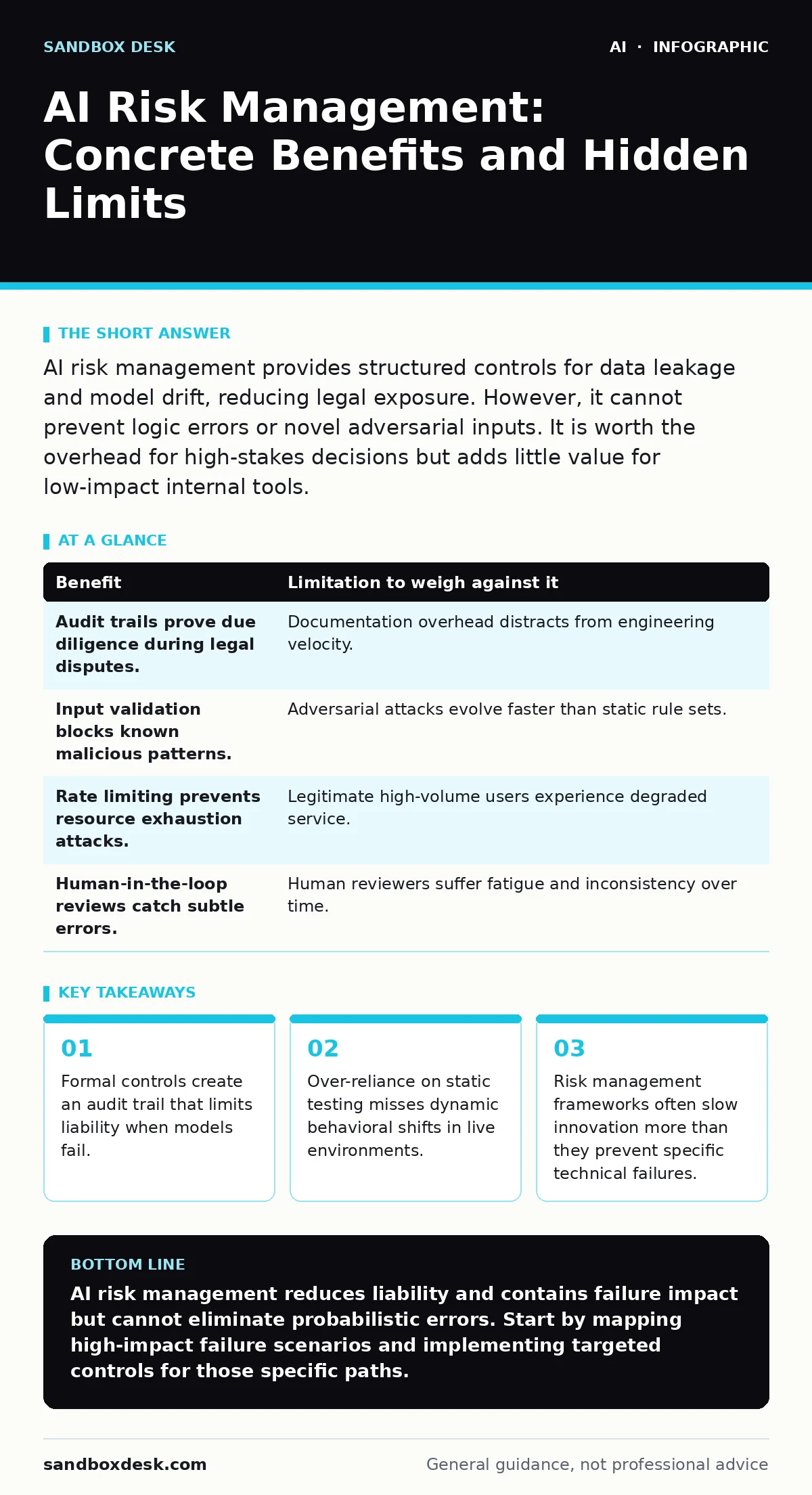
AI risk management provides structured controls for data leakage and model drift, reducing legal exposure. However, it cannot prevent logic errors or novel adversarial inputs. It is worth the overhead for high-stakes decisions but adds little value for low-impact internal tools.
The Mechanics of Structured Uncertainty
Artificial intelligence introduces non-deterministic behavior into software systems. Unlike traditional code, which produces the same output for the same input, machine learning models generate probabilistic results. This unpredictability makes standard testing insufficient. You cannot verify every possible output path. Risk management attempts to bound this uncertainty using statistical guarantees and operational controls.
The primary mechanism is not preventing every error, but containing the impact of errors that occur. You build systems to fail safely. This requires shifting from a prevention-only mindset to a resilience-focused architecture. You accept that the model will occasionally produce incorrect or harmful outputs. The goal is to ensure those outputs do not cause irreversible damage.
Operational Controls and Their Costs
Implementing controls introduces friction into your development pipeline. Every check adds latency. Every review step adds time. You must weigh the cost of this friction against the potential cost of a failure. For a chatbot that answers customer FAQs, the cost of a wrong answer is low. For an automated trading system, the cost is existential.
| Benefit | Limitation to weigh against it |
|---|---|
| Audit trails prove due diligence during legal disputes. | Documentation overhead distracts from engineering velocity. |
| Input validation blocks known malicious patterns. | Adversarial attacks evolve faster than static rule sets. |
| Rate limiting prevents resource exhaustion attacks. | Legitimate high-volume users experience degraded service. |
| Human-in-the-loop reviews catch subtle errors. | Human reviewers suffer fatigue and inconsistency over time. |
The Illusion of Comprehensive Testing
You cannot test for all possible inputs in a high-dimensional space. Traditional unit tests verify specific cases. They do not guarantee behavior between those cases. Machine learning models often exhibit sharp changes in output for minor, imperceptible changes in input. This is known as sensitivity to adversarial perturbations.
Risk management frameworks often rely on benchmark datasets. These datasets are finite and static. An attacker can reverse-engineer the training data or the evaluation criteria. Once they know what the system is tested against, they can craft inputs that pass the tests but fail in production. This is a fundamental limitation of offline evaluation. You must assume that passing internal benchmarks does not equate to safety in the wild.
Data Governance and Privacy Boundaries
Data is the fuel for these systems. Poor governance leads to leakage of sensitive information. Models can memorize training data and regurgitate it in response to specific queries. This is not a bug; it is a feature of how neural networks learn patterns. You must treat model weights as potentially containing confidential data.
Techniques like differential privacy add noise to training data to prevent memorization. This reduces the accuracy of the model. There is a direct trade-off between privacy and performance. You must decide how much accuracy you are willing to sacrifice for privacy guarantees. For many applications, the loss of precision is unacceptable. For others, it is the only viable path. See our guide on AI supply chain risks for details on third-party data handling.
When It Is Worth It
Formal risk management is worth the investment when the cost of failure exceeds the cost of control. This includes systems that make financial decisions, medical diagnoses, or legal judgments. It also applies to systems that handle personally identifiable information at scale. In these cases, the liability is high. The regulatory scrutiny is intense.
It is also worth it when the system operates autonomously without human oversight. If a bot can execute transactions or send communications on its own, you need robust guardrails. The speed of automated action amplifies the impact of errors. You cannot rely on a human to catch mistakes in real-time. The controls must be embedded in the system architecture.
See also: Difference Between Fine Tuning and Transfer Learning for Models · Explainable AI in Healthcare: Why Opacity Risks Patient Safety
When It Is Not
For internal tools with limited scope, heavy risk management is often counterproductive. If a model helps developers write boilerplate code, the risk of catastrophic failure is low. The cost of implementing complex governance frameworks may exceed the value of the tool. You should not apply enterprise-grade controls to experimental prototypes.
It is also not worth it when the problem is better solved by simpler means. If a rule-based system can achieve the desired outcome with deterministic behavior, do not use machine learning. The added complexity of managing model risk is unnecessary. See our section on machine learning in cybersecurity for examples where traditional methods outperform AI.
The Hidden Cost of False Security
One of the most dangerous aspects of risk management is the illusion of safety it provides. Stakeholders often believe that because a system has passed security reviews, it is safe. This complacency reduces vigilance. It leads to fewer resources being allocated to monitoring and incident response.
You must communicate the limitations of your controls clearly. Document what the system cannot detect. Define the boundary of your guarantees. This prevents stakeholders from assuming protection where none exists. Transparency about limitations is a critical part of risk management. It manages expectations and prepares you for inevitable breaches.
Integrating with Existing Frameworks
You do not need to invent new processes. Extend your existing security and quality assurance practices. Treat AI components as third-party dependencies. Apply the same scrutiny to model inputs and outputs as you do to API calls. This includes logging, monitoring, and access control.
See the OWASP Top 10 for LLM applications for a standardized list of risks. Use this as a checklist, not a final answer. Adapt it to your specific context. Ignore items that do not apply to your architecture. Focus on the risks that could actually impact your users. Do not waste effort on theoretical threats that have no practical pathway to exploitation.
Key takeaways
- Formal controls create an audit trail that limits liability when models fail.
- Over-reliance on static testing misses dynamic behavioral shifts in live environments.
- Risk management frameworks often slow innovation more than they prevent specific technical failures.
AI risk management reduces liability and contains failure impact but cannot eliminate probabilistic errors. Start by mapping high-impact failure scenarios and implementing targeted controls for those specific paths.
Frequently asked questions
Does passing security testing guarantee my AI is safe?
No. Static testing only covers known cases. Adversarial inputs can bypass filters and exploit model blind spots that were not present in the test set.
How do I balance privacy and model accuracy?
You must accept a trade-off. Adding noise for privacy reduces precision. Determine the minimum accuracy required for your use case and adjust privacy controls accordingly.
Is human review a sufficient control?
Human review is effective for low-volume, high-stakes decisions. It fails at scale due to fatigue and inconsistency. It should be part of a layered defense, not the sole control.
What is the first step in AI risk management?
Identify the highest-impact failure modes. Focus your efforts on preventing or mitigating those specific scenarios rather than trying to secure every possible input.
How this guide was produced: written by the Sandbox Desk editorial team with AI assistance, checked against the public references listed below, and reviewed when the facts change. See our editorial policy or report an error.