How to Spot AI Hallucinations: Detect Fabricated Facts in Outputs
AI models prioritize plausible syntax over factual truth, meaning confident-sounding errors often hide in the most structured parts of generated text.

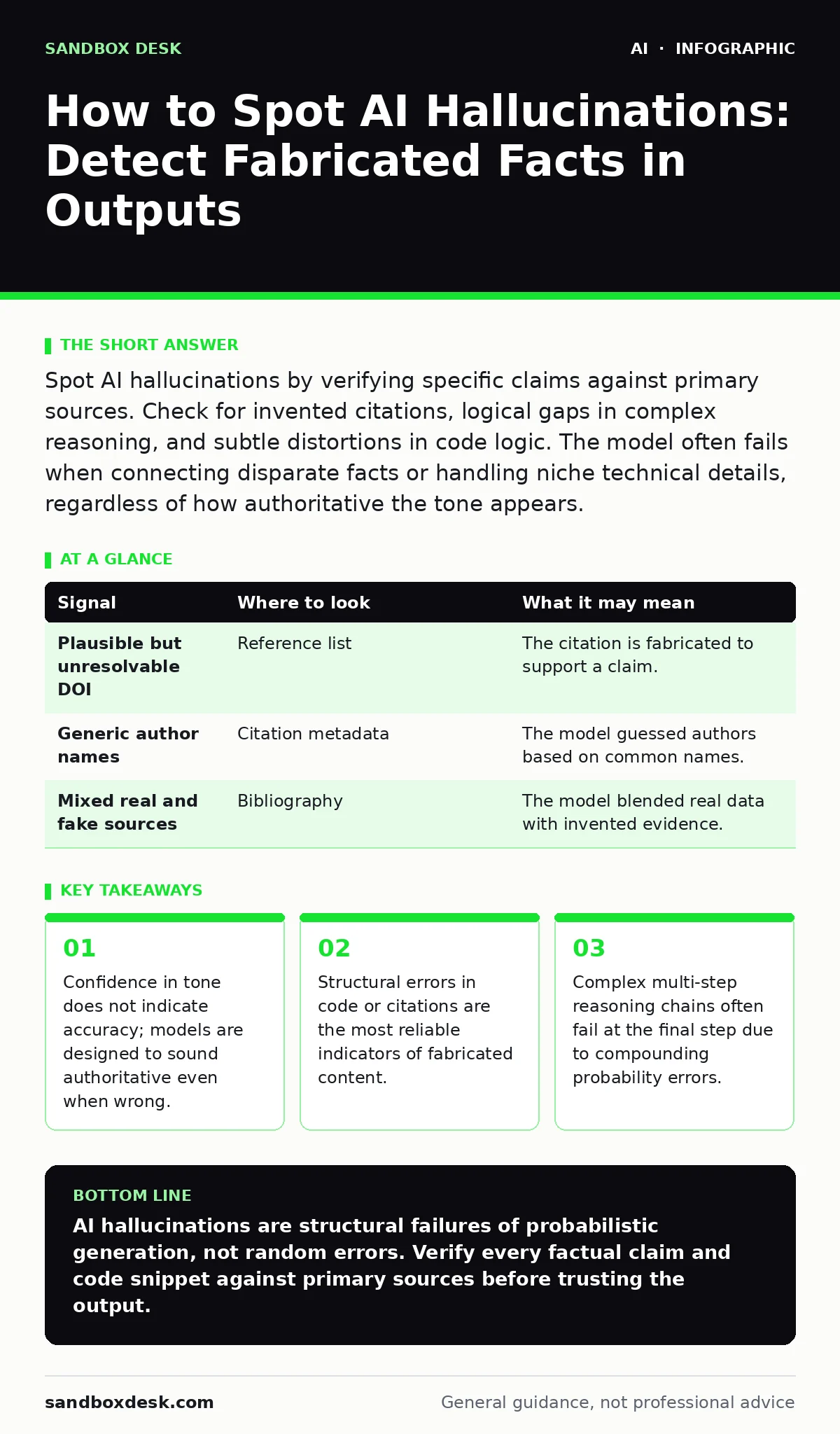
Spot AI hallucinations by verifying specific claims against primary sources. Check for invented citations, logical gaps in complex reasoning, and subtle distortions in code logic. The model often fails when connecting disparate facts or handling niche technical details, regardless of how authoritative the tone appears.
How to Spot AI Hallucinations in Text
The language model constructs responses by predicting the next likely word, not by retrieving verified facts. This probabilistic nature means the output resembles truth without necessarily being true. When you ask for a summary, the model synthesizes patterns from its training data. It does not read the source material again. It reconstructs what it believes the source said based on statistical likelihood. This reconstruction process introduces subtle distortions that are difficult to detect at a glance.
You must treat every factual claim as unverified until you check it. The model will often blend real facts with invented details to create a coherent narrative. This blending is the core mechanism of hallucination. The resulting text flows smoothly and uses correct grammar. It maintains a consistent tone and structure. These qualities make the fabrication feel authoritative. You cannot rely on the quality of the writing to judge the truth of the content.
Where to Look for Fabricated Citations
Citations are a primary location for hallucinations. Models often generate realistic-looking but non-existent references. These fake citations include correct journal names, plausible author names, and valid volume numbers. The combination of these elements creates a convincing facade. You must verify each citation individually. Do not assume that a list of references is accurate because the formatting looks professional.
Imagine a scenario where a model provides a literature review. It lists three papers that support a specific conclusion. Two papers exist and support the conclusion. The third paper contains the key evidence but does not exist. The model invented this paper to bridge a gap in the argument. You must search for the DOI or title of each reference. If the link does not resolve or the paper is missing from academic databases, the entire argument may be compromised.
| Signal | Where to look | What it may mean |
|---|---|---|
| Plausible but unresolvable DOI | Reference list | The citation is fabricated to support a claim. |
| Generic author names | Citation metadata | The model guessed authors based on common names. |
| Mixed real and fake sources | Bibliography | The model blended real data with invented evidence. |
Checking Code and Technical Logic
Code generation is another high-risk area for hallucinations. Models often produce syntax that looks correct but fails to compile or execute. They may import libraries that do not exist or use functions with incorrect parameters. The code might run in a simple case but fail under edge conditions. You cannot trust the model to handle complex logic without manual review.
The model does not execute the code it writes. It predicts code tokens based on patterns in its training data. If it has seen similar code snippets before, it will replicate the pattern. It does not understand the runtime behavior. It does not know if a variable is defined in the current scope. It generates text that resembles code. You must test every snippet in a sandbox environment.
Blind Spots in Multi-Step Reasoning
Complex reasoning tasks expose the limits of probabilistic generation. When you ask for a solution that requires multiple steps, the model may fail at later stages. It loses track of constraints established in earlier steps. This is known as context drift. The model focuses on generating the next logical step without maintaining the global state of the problem.
Imagine you ask for a plan to migrate a database. The model provides a correct backup strategy. It then suggests a migration tool that is incompatible with the backup format. It does not connect the two steps. It treats each step as an independent generation task. You must verify the consistency of the entire chain. Check that the output of one step is a valid input for the next.
Detecting Subtle Factual Distortions
Subtle distortions are harder to spot than outright fabrications. The model may change a technical term to a similar but incorrect one. It might swap two variables in a formula. It could invert a logical condition. These errors are small but critical. They do not break the flow of the text. They do not raise obvious red flags.
You need domain expertise to catch these errors. The model uses terms correctly in isolation. It fails when terms interact. It may use a security protocol name correctly but describe its handshake process incorrectly. It might describe a cryptographic algorithm with the right key length but the wrong block size. These details matter. You must verify technical specifications against official documentation.
See also: Malware Targeting AI Infrastructure: Threats and Defense · Treat AI Models as Untrusted Insiders: 8 Security Practices
The Role of Prompt Structure
The structure of your prompt influences the likelihood of hallucination. Vague prompts encourage the model to fill in gaps with probable but incorrect information. Specific prompts constrain the model to known data. You should provide clear boundaries and constraints. Tell the model what not to do. Specify the format you expect. Limit the scope of the response.
If you ask for a general explanation of a complex topic, the model will generalize. Generalization increases the risk of error. If you ask for a specific definition from a specific standard, the model is more likely to be accurate. It can anchor its generation to a narrow set of facts. You reduce hallucination by narrowing the search space for the model.
Integrating Verification into Workflow
Verification must be part of your development workflow. You cannot trust the output of the model without checks. This applies to text, code, and data. You need a process for validating each type of output. For text, check facts against primary sources. For code, run tests and static analysis. For data, verify the source and the transformation logic.
The OWASP Top 10 for LLM applications outlines common risks in AI systems. It includes guidance on prompt injection and data leakage. It also addresses the risk of unreliable outputs. You should review this framework to understand the broader security context. It helps you design systems that account for these failures. It provides a structured approach to mitigating risk.
Handling Edge Cases in Data
Edge cases often trigger hallucinations. The model may struggle with rare languages, obscure technical standards, or highly specific domain knowledge. It has seen less data in these areas. Its predictions are less reliable. It may default to common patterns that do not apply. You must be extra cautious when working with niche topics.
Suppose you ask for a translation of a technical manual into a rare language. The model may produce grammatically correct text that uses the wrong terminology. It may invent words that sound like the target language. It may miss cultural nuances. You need a human reviewer who understands both the source and target domains. Automated checks are insufficient for these cases.
The field of machine learning for fraud detection relies on accurate data. If the training data contains hallucinations, the model will learn false patterns. This can lead to incorrect classifications. You must ensure the integrity of your data sources. You must verify the labels and the features. Garbage in, garbage out applies to AI systems.
Key takeaways
- Confidence in tone does not indicate accuracy; models are designed to sound authoritative even when wrong.
- Structural errors in code or citations are the most reliable indicators of fabricated content.
- Complex multi-step reasoning chains often fail at the final step due to compounding probability errors.
AI hallucinations are structural failures of probabilistic generation, not random errors. Verify every factual claim and code snippet against primary sources before trusting the output.
Frequently asked questions
Can AI hallucinations be completely prevented?
No, hallucinations are an inherent risk of probabilistic language models. You can reduce them with better prompts and strict verification, but you cannot eliminate them entirely.
How do I verify a citation that looks real?
Search for the DOI or title in academic databases like CrossRef or PubMed. If the record does not exist or the abstract does not match the claim, the citation is likely fake.
Why does the model sound confident when it is wrong?
The model is trained to predict the next likely word, creating fluent and authoritative-sounding text. It does not have a mechanism for self-doubt or uncertainty in its output.
Is it safe to use AI for writing production code?
Only if you review and test every line of code. The model may generate code that compiles but contains logical errors or security vulnerabilities. Never deploy untested AI-generated code.
How this guide was produced: written by the Sandbox Desk editorial team with AI assistance, checked against the public references listed below, and reviewed when the facts change. See our editorial policy or report an error.