How Large Language Models Work: Mechanics, Limits, and Reality
Large language models predict the next word using statistical probability, not by accessing a database of verified facts or understanding meaning.

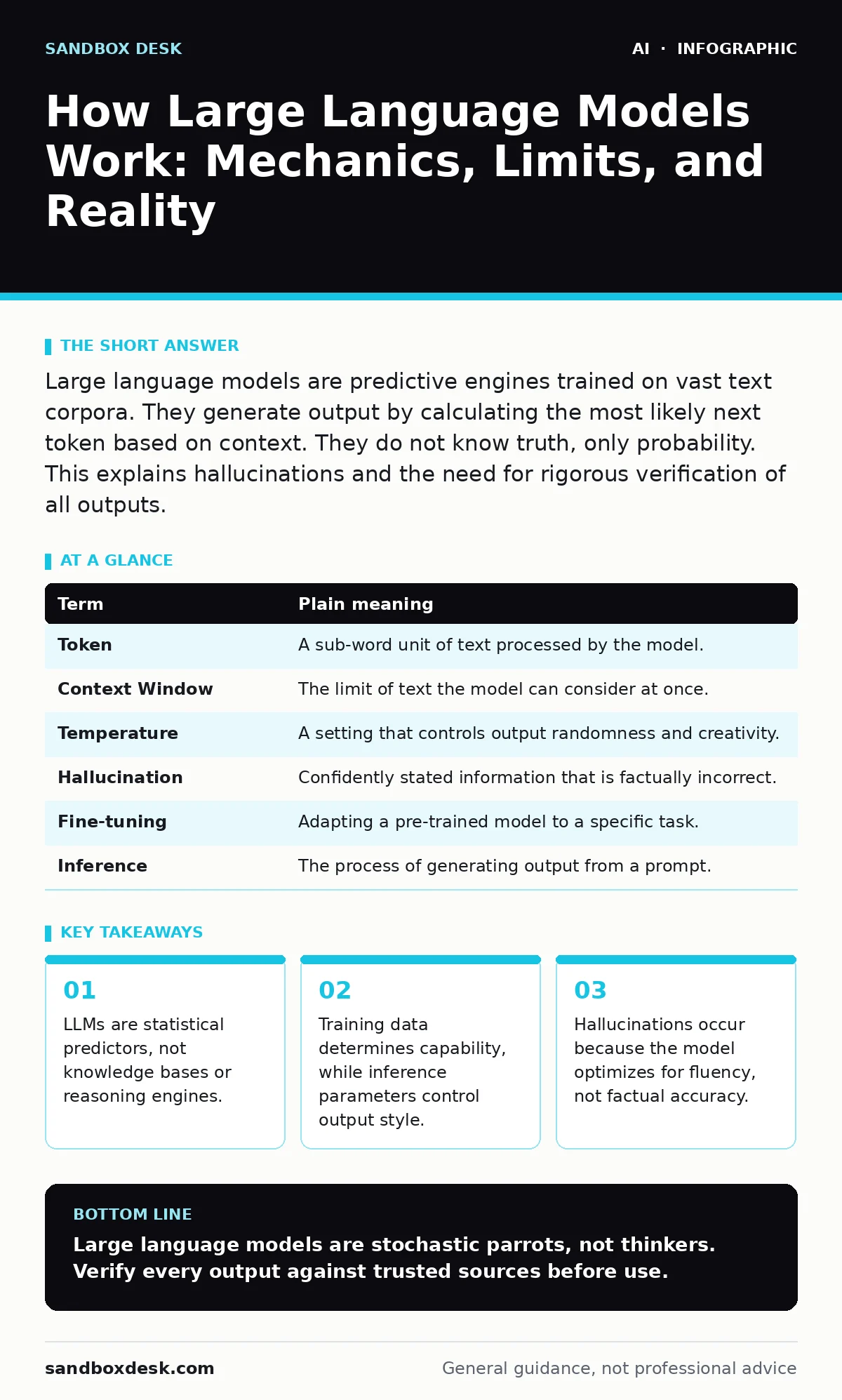
Large language models are predictive engines trained on vast text corpora. They generate output by calculating the most likely next token based on context. They do not know truth, only probability. This explains hallucinations and the need for rigorous verification of all outputs.
The Restaurant Analogy
Imagine a chef who has memorized every recipe book in existence but has never tasted food. You ask for a "savory dinner." The chef does not look in a pantry. Instead, the chef calculates which words usually follow "savory dinner" based on millions of prior menus. They serve you a coherent-sounding description of a meal. The description is grammatically perfect. It may even sound delicious. But the chef has no idea if the ingredients actually exist or if the cooking method is safe. This is how large language models operate. They predict the next piece of text, not the truth.
Tokenization and Prediction
The model breaks your input into tokens, which are chunks of text like words or parts of words. It then uses a neural network to estimate the probability of every possible next token. It selects the most likely option, or samples from a weighted distribution if you allow for randomness. This process repeats until the output is complete. Each step depends entirely on the previous ones. The model has no long-term memory of your session beyond the context window. It does not "remember" you. It only processes the immediate text provided.
| Term | Plain meaning |
|---|---|
| Token | A sub-word unit of text processed by the model. |
| Context Window | The limit of text the model can consider at once. |
| Temperature | A setting that controls output randomness and creativity. |
| Hallucination | Confidently stated information that is factually incorrect. |
| Fine-tuning | Adapting a pre-trained model to a specific task. |
| Inference | The process of generating output from a prompt. |
The Illusion of Understanding
Readers often confuse fluency with comprehension. The model produces sentences that follow the grammatical and semantic patterns of its training data. This creates a strong illusion of intent. However, the model lacks grounding, which is the connection between symbols and real-world objects. It does not know what a "chair" is. It only knows that "chair" often appears near "sit" and "wood." This gap explains why the model can write a poem about love but cannot verify if a specific historical date is correct. It prioritizes linguistic coherence over factual correctness.
Temperature and Determinism
The temperature setting alters how the model selects tokens. A low temperature forces the model to choose the highest-probability token. This yields consistent, conservative, and often repetitive output. A high temperature allows the model to select lower-probability tokens. This yields creative, varied, and potentially erratic output. There is no "correct" setting. It depends on whether you need a structured data format or a creative draft. Many users leave this at default, missing the trade-off between reliability and novelty.
Context Window Constraints
The context window is the maximum amount of text the model can process simultaneously. If your input exceeds this limit, the model truncates the earlier parts. This is not a storage issue. It is a computational constraint. Important details at the beginning of a long document may be ignored entirely. You must structure prompts to place critical instructions within the active window. This limitation affects how you handle large codebases or legal documents. You cannot simply paste everything and expect full comprehension.
See also: 7 AI Model Monitoring Mistakes That Break Production Systems · How Machine Learning Changes Cybersecurity Decision Making
Hallucinations and Verification
Hallucinations are fabricated details that fit the expected pattern. The model fills gaps in its knowledge with plausible-sounding text. This happens because the objective function rewards likelihood, not truth. If the model lacks data on a niche topic, it will invent one that matches the surrounding context. This is not a bug. It is a feature of generative systems. You must verify all factual claims, citations, and code snippets. Do not trust the model’s internal logic. Treat output as a draft requiring external validation. For deeper analysis on these risks, see training data leakage.
Try This Now
- Ask the model to define a fictional concept. Observe how it constructs a plausible definition using real-world analogies.
- Repeat the same prompt with temperature set to zero. Compare the output for rigidity and repetition.
- Insert a false premise in the prompt. Watch how the model adapts its logic to support the error.
Practical Implications for Development
When integrating these models into software, you must handle errors gracefully. The model may refuse requests, produce garbage, or leak sensitive data if prompted correctly. This is not a failure of intelligence. It is a failure of alignment. You need guardrails. These are separate systems that filter inputs and outputs. They check for policy violations and data exposure. Without them, your application is vulnerable to prompt injection. See insecure AI plugins and agents for implementation details. Also consider AI usage policies at work for organizational governance.
The Role of Training Data
The model’s capabilities are bounded by its training data. It cannot know what was not in the corpus. It cannot reason about events after its cutoff. It cannot access private information. This makes it a powerful tool for pattern matching and generation. It is a poor tool for real-time fact-checking. Understanding this boundary prevents misuse. It shifts the focus from asking for answers to structuring problems for the model. See machine learning in cybersecurity for how these patterns are detected.
Key takeaways
- LLMs are statistical predictors, not knowledge bases or reasoning engines.
- Training data determines capability, while inference parameters control output style.
- Hallucinations occur because the model optimizes for fluency, not factual accuracy.
Large language models are stochastic parrots, not thinkers. Verify every output against trusted sources before use.
Frequently asked questions
Do large language models have consciousness?
No. They are mathematical functions that map input sequences to output sequences. They simulate conversation without subjective experience or self-awareness.
Why do models sometimes contradict themselves?
Contradictions arise from the probabilistic nature of token selection. If the context shifts, the model may generate conflicting statements to maintain local coherence.
Can I train a model on private data?
You can fine-tune models on private data, but this requires significant compute resources. It also raises security concerns if the data leaks during training or inference.
What is the difference between an LLM and a search engine?
A search engine retrieves existing documents. An LLM generates new text by predicting patterns. One finds information; the other constructs it from memory.
How this guide was produced: written by the Sandbox Desk editorial team with AI assistance, checked against the public references listed below, and reviewed when the facts change. See our editorial policy or report an error.