How to Read the OWASP Top 10 for LLM Applications Correctly
The OWASP LLM Top 10 is a diagnostic lens for architectural flaws, not a checklist of vulnerabilities to patch before you ship your model to production.

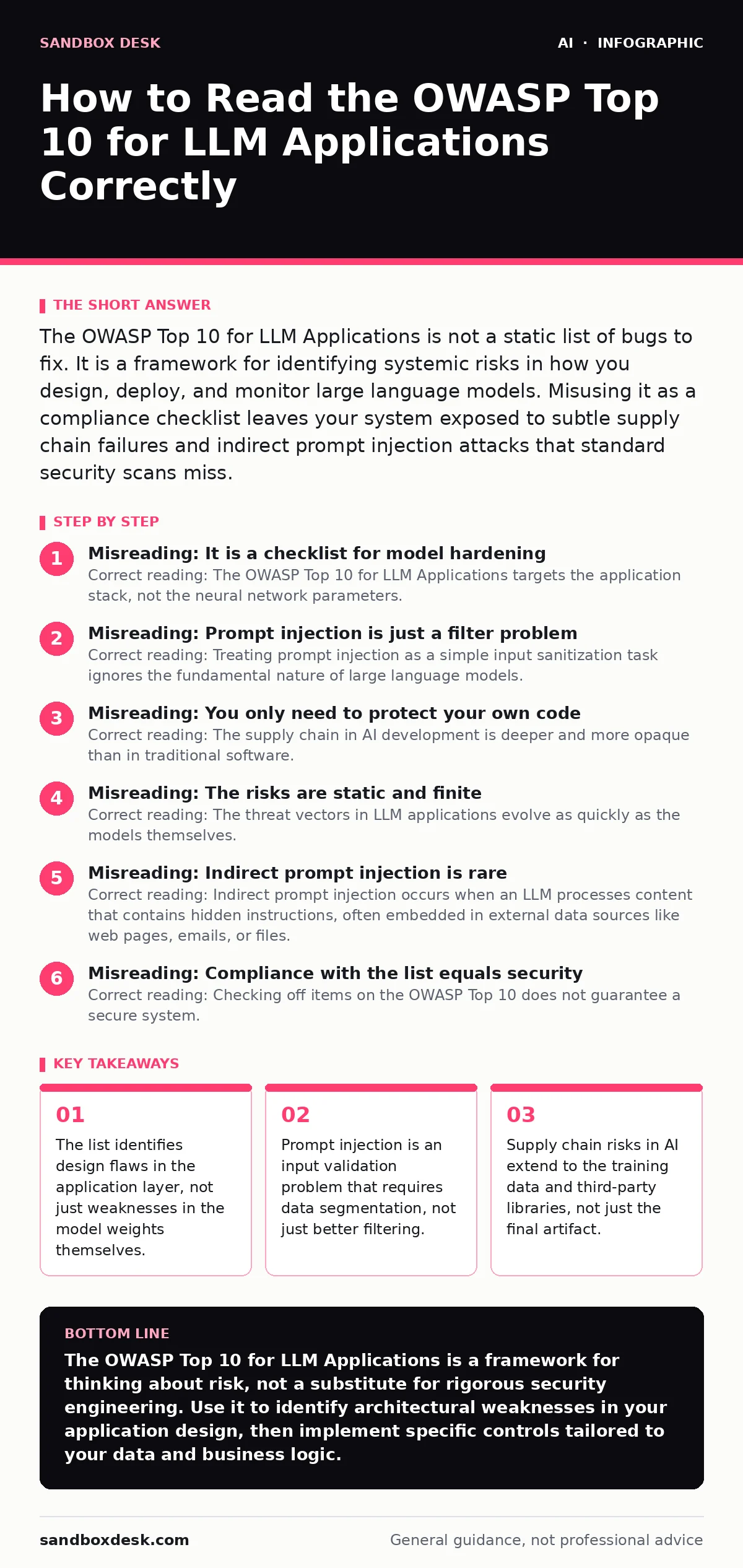
The OWASP Top 10 for LLM Applications is not a static list of bugs to fix. It is a framework for identifying systemic risks in how you design, deploy, and monitor large language models. Misusing it as a compliance checklist leaves your system exposed to subtle supply chain failures and indirect prompt injection attacks that standard security scans miss.
Misreading: It is a checklist for model hardening
Correct reading: The OWASP Top 10 for LLM Applications targets the application stack, not the neural network parameters. Many teams assume that scanning a model for adversarial examples satisfies security requirements. This is incorrect. The framework addresses how your code interacts with the model, how you handle user input, and how you manage the surrounding infrastructure. A model can be mathematically sound while the application wrapping it leaks sensitive data or executes arbitrary code. You must separate model evaluation from application security. The risks here are often in the glue code, the API gateways, and the data pipelines that feed the context window.
Misreading: Prompt injection is just a filter problem
Correct reading: Treating prompt injection as a simple input sanitization task ignores the fundamental nature of large language models. These models process all text in a single context window without distinguishing between user instructions and system directives. Blocking specific keywords creates a false sense of security because attackers can use paraphrasing or encoded payloads to bypass static filters.
The correct approach is architectural separation. You must keep user data and system instructions in distinct logical spaces. If the model can read user input as an instruction, you have a vulnerability. See the guide on jailbreaking AI chatbots for deeper analysis of these evasion techniques. This requires designing your prompt templates to be structurally rigid, not just semantically filtered.
Misreading: You only need to protect your own code
Correct reading: The supply chain in AI development is deeper and more opaque than in traditional software. When you use a pre-trained model, you inherit the risks of its training data, its fine-tuning process, and the libraries used to serve it. A vulnerability in a dependency can allow an attacker to exfiltrate training data or manipulate model behavior.
This goes beyond standard software dependencies. You must audit the provenance of your models and the data used to train them. The guide on AI supply chain risks details how to verify these upstream components. If you cannot verify how a model was trained, you cannot fully trust its outputs or its security posture. This applies even to open-source models where the training data may contain poisoned samples.
Misreading: The risks are static and finite
Correct reading: The threat vectors in LLM applications evolve as quickly as the models themselves. A technique that works today may fail tomorrow due to model updates, while new exploits emerge from changes in model behavior. The OWASP list is a snapshot of known risks, not a prediction of future ones. You must treat security as a continuous process of monitoring and adaptation.
This includes observing model outputs for anomalies and re-evaluating your defenses as the model learns or changes. The concept of machine learning in cybersecurity is relevant here, as automated systems can help detect drift or unusual patterns in model usage. Static compliance checks will always lag behind active exploitation methods. You need a feedback loop that connects runtime observations back to your design decisions.
Misreading: Indirect prompt injection is rare
Correct reading: Indirect prompt injection occurs when an LLM processes content that contains hidden instructions, often embedded in external data sources like web pages, emails, or files. This is not a hypothetical edge case; it is a structural inevitability of models that ingest external context. If your application summarizes a webpage or reads an email, an attacker can place instructions in that content to manipulate the model’s behavior.
This bypasses direct user input filters entirely. The guide on insecure AI plugins and agents explores how these vectors exploit the trust boundaries of autonomous systems. You must assume that any external data consumed by the model is hostile. Segregating trusted system prompts from untrusted external data is the primary mitigation.
See also: Explainable AI in Healthcare: Why Opacity Risks Patient Safety · How to Spot AI Hallucinations: Detect Fabricated Facts in Outputs
Misreading: Compliance with the list equals security
Correct reading: Checking off items on the OWASP Top 10 does not guarantee a secure system. It ensures you have considered common categories of risk. However, it does not account for your specific business logic, data sensitivity, or operational environment. A healthcare application faces different risks than a creative writing tool, even if they use the same model.
You must map the generic risks to your specific use case. This involves understanding the impact of each potential failure mode on your users and your organization. The guide on AI risk management provides a framework for this contextual assessment. Security is not a binary state of pass or fail. It is a spectrum of risk tolerance and mitigation effectiveness.
Misreading: Data leakage is only about privacy
Correct reading: Data leakage in LLM applications extends beyond personal identifiable information. It includes the exposure of proprietary business logic, internal documents, and sensitive configuration details. When a model memorizes training data or exposes it through retrieval-augmented generation, it can reveal intellectual property or competitive intelligence.
This is a business risk as much as a privacy risk. The guide on training data leakage explains how to identify and mitigate these exposures. You must classify your data and restrict what the model can access based on that classification. Masking or redacting sensitive information before it enters the context window is a necessary step.
Misreading: Agent security is just prompt security
Correct reading: AI agents that can interact with external tools face a broader attack surface. They can execute code, make API calls, or modify systems. A prompt injection can lead to direct system compromise if the agent has privileged access. This elevates the severity of indirect injection attacks. The guide on securing AI agents details how to constrain agent capabilities and monitor their actions. You must implement strict permission controls and audit trails for all agent actions. Assume that any action taken by an agent was influenced by potentially malicious input.
Key takeaways
- The list identifies design flaws in the application layer, not just weaknesses in the model weights themselves.
- Prompt injection is an input validation problem that requires data segmentation, not just better filtering.
- Supply chain risks in AI extend to the training data and third-party libraries, not just the final artifact.
The OWASP Top 10 for LLM Applications is a framework for thinking about risk, not a substitute for rigorous security engineering. Use it to identify architectural weaknesses in your application design, then implement specific controls tailored to your data and business logic.
Frequently asked questions
Does the OWASP Top 10 cover all AI security risks?
No, it focuses on common vulnerabilities in LLM applications. It does not cover all possible risks, especially those specific to your unique implementation or emerging threats.
How often should I review my security posture against the OWASP list?
You should review it continuously, especially after significant changes to your model, application code, or data sources. Security is an ongoing process.
Can I use the OWASP list for non-LLM machine learning models?
The list is specific to LLMs. While some principles may apply, traditional machine learning models have different risk profiles and require different mitigation strategies.
Is prompt injection the only input risk?
No, other risks include data poisoning, model inversion, and denial of service. Prompt injection is prominent because of its ease of exploitation, but it is not the only concern.
How this guide was produced: written by the Sandbox Desk editorial team with AI assistance, checked against the public references listed below, and reviewed when the facts change. See our editorial policy or report an error.