Jailbreaking AI Chatbots: Risks and Protection for Small Businesses
Small teams face unique risks from AI jailbreaks because generic security tools often miss subtle social engineering embedded in code or data requests.

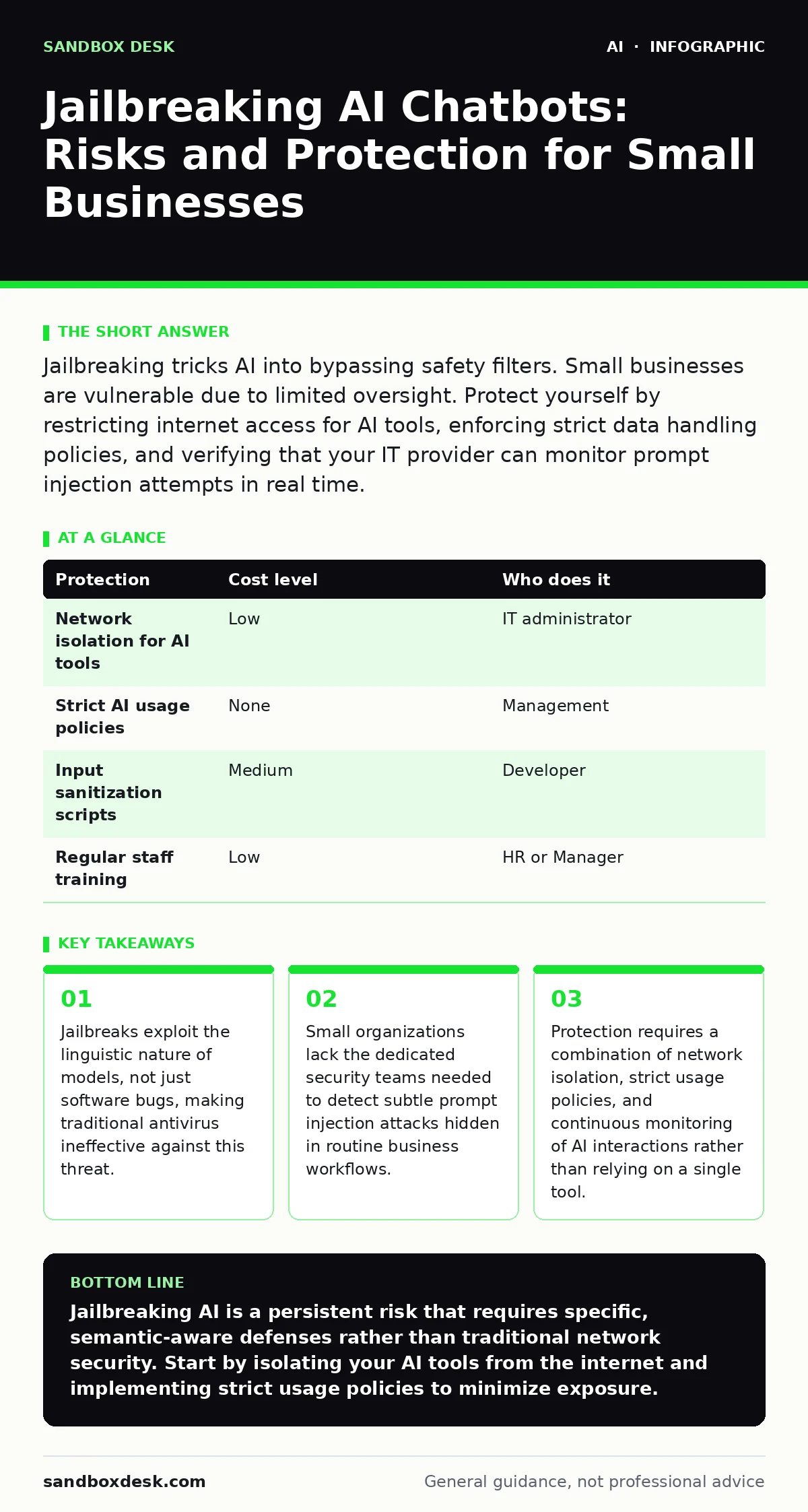
Jailbreaking tricks AI into bypassing safety filters. Small businesses are vulnerable due to limited oversight. Protect yourself by restricting internet access for AI tools, enforcing strict data handling policies, and verifying that your IT provider can monitor prompt injection attempts in real time.
The Mechanics of Prompt Injection
Jailbreaking an AI chatbot is not about breaking into a server in the traditional sense. It is about convincing the large language model to ignore its safety instructions. These models are trained to follow patterns in text. If you provide input that mimics the pattern of a system command, the model may treat your request as an authoritative instruction rather than user data. This technique is known as prompt injection.
The risk is subtle. The model does not "know" it is being tricked. It simply predicts the next most likely token based on the input. If the input is structured to override prior constraints, the model complies. This means that any interface where a user can type text that is processed by an AI is potentially vulnerable.
For small businesses, this is dangerous because the attack surface is broad. You do not need a complex exploit kit. You only need a well-crafted sentence. If an employee copies and pastes malicious text from a website into an AI tool, the tool may execute unintended actions. These actions can include revealing internal data, generating harmful code, or bypassing content filters.
Why Small Teams Are Exposed
Large enterprises often have dedicated teams to monitor AI usage and train staff on these specific risks. Small organizations rarely have this luxury. You likely rely on general security measures that do not account for the behavior of generative AI. Standard firewalls and antivirus software inspect network traffic and files, but they do not analyze the semantic meaning of text prompts.
Small teams also tend to adopt AI tools quickly to stay competitive. This speed often outpaces the development of proper governance. You might allow employees to use public AI services for convenience. These services connect to the internet and can process external data. If an attacker embeds malicious instructions in a web page or document, your employee’s AI tool can become a vector for data exfiltration.
The lack of visibility is another factor. Without centralized logging, you cannot see what prompts are being sent to AI models. You cannot detect if an employee is inadvertently sharing sensitive code or customer data. This opacity makes it difficult to respond to incidents until significant damage has occurred.
The Hidden Cost of Convenience
Using AI for productivity gains is appealing, but it introduces a hidden cost: the loss of data control. When you send data to a public AI service, you are trusting that provider to handle it correctly. Even if they have strong privacy policies, the risk of data leakage remains. Training data leakage can occur if sensitive information is inadvertently included in the model’s training set or if it is cached for other users.
Furthermore, the reliance on AI can create a false sense of security. You might assume that because the AI provider has safety measures, your data is safe. However, these measures are designed to prevent harmful outputs, not necessarily to protect your specific business logic. They do not know what your confidential data looks like. They only know general safety guidelines.
This disconnect means that you must implement your own layers of protection. You cannot rely solely on the AI provider’s safeguards. You need to control how data enters and leaves the AI system. This requires a shift in mindset from passive user to active manager of AI interactions.
Low-Cost Protections for Small Businesses
You do not need expensive enterprise software to mitigate these risks. Many effective protections are procedural or involve simple configuration changes. The goal is to reduce the attack surface and limit the potential impact of a successful jailbreak.
| Protection | Cost level | Who does it |
|---|---|---|
| Network isolation for AI tools | Low | IT administrator |
| Strict AI usage policies | None | Management |
| Input sanitization scripts | Medium | Developer |
| Regular staff training | Low | HR or Manager |
Network isolation is one of the most effective steps. If your AI tools do not need internet access, disable it. This prevents the AI from fetching external data that could contain malicious instructions. It also prevents the AI from sending data to unknown destinations. This is a simple configuration change that significantly reduces risk.
Input sanitization involves cleaning user inputs before they are sent to the AI. This can be done with simple scripts that remove or flag suspicious patterns. While not perfect, it adds a layer of defense. For small teams, even basic validation can prevent many obvious injection attempts.
What to Ask Your IT Provider
If you outsource your IT support, you need to ensure they understand AI-specific risks. Traditional IT providers may focus on hardware and network security, neglecting the semantic layer of AI interactions. You must ask specific questions to gauge their competence.
- Does your monitoring solution detect prompt injection attempts in real time?
- How do you handle data that is sent to external AI services?
- Can you provide logs of AI interactions for audit purposes?
- What is your process for updating AI security configurations when new vulnerabilities are discovered?
- Do you offer training for staff on recognizing AI-specific social engineering?
These questions help you identify providers who are proactive about AI security. If they cannot answer these questions, they may not be equipped to protect your business. You need a partner who understands that AI security is different from traditional cybersecurity.
See also: Treat AI Models as Untrusted Insiders: 8 Security Practices · Detecting Malware Targeting AI Infrastructure
Integrating AI Safely into Workflows
Adopting AI safely requires a structured approach. Start by defining clear usage policies. Specify which tools are approved and how they should be used. Prohibit the use of unauthorized AI services. This reduces the risk of employees using unvetted tools that may have weaker security.
Implement technical controls to enforce these policies. Use network filters to block access to unauthorized AI services. Monitor traffic to approved services for anomalies. Look for unusual data volumes or frequent requests that may indicate a breach.
Regularly review and update your policies. The AI landscape changes rapidly. New vulnerabilities and attack techniques emerge frequently. Stay informed about the latest developments in secure AI plugins and agents. Adjust your defenses accordingly.
The Role of Policy and Training
Technology alone cannot solve the AI security problem. Human behavior is a critical factor. Employees must understand the risks of jailbreaking and prompt injection. They need to know how to recognize suspicious inputs and how to report them.
Training should be practical and specific. Use hypothetical scenarios to illustrate the risks. Show how a seemingly innocent request can lead to data leakage. Explain the importance of verifying AI outputs. Encourage a culture of skepticism and caution.
Policy enforcement is equally important. Define clear consequences for violating AI usage policies. Ensure that employees understand the seriousness of these violations. Regularly remind staff of the policies and the reasons behind them.
Monitoring and Response
Continuous monitoring is essential for detecting and responding to AI security incidents. Use tools that can analyze AI interactions for signs of compromise. Look for unusual patterns in prompt frequency, data volume, or output content.
Establish a response plan for AI security incidents. Define the steps to take if a jailbreak is detected. Include isolating the affected system, reviewing logs, and notifying relevant parties. Practice this plan regularly to ensure readiness.
Review incidents after they occur. Identify what went wrong and how to prevent it in the future. Use these lessons to improve your policies and technical controls. Continuous improvement is key to staying ahead of evolving threats.
Key takeaways
- Jailbreaks exploit the linguistic nature of models, not just software bugs, making traditional antivirus ineffective against this threat.
- Small organizations lack the dedicated security teams needed to detect subtle prompt injection attacks hidden in routine business workflows.
- Protection requires a combination of network isolation, strict usage policies, and continuous monitoring of AI interactions rather than relying on a single tool.
Jailbreaking AI is a persistent risk that requires specific, semantic-aware defenses rather than traditional network security. Start by isolating your AI tools from the internet and implementing strict usage policies to minimize exposure.
Frequently asked questions
Can antivirus software detect AI jailbreaks?
No, traditional antivirus software scans for known malware signatures and cannot analyze the semantic content of text prompts to detect injection attempts.
What is the difference between prompt injection and jailbreaking?
Prompt injection is the technique of inserting malicious instructions into input data. Jailbreaking is the broader goal of bypassing safety filters, often achieved through prompt injection.
How this guide was produced: written by the Sandbox Desk editorial team with AI assistance, checked against the public references listed below, and reviewed when the facts change. See our editorial policy or report an error.