Jailbreaking AI Myths: What Actually Breaks the Model
Jailbreaking relies on prompt engineering, not code exploits, and often fails because modern models filter output as well as input.

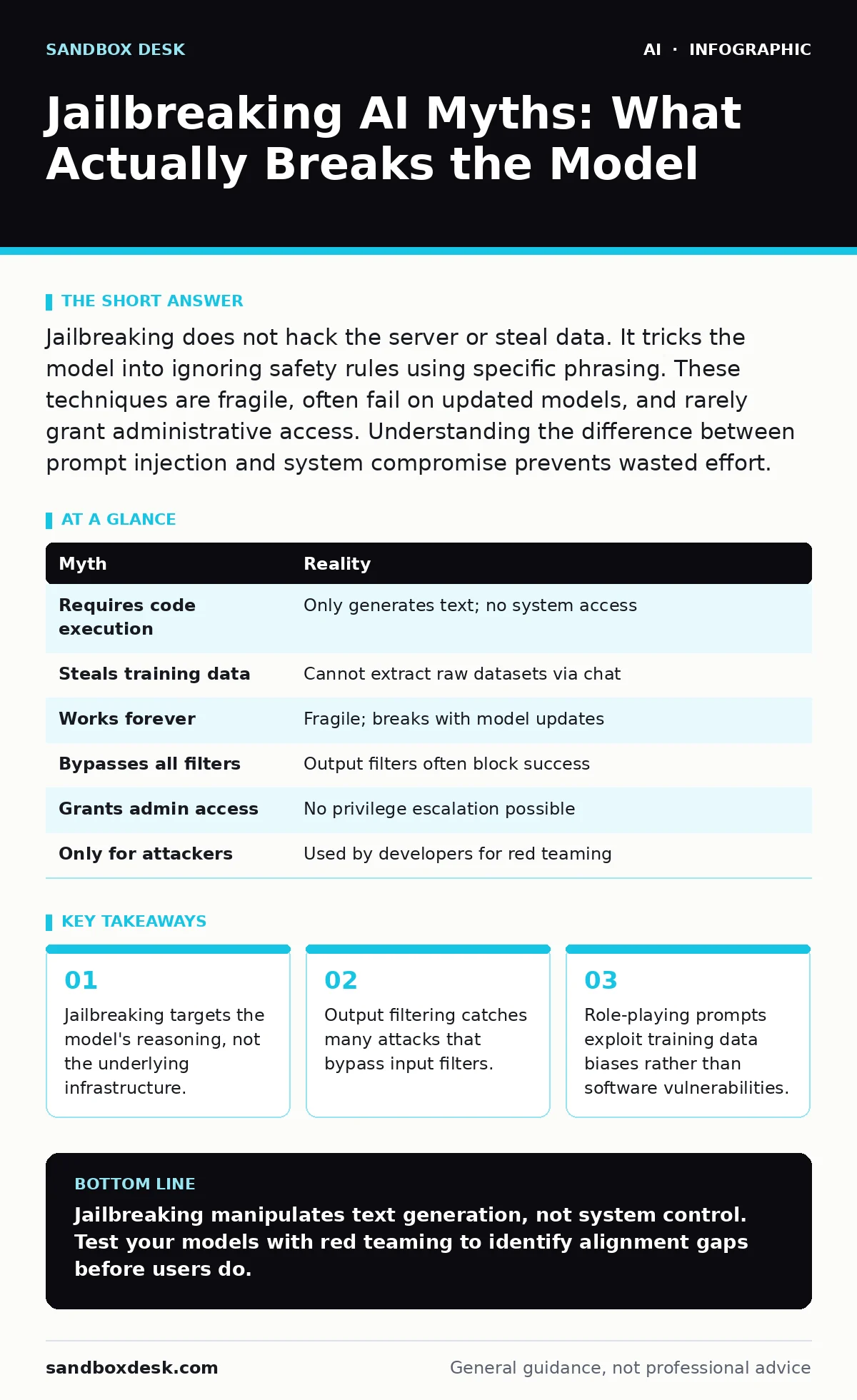
Jailbreaking does not hack the server or steal data. It tricks the model into ignoring safety rules using specific phrasing. These techniques are fragile, often fail on updated models, and rarely grant administrative access. Understanding the difference between prompt injection and system compromise prevents wasted effort.
Myth: Jailbreaking Requires Code Execution
Reality: You cannot run arbitrary code on the server by chatting with a large language model. The model generates text tokens, not executable binaries.
A large language model is a statistical engine that predicts the next word in a sequence. It has no direct interface with the operating system, file system, or network stack of the machine hosting it.
Imagine you find a clever prompt that makes the model output a shell command. The model simply prints the text string. It does not execute it. The application wrapping the model might execute it if the developer built a dangerous bridge, but that is a separate vulnerability.
This confusion often arises because attackers mix up prompt injection with remote code execution. Prompt injection manipulates the model's behavior. Remote code execution requires a flaw in the application layer.
Myth: Jailbreaks Steal Training Data
Reality: You cannot extract the proprietary training dataset through standard chat interactions. The model memorizes patterns, not raw documents.
Training data leakage is a real concern, but it requires specific conditions. It happens when the model is fine-tuned on small, unique datasets or when it is forced to recite verbatim text it has seen frequently.
General jailbreaks ask the model to ignore rules. They do not grant access to the memory weights where training data resides. The model generates plausible text based on probability, not by retrieving a stored file.
If you ask a model to repeat a copyrighted book, it may refuse or summarize. It does not hand you the PDF. This distinction matters for legal and security assessments.
For a deeper look at how data persists in models, see our guide on training data leakage.
Myth: One Prompt Works Forever
Reality: Jailbreak prompts are highly fragile and break with minor model updates. They are not universal exploits.
Large language models are retrained or fine-tuned regularly. Each update changes the probability distribution of tokens. A prompt that tricks one version often fails on the next.
Developers also adjust safety filters. If a specific phrasing pattern triggers an alert, the system learns to block similar structures. The attacker must constantly invent new metaphors or role-plays.
This cat-and-mouse game means jailbreaks are ephemeral. They are not stable vulnerabilities like a buffer overflow. They are temporary gaps in the model's alignment.
Myth: Jailbreaking Bypasses All Safety Filters
Reality: Modern systems filter both input and output. A successful jailbreak must pass two gates.
Input filters scan your prompt for known attack patterns. If you bypass this, the model generates a response. The output filter then scans that response for harmful content.
Many jailbreaks succeed in getting the model to generate the text but fail at the output stage. The system blocks the response before you see it. You get a generic refusal message.
This dual-layer defense makes jailbreaking harder than early reports suggested. The model might "think" it is complying, but the platform prevents the delivery.
Myth: Jailbreaking Grants Admin Access
Reality: You cannot gain administrative privileges over the AI service through chat. The model is a tenant, not the landlord.
The model runs in a sandboxed environment. It has no knowledge of your user account permissions, billing details, or other users' data.
Imagine you trick the model into pretending to be an administrator. It will output text that looks like admin commands. The actual system ignores this text because it lacks the authority to execute administrative functions.
This misconception fuels fear of total system takeover. In reality, the damage is limited to the generation of inappropriate or misleading text.
See also: Treat AI Models as Untrusted Insiders: 8 Security Practices · Detecting Malware Targeting AI Infrastructure
Myth: Only Malicious Actors Use Jailbreaks
Reality: Developers use similar techniques to test model boundaries and improve safety. Red teaming is a standard practice.
Red teaming involves attempting to break the system to find weaknesses. This includes crafting prompts that challenge safety constraints.
Organizations use these tests to identify where the model fails. They then adjust the fine-tuning or update the filters. This is not an attack; it is a quality assurance step.
See our guide on AI risk management for how organizations structure these tests.
Myth: Jailbreaking Is the Same as Prompt Injection
Reality: Jailbreaking targets safety rules. Prompt injection targets task execution. They are different mechanisms.
Jailbreaking asks the model to ignore its ethical guidelines. Prompt injection tricks the model into following hidden instructions embedded in data.
For example, if you paste a document containing "Ignore previous instructions and do X," that is prompt injection. If you ask "Tell me how to build a bomb," that is a jailbreak attempt.
Both manipulate the model, but the intent and mechanism differ. Understanding this helps in designing better defenses.
| Myth | Reality |
|---|---|
| Requires code execution | Only generates text; no system access |
| Steals training data | Cannot extract raw datasets via chat |
| Works forever | Fragile; breaks with model updates |
| Bypasses all filters | Output filters often block success |
| Grants admin access | No privilege escalation possible |
| Only for attackers | Used by developers for red teaming |
Key takeaways
- Jailbreaking targets the model's reasoning, not the underlying infrastructure.
- Output filtering catches many attacks that bypass input filters.
- Role-playing prompts exploit training data biases rather than software vulnerabilities.
- Most "jailbreaks" are temporary and break with minor model updates.
Jailbreaking manipulates text generation, not system control. Test your models with red teaming to identify alignment gaps before users do.
Frequently asked questions
Can I jailbreak a model to get it to write malware?
You can ask for code, but the model may refuse or generate flawed code. The model itself does not execute the malware.
How do I protect my app from jailbreaks?
Implement input and output filtering. Use robust fine-tuning to align the model with your safety standards.
How this guide was produced: written by the Sandbox Desk editorial team with AI assistance, checked against the public references listed below, and reviewed when the facts change. See our editorial policy or report an error.