How Machine Learning Changes Cybersecurity Decision Making
Machine learning shifts security from static rule matching to dynamic behavior analysis, allowing teams to detect novel threats that bypass traditional signature-based defenses.

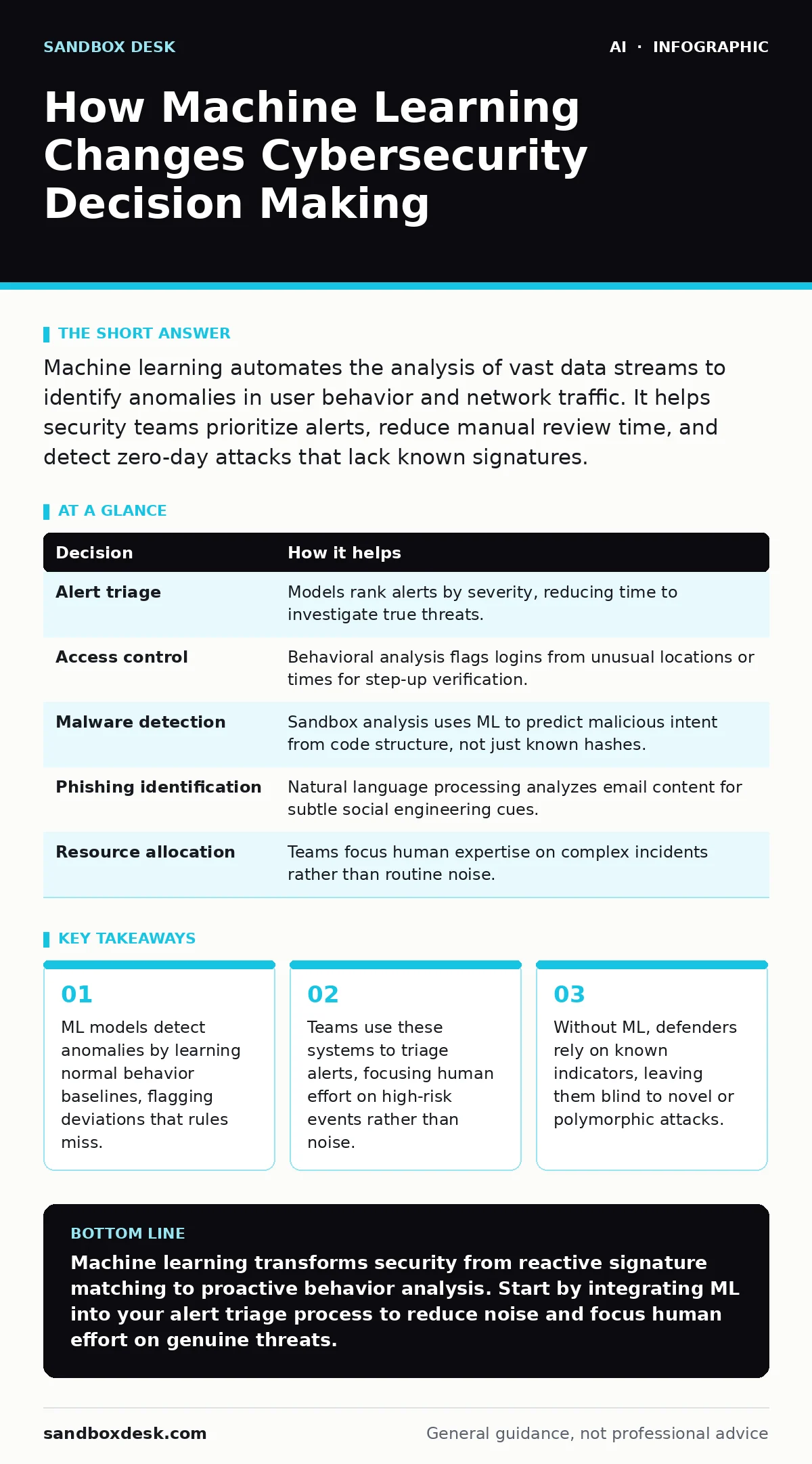
Machine learning automates the analysis of vast data streams to identify anomalies in user behavior and network traffic. It helps security teams prioritize alerts, reduce manual review time, and detect zero-day attacks that lack known signatures.
The Limits of Static Rules
Traditional security tools rely on signatures. A signature is a unique identifier for a known threat, such as a specific hash value for a malicious file. When a tool encounters a file with that hash, it blocks it. This approach works well against known malware. It fails against new threats.
Attackers modify code slightly to change its hash. This technique is called polymorphism. The new variant behaves identically to the original but looks different to signature scanners. Defenders must wait for an analyst to identify the new hash and update the rules. This delay creates a window of exposure.
Machine learning changes this dynamic. Instead of matching exact patterns, models look for statistical anomalies. They learn what normal traffic looks like. When traffic deviates from that baseline, the model flags it. This allows detection of novel threats before a signature exists.
Decisions Informed by Probability
Security teams face a constant stream of alerts. Most are false positives. These are benign events that trigger a rule. Analysts spend hours investigating them. This leads to alert fatigue. Analysts become desensitized to warnings. They may ignore real threats because they are buried in noise.
Machine learning models assign a risk score to each event. This score reflects the probability that the event is malicious. Teams use these scores to prioritize work. High-risk events get immediate attention. Low-risk events are queued or ignored.
| Decision | How it helps |
|---|---|
| Alert triage | Models rank alerts by severity, reducing time to investigate true threats. |
| Access control | Behavioral analysis flags logins from unusual locations or times for step-up verification. |
| Malware detection | Sandbox analysis uses ML to predict malicious intent from code structure, not just known hashes. |
| Phishing identification | Natural language processing analyzes email content for subtle social engineering cues. |
| Resource allocation | Teams focus human expertise on complex incidents rather than routine noise. |
What Happens Without It
Imagine a team that relies solely on static rules. They update their firewall signatures daily. They scan all incoming email for known malicious attachments. This seems thorough. It is not.
An attacker sends a phishing email. The email does not contain a known malicious link. It uses a legitimate cloud storage service. The content is crafted to look like a routine HR update. There is no signature for this. The rule-based system lets it through.
The recipient clicks the link. The attacker’s server delivers a payload. The payload is new. It has no known hash. The endpoint detection tool does not block it. The attacker moves laterally through the network. The team does not notice until data is exfiltrated.
Without machine learning, defenders are always one step behind. They react to what they know. They cannot predict what they do not know. This reactive posture is unsustainable in a fast-moving threat environment.
How Teams Deploy These Models
Teams do not simply turn on a machine learning model. They integrate it into existing workflows. The goal is augmentation, not replacement. Humans make the final call. Models provide context.
First, teams collect data. This includes network logs, endpoint telemetry, and user activity records. The data must be clean. Poor quality data leads to poor predictions. Teams spend significant time engineering features. Features are specific data points that the model uses to make decisions.
Next, teams train the model. They feed it historical data labeled as benign or malicious. The model learns patterns. It builds a baseline of normal behavior. This process requires time and compute resources.
Finally, teams monitor the model. Models degrade over time. This is called concept drift. As user behavior changes, the baseline shifts. The model must be retrained to reflect new norms. Ignoring this leads to increased false positives.
The Hidden Costs of Automation
Machine learning is not a silver bullet. It introduces new complexities. The most significant is the black box problem. Many models, especially deep neural networks, are opaque. It is difficult to understand why they made a specific decision.
This lack of explainability creates friction. When a model blocks a legitimate user, the user demands an explanation. If the analyst cannot explain why the model flagged the action, trust erodes. Users may disable security tools. This creates new vulnerabilities.
Another cost is the need for specialized skills. Security teams need data scientists or machine learning engineers. These roles are competitive. Hiring and retaining talent is expensive. Teams must balance the cost of expertise against the benefit of automation.
See also: How Large Language Models Work: Mechanics, Limits, and Reality · AI Threat Detection: Real Benefits and Hidden Costs
Edge Cases and Model Failure
Machine learning models can fail in unexpected ways. Adversarial attacks are a growing concern. Attackers can craft inputs that look benign to the model but are actually malicious. This is similar to how optical illusions trick human vision.
For example, an attacker might add noise to a malicious file. The noise is imperceptible to humans. It changes the file’s features enough to bypass the model. The model classifies it as benign. The file executes successfully.
Another edge case is data poisoning. Attackers inject malicious data into the training set. This corrupts the model’s understanding of normal behavior. The model becomes less effective over time. Detecting poisoned data is difficult. It requires rigorous data validation processes.
Teams must assume models will fail. They should design systems that degrade gracefully. If the model is unavailable or unreliable, fallback rules must exist. These rules may be less effective, but they provide a baseline of security.
Integrating With Broader Security
Machine learning works best as part of a layered defense. It complements other security measures. It does not replace them. Teams should use ML to enhance existing controls.
For instance, ML can improve access control. It analyzes login patterns. If a user logs in from a new device in a new country, the model flags it. The system then requires multi-factor authentication. This adds friction only when necessary.
ML also aids in incident response. It correlates events across different sources. It identifies the scope of an attack. This helps responders contain the threat faster. Without this correlation, responders may miss the full picture.
Looking Beyond Detection
The role of machine learning in security is evolving. It is moving beyond detection to prediction. Teams are exploring how to predict where attacks will happen. This is known as threat hunting.
By analyzing global threat intelligence, models can identify emerging tactics. They can predict which vulnerabilities attackers will target next. This allows teams to patch systems proactively. It shifts the balance from reaction to prevention.
However, prediction is probabilistic. It is not certain. Teams must balance the cost of preemptive patching against the risk of disruption. Over-patching can break applications. Under-patching leaves systems vulnerable. Judgment remains key.
Key takeaways
- ML models detect anomalies by learning normal behavior baselines, flagging deviations that rules miss.
- Teams use these systems to triage alerts, focusing human effort on high-risk events rather than noise.
- Without ML, defenders rely on known indicators, leaving them blind to novel or polymorphic attacks.
Machine learning transforms security from reactive signature matching to proactive behavior analysis. Start by integrating ML into your alert triage process to reduce noise and focus human effort on genuine threats.
Frequently asked questions
Does machine learning replace security analysts?
No, it augments them by handling routine analysis and prioritizing high-risk events, allowing analysts to focus on complex investigations.
How do I know if my ML model is accurate?
Monitor false positive and false negative rates. Regularly review model decisions against ground truth data to ensure it remains aligned with your environment.
Can attackers fool machine learning models?
Yes, through adversarial attacks that manipulate input data to bypass detection. Defense requires diverse models and human oversight to catch these evasion techniques.
Is machine learning secure for sensitive data?
It can be, provided data is encrypted in transit and at rest. Use privacy-preserving techniques like federated learning to train models without exposing raw sensitive data.
How this guide was produced: written by the Sandbox Desk editorial team with AI assistance, checked against the public references listed below, and reviewed when the facts change. See our editorial policy or report an error.