Explainable AI in Healthcare: Why Opacity Risks Patient Safety
Clinical AI models often hide their reasoning behind opaque weights, making it impossible to verify if they rely on dangerous proxies rather than actual medical signals.

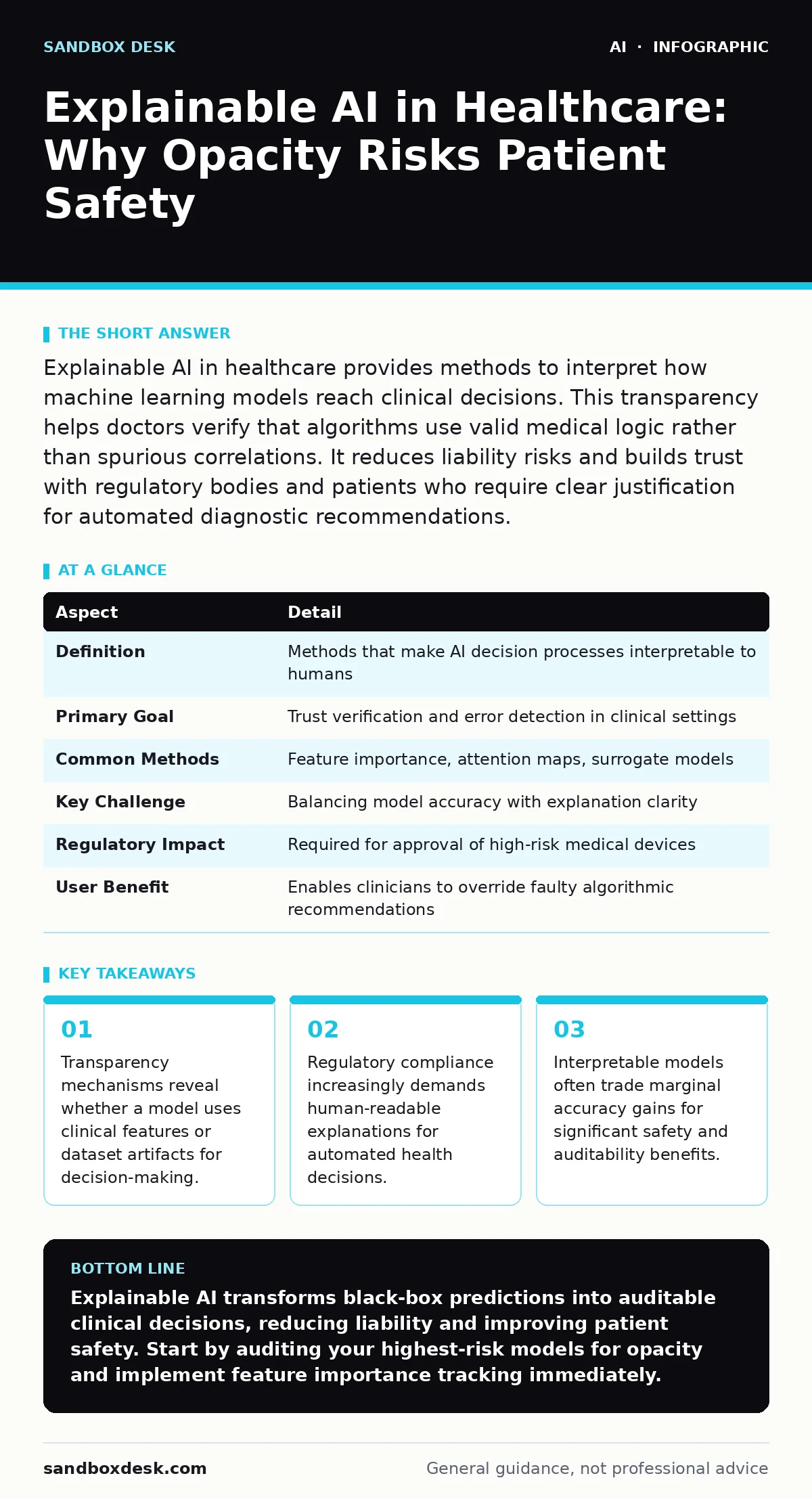
Explainable AI in healthcare provides methods to interpret how machine learning models reach clinical decisions. This transparency helps doctors verify that algorithms use valid medical logic rather than spurious correlations. It reduces liability risks and builds trust with regulatory bodies and patients who require clear justification for automated diagnostic recommendations.
The Black Box Problem in Medicine
Imagine a radiologist receives a cancer prediction from an algorithm. The doctor cannot treat the patient based on confidence alone. The doctor needs to know why. Explainable AI in healthcare addresses this gap by making the internal logic of machine learning models visible to human operators. This visibility transforms opaque probability scores into traceable decision paths.
| Aspect | Detail |
|---|---|
| Definition | Methods that make AI decision processes interpretable to humans |
| Primary Goal | Trust verification and error detection in clinical settings |
| Common Methods | Feature importance, attention maps, surrogate models |
| Key Challenge | Balancing model accuracy with explanation clarity |
| Regulatory Impact | Required for approval of high-risk medical devices |
| User Benefit | Enables clinicians to override faulty algorithmic recommendations |
Most modern AI systems, particularly deep neural networks, function as black boxes. They ingest data and output predictions without revealing the intermediate steps. In software development, this is acceptable for recommendation engines or ad targeting. In medicine, it is dangerous. A model might correlate pixel brightness with disease presence because training data came from one specific scanner brand. Without explanation, this bias remains hidden until it harms patients.
How Explainable AI Mechanisms Work
Explainable AI relies on three primary mechanisms to uncover model reasoning. Feature importance techniques rank input variables by their influence on the output. Attention maps highlight specific regions of an image that drove the prediction. Surrogate models train a simple, interpretable algorithm to mimic the complex model's behavior. Each method has distinct trade-offs regarding computational cost and fidelity.
Feature importance works by measuring how much the prediction changes when you alter a specific input. If removing a patient's age drastically changes the risk score, age is an important feature. This method is straightforward but can miss complex interactions between variables. Attention maps are common in computer vision tasks. They overlay a heatmap on medical images to show which pixels the model focused on. This helps radiologists verify that the model looks at the tumor, not the watermark.
Surrogate models act as translators. You train a decision tree to approximate the outputs of a deep neural network. The tree is easy for humans to read. This approach sacrifices some precision for clarity. The surrogate may not capture every nuance of the original model. You must decide if the loss in accuracy is acceptable for the gain in understanding. Understanding these mechanisms helps you choose the right tool for your specific diagnostic task.
Who Bears the Burden of Transparency
The responsibility for explainable AI in healthcare falls on multiple stakeholders. Algorithm developers must build models that can be audited. Clinicians must interpret explanations correctly and not over-rely on them. Hospital administrators must implement governance frameworks that track model performance over time. Patients have a right to understand how automated systems influence their care.
Developers face the technical burden. They must select architectures that support interpretation or apply post-hoc explanation methods. This adds engineering complexity. It often slows down deployment cycles. Clinicians face the cognitive burden. They must distinguish between a plausible explanation and a correct one. An explanation can be convincing but wrong if the underlying model is flawed. This phenomenon is known as the explanation paradox.
Hospital administrators handle the legal and ethical burden. They must ensure compliance with emerging regulations that mandate transparency. They must also manage liability when an algorithm makes an error despite being explainable. Patients suffer the consequences of opaque systems. If a model denies insurance coverage or recommends a risky treatment without clear reasoning, patients cannot contest the decision effectively. Transparency shifts power back to human decision-makers.
What to Do About Model Opacity
Addressing opacity requires a structured approach to model selection and validation. Start by defining the required level of interpretability for your specific use case. Not all decisions need the same depth of explanation. High-risk diagnoses require full transparency. Low-risk administrative tasks may tolerate black-box models. Establish clear criteria for what constitutes an acceptable explanation before you begin development.
Implement continuous monitoring of model drift. Data distributions change over time. A model that explains its reasoning correctly today may rely on new, invalid correlations tomorrow. Set up alerts for significant changes in feature importance distributions. Review these changes with clinical experts regularly. Do not assume that initial validation guarantees long-term reliability.
Integrate explainability tools into your standard development pipeline. Treat explanations as first-class outputs alongside predictions. Test explanations for consistency and stability. If small changes in input cause large swings in the explanation, the model is unstable. Unstable explanations erode trust. Combine technical monitoring with human-in-the-loop reviews. Use the insights from AI risk management to prioritize models that pose the greatest safety hazards.
Common Misconceptions About Explainability
Many teams confuse transparency with accuracy. They assume that an explainable model is necessarily more accurate. This is false. Simple models like linear regression are highly interpretable but often less accurate than complex deep learning models. The trade-off is real. You must accept some accuracy loss to gain interpretability. Do not chase perfect performance if it comes at the cost of safety.
Another misconception is that explanations are objective truths. Explanations are approximations of complex mathematical processes. Different explanation methods can produce conflicting results for the same model. One method might highlight a patient's weight, while another highlights their blood pressure. Both are valid perspectives on the model's behavior. You must understand the limitations of each explanation technique.
Some believe that once a model is explained, it is safe. This ignores the risk of gaming. Adversaries can manipulate inputs to trigger desired explanations. This is particularly relevant in malware that targets AI infrastructure, where attackers might craft inputs to bypass detection. Explainability does not prevent attacks. It only helps you detect them after they occur. Security and interpretability are separate concerns that must be addressed in parallel.
Regulatory and Ethical Implications
Regulatory bodies are increasingly demanding transparency for medical AI. The FDA and other agencies require evidence that developers understand how their models work. This documentation must demonstrate that the model relies on clinically relevant features. It must also show that the model performs consistently across diverse populations. Lack of explainability can lead to rejection of otherwise effective tools.
Ethically, opacity violates the principle of informed consent. Patients should know if an algorithm contributed to their diagnosis. They should understand the basis for that diagnosis. This requires explanations that are not just technically accurate but also comprehensible to non-experts. Developing such explanations is challenging. It requires collaboration between engineers, clinicians, and communication specialists.
The legal landscape is shifting towards stricter liability for AI errors. If a model makes a mistake and you cannot explain why, you are vulnerable to lawsuits. Explainability serves as a defense mechanism. It allows you to demonstrate due diligence. It shows that you monitored the model and understood its limitations. This protection is vital for long-term sustainability in the healthcare sector.
Practical Steps for Implementation
Begin by auditing your existing models for opacity. Identify which models make high-stakes decisions. Prioritize these for explanation implementation. Use open standards for reporting model behavior. This ensures compatibility with future regulatory requirements. Document the explanation methods you use and their limitations. Share this documentation with clinical staff.
Train your clinical staff on how to interpret AI explanations. They need to understand what feature importance means. They need to know how to spot spurious correlations. Provide clear guidelines on when to trust the model and when to override it. Regularly update these guidelines as new evidence emerges.
Collaborate with external experts to validate your explanations. Peer review is essential. Have independent clinicians assess whether your explanations make sense. This external validation strengthens your case for regulatory approval. It also builds trust with your users. Remember that training data leakage can create false patterns that explainability tools might highlight as important. Clean your data thoroughly before applying explanation methods.
Key takeaways
- Transparency mechanisms reveal whether a model uses clinical features or dataset artifacts for decision-making.
- Regulatory compliance increasingly demands human-readable explanations for automated health decisions.
- Interpretable models often trade marginal accuracy gains for significant safety and auditability benefits.
Explainable AI transforms black-box predictions into auditable clinical decisions, reducing liability and improving patient safety. Start by auditing your highest-risk models for opacity and implement feature importance tracking immediately.
Frequently asked questions
How does explainable AI differ from standard AI validation?
Standard validation checks if the model is accurate on average. Explainable AI checks if the model uses correct reasoning for individual predictions, revealing hidden biases and logical flaws.
Can I use explainable AI for real-time diagnosis?
Yes, but some explanation methods are computationally expensive. Lightweight methods like attention maps or pre-computed feature importance are suitable for real-time use, while complex surrogate models may cause latency.
Does explainable AI replace the need for human doctors?
No, it augments human decision-making. Explainability provides context for the doctor, who retains final responsibility. The system supports verification, not autonomous action.
What is the cost of implementing explainable AI?
Implementation requires additional engineering time for integration and validation. It may also reduce model accuracy slightly. However, the cost of regulatory failure or patient harm is significantly higher.
How this guide was produced: written by the Sandbox Desk editorial team with AI assistance, checked against the public references listed below, and reviewed when the facts change. See our editorial policy or report an error.