7 AI Model Monitoring Mistakes That Break Production Systems
Monitoring output accuracy alone misses silent data drift and prompt injection vectors that degrade model utility and security over time.

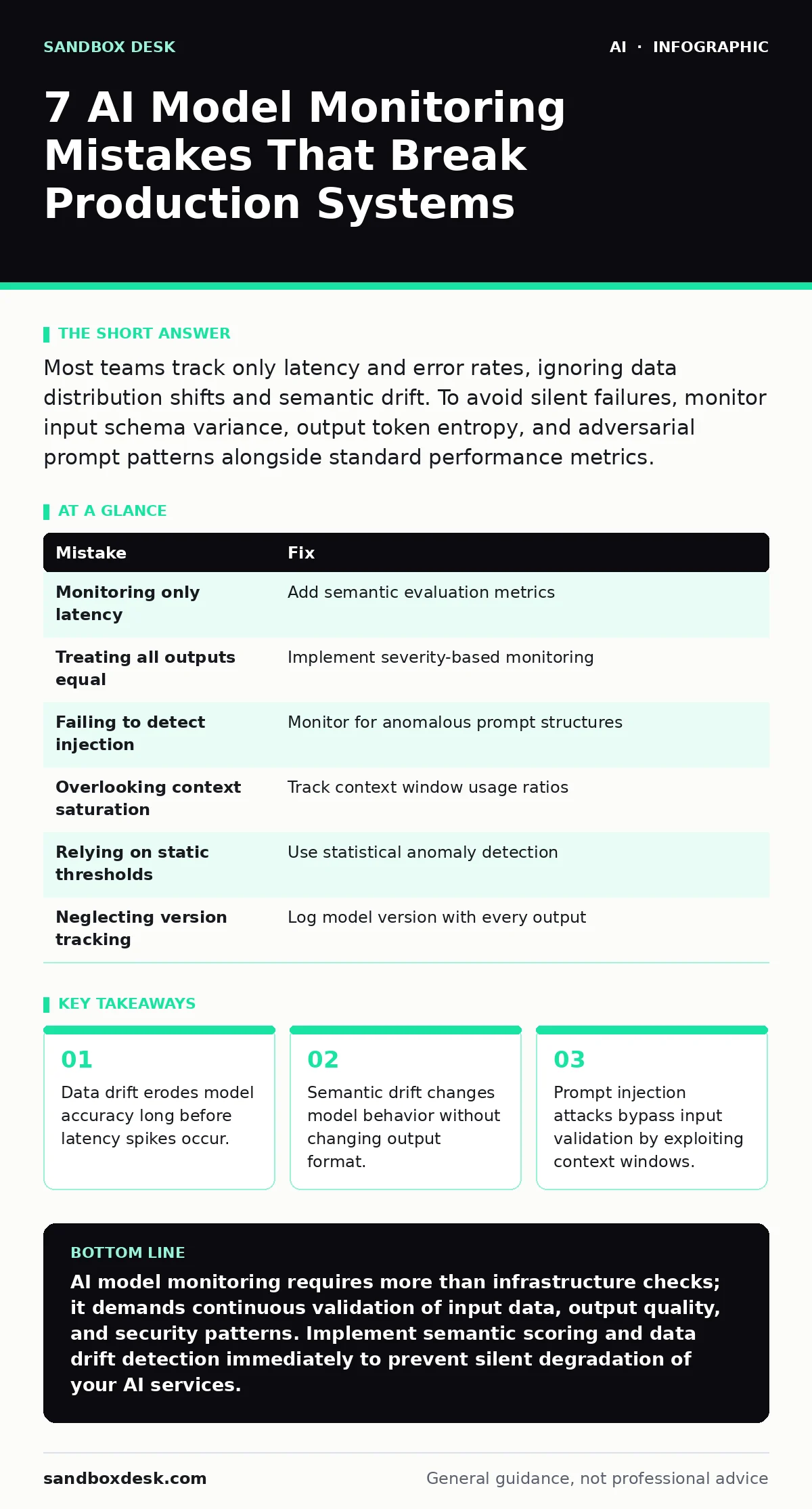
Most teams track only latency and error rates, ignoring data distribution shifts and semantic drift. To avoid silent failures, monitor input schema variance, output token entropy, and adversarial prompt patterns alongside standard performance metrics.
Mistake 1: Monitoring Only Latency and Error Rates
Many engineering teams treat AI models like traditional microservices. You track how fast the model responds and whether it returns an HTTP 200 status code. This approach assumes that if the service is up, the service is correct. It is not. An AI model can return a syntactically valid response that is factually wrong, logically incoherent, or contextually irrelevant. If you only monitor infrastructure health, you will not know the model is failing until users complain.
Why it hurts:
Silent failures accumulate trust debt. Users may not report every bad response, but they will stop using the feature. By the time you notice a drop in engagement, the model may have been generating poor outputs for weeks. This makes debugging difficult because you lack historical data on when the degradation started. You are flying blind on the most important metric: correctness.
The fix:
Implement semantic evaluation metrics alongside infrastructure metrics. Use a secondary, smaller model to score the output of your primary model against ground truth or style guidelines. This technique, often called model-as-a-judge, provides a continuous feedback loop on quality. Combine this with human-in-the-loop review for a random sample of outputs to calibrate the automated scorer. See also our guide on generative AI for more on evaluation strategies.
Mistake 2: Ignoring Input Data Drift
AI models are trained on static datasets. The real world is dynamic. Over time, the distribution of inputs changes. This is called data drift. If your customer service bot was trained on formal complaints, it may fail when users start sending casual slang or memes. The model does not know the world has changed. It applies old patterns to new data, resulting in lower accuracy.
Why it hurts:
Data drift causes a gradual decline in performance. Unlike a server crash, this is a slow bleed. In reality, the model is misclassifying a growing segment of inputs. This leads to inconsistent user experiences and increased support costs as humans have to fix the AI’s mistakes.
The fix:
Monitor the statistical properties of your input data. Track the distribution of token lengths, vocabulary usage, and semantic embeddings. If the distance between current inputs and training data increases beyond a threshold, trigger an alert. This does not fix the model, but it tells you when retraining is necessary. Regularly update your training data with recent examples to keep the model aligned with current usage patterns.
Mistake 3: Treating All Outputs as Equal
Not all errors are created equal. A typo in a casual chat is minor. A hallucinated medical diagnosis or legal advice is catastrophic. Many monitoring systems treat every incorrect output as a single data point. This flattens the risk profile.
Why it hurts:
High-severity errors escape detection because they are diluted by low-severity ones. You optimize for overall accuracy, which masks the frequency of dangerous outputs. Users may encounter a harmless error and ignore it, but a single severe error can cause reputational damage or regulatory issues. You cannot manage risk if you do not categorize it.
The fix:
Implement severity-based monitoring. Define categories of risk for your specific use case. Flag outputs that contain sensitive information, medical claims, or legal advice for immediate review. Use confidence scores to identify low-confidence predictions. When the model is unsure, route the request to a human or a fallback system. This aligns with best practices for securing AI agents by reducing the attack surface for high-impact failures.
Mistake 4: Failing to Detect Prompt Injection
Prompt injection occurs when a user manipulates the input to override the model’s instructions. This is a security vulnerability, not just a quality issue. For example, a user might ask the model to ignore previous rules and output its system prompt. Standard input validation often misses this because the input looks like normal text. The model processes it as instruction, not data.
Why it hurts:
Prompt injection can lead to data leakage, privilege escalation, or denial of service. An attacker might extract sensitive training data or force the model to perform unauthorized actions. If you do not monitor for these patterns, your system is vulnerable. This is distinct from traditional security flaws because it exploits the model’s reasoning capabilities rather than code execution bugs.
The fix:
Monitor for anomalous prompt structures. Look for sudden changes in token usage, unusual command-like phrases, or attempts to access system instructions. Use adversarial testing to identify weak points in your prompt engineering. Implement input sanitization to strip out potential injection vectors before they reach the model. Refer to our guide on insecure AI plugins and agents for deeper technical defenses.
Mistake 5: Overlooking Context Window Saturation
Large language models have a limited context window. As conversations grow, older parts of the conversation may be truncated or lose influence. This is often invisible to the user. The model may forget earlier constraints or facts. If you do not monitor context usage, you may assume the model remembers everything, leading to inconsistent behavior.
Why it hurts:
Context saturation causes logical inconsistencies. The model may contradict itself because it no longer has access to earlier parts of the dialogue. This breaks the user experience and reduces trust. It also increases computational costs if you are paying for tokens that the model effectively ignores. You are wasting resources on context that provides no value.
The fix:
Track the ratio of active context to total window size. Implement summarization strategies to condense older conversation history. Monitor for drops in relevance scores as the conversation lengthens. If the model’s performance degrades with length, adjust your prompt management strategy. This ensures the model focuses on the most relevant information.
See also: How Large Language Models Work: Mechanics, Limits, and Reality · How Machine Learning Changes Cybersecurity Decision Making
Mistake 6: Relying on Static Thresholds
Many teams set fixed thresholds for alerting. For example, alert if latency exceeds 500ms. However, AI performance varies by time of day, user segment, and input complexity. Static thresholds generate too many false positives or miss true anomalies. A 500ms response might be normal for a complex query but abnormal for a simple one.
Why it hurts:
Alert fatigue sets in when you receive too many false positives. Engineers start ignoring alerts. When a real issue occurs, it may be missed. Conversely, if thresholds are too loose, real issues go undetected. You need dynamic baselines that adapt to normal variation. This requires more sophisticated monitoring than simple static checks.
The fix:
Use statistical process control to detect anomalies. Establish a baseline of normal performance for different types of inputs. Alert only when performance deviates significantly from this baseline. This reduces noise and highlights true outliers. Combine this with trend analysis to spot gradual degradation.
Mistake 7: Neglecting Model Version Tracking
When you update a model, you change its behavior. If you do not track which version produced which output, you cannot debug issues. You might roll back to a previous version, but you will not know which specific change caused the problem. This makes iterative improvement difficult and risky.
Why it hurts:
Lack of version tracking leads to regression errors. A new model version might introduce subtle biases or errors that were not present before. Without clear lineage, you cannot isolate the cause. This slows down development and increases the risk of deploying broken models.
The fix:
Implement strict version control for your models. Tag every deployment with a unique identifier. Log the model version alongside every input and output. This allows you to correlate performance issues with specific model releases. Use A/B testing to compare new versions against the current production model before full rollout. See also our guide on fine-tuning for best practices in model iteration.
| Mistake | Fix |
|---|---|
| Monitoring only latency | Add semantic evaluation metrics |
| Treating all outputs equal | Implement severity-based monitoring |
| Failing to detect injection | Monitor for anomalous prompt structures |
| Overlooking context saturation | Track context window usage ratios |
| Relying on static thresholds | Use statistical anomaly detection |
| Neglecting version tracking | Log model version with every output |
Key takeaways
- Data drift erodes model accuracy long before latency spikes occur.
- Semantic drift changes model behavior without changing output format.
- Prompt injection attacks bypass input validation by exploiting context windows.
AI model monitoring requires more than infrastructure checks; it demands continuous validation of input data, output quality, and security patterns. Implement semantic scoring and data drift detection immediately to prevent silent degradation of your AI services.
Frequently asked questions
How often should I retrain my AI model?
Retrain when data drift metrics exceed your defined thresholds or when semantic evaluation scores drop significantly. There is no fixed schedule; it depends on how fast your input data changes.
Can I use the same model for monitoring and production?
It is possible but risky. Using the same model to score itself can create circular logic. A smaller, specialized model is often better for evaluation tasks.
What is the best tool for monitoring AI models?
There is no single best tool. You need a combination of infrastructure monitoring, custom semantic evaluation scripts, and security scanners. Build a pipeline that integrates these sources.
How do I handle prompt injection in real-time?
Use input sanitization and adversarial testing. Monitor for sudden changes in token usage and command-like phrases. Block or flag suspicious inputs before they reach the main model.
How this guide was produced: written by the Sandbox Desk editorial team with AI assistance, checked against the public references listed below, and reviewed when the facts change. See our editorial policy or report an error.