AI Usage Policy Checklist for Secure Enterprise Deployment
Most policy failures stem from ignoring the hidden data exfiltration paths created by automated agent workflows and shadow integration endpoints.

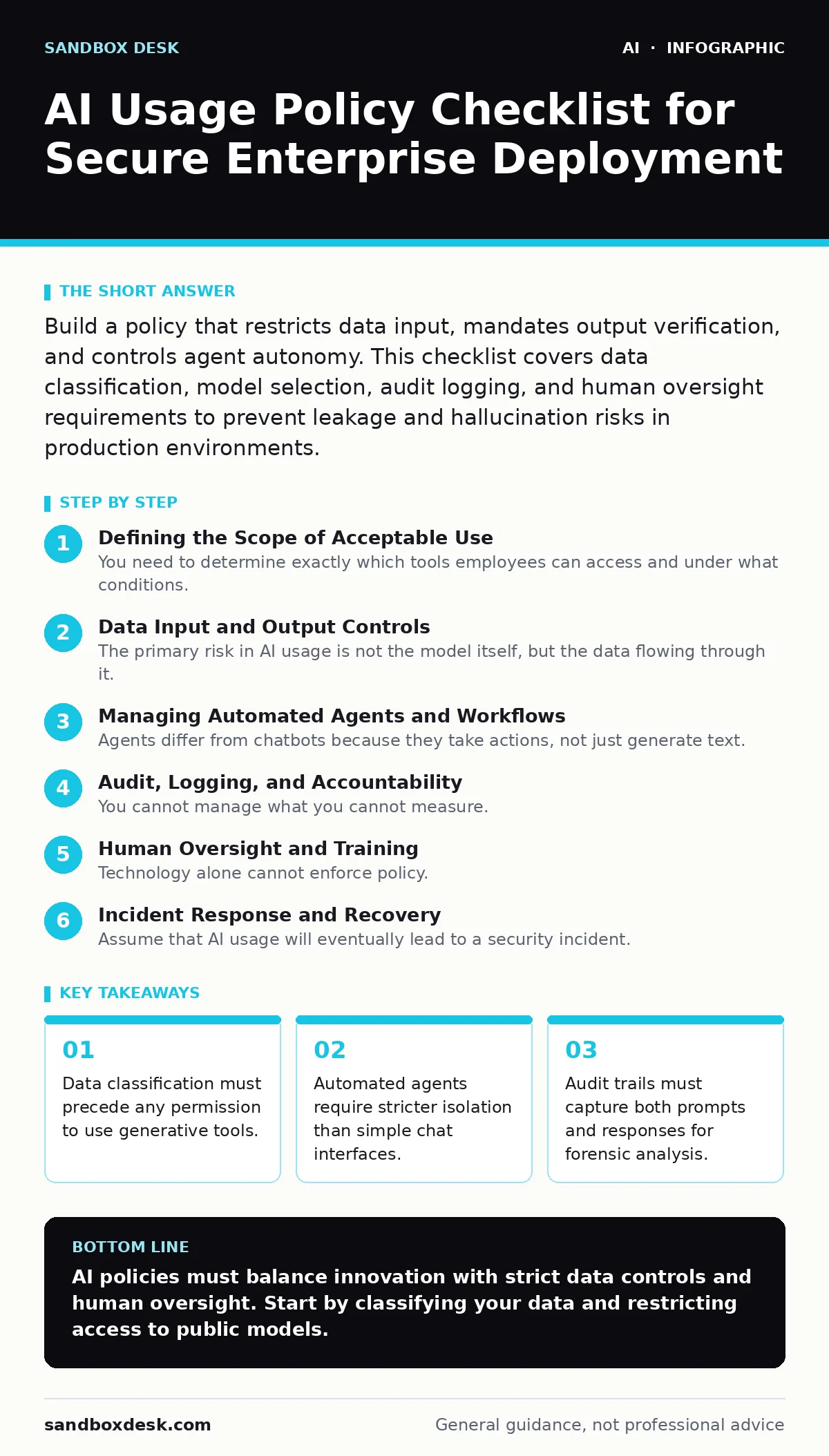
Build a policy that restricts data input, mandates output verification, and controls agent autonomy. This checklist covers data classification, model selection, audit logging, and human oversight requirements to prevent leakage and hallucination risks in production environments.
Defining the Scope of Acceptable Use
You need to determine exactly which tools employees can access and under what conditions. Unrestricted access to public large language models creates immediate liability regarding intellectual property and confidential data. This section establishes the boundary between personal convenience and enterprise risk.
- Classify all data types before allowing AI interaction: Prevents accidental ingestion of sensitive records into public models.
- Ban copy-pasting code into public interfaces: Stops proprietary logic from becoming training data for competitors.
- Require vendor approval for new AI tools: Ensures security teams vet external services before adoption.
- Define acceptable output uses: Clarifies whether AI-generated content can be used in customer-facing materials.
Imagine a developer pasting a snippet of internal authentication code into a public chatbot to fix a bug. The model may not store the code permanently, but it can reproduce it in future responses to other users. This creates a permanent leak of your proprietary logic.
Data Input and Output Controls
The primary risk in AI usage is not the model itself, but the data flowing through it. You must treat every prompt as a potential data exfiltration vector and every response as untrusted input. These controls limit the surface area for accidental or malicious data loss.
- Enforce data masking before input: Removes personally identifiable information from prompts automatically.
- Block file uploads of certain extensions: Prevents sensitive documents from being processed by the model.
- Require human review of all outputs: Ensures a person validates accuracy and safety before publication.
- Disable memory or history features: Stops the model from retaining context across sessions or users.
Managing Automated Agents and Workflows
Agents differ from chatbots because they take actions, not just generate text. An AI agent can read emails, send messages, or modify code without direct human intervention for each step. This autonomy requires significantly tighter controls than passive text generation.
- Isolate agent environments from production: Prevents automated actions from affecting live systems directly.
- Limit agent tool access to specific APIs: Reduces the blast radius if the agent behaves unexpectedly.
- Require human approval for external communications: Stops agents from sending emails or messages autonomously.
- Log all agent decision paths: Provides a record of why the agent chose a specific action.
Securing AI agents requires a different mindset than securing standard applications. You are not just protecting code, but managing a system that makes decisions. See our guide on securing AI agents for deeper technical controls.
Audit, Logging, and Accountability
You cannot manage what you cannot measure. AI systems generate vast amounts of interaction data that must be captured, stored, and analyzed. Without detailed logs, you have no way to investigate incidents or prove compliance with internal policies.
- Capture full prompt and response pairs: Allows forensic analysis of specific interactions after an incident.
- Store logs in immutable storage: Prevents tampering with evidence during internal or external investigations.
- Set retention periods for interaction data: Balances forensic needs with privacy and storage costs.
- Alert on anomalous usage patterns: Flags unusual volumes of requests or sensitive data access.
AI model monitoring helps detect drift and bias over time, but it also serves as a security control. By tracking input and output patterns, you can identify when a model is being used in ways it was not intended.
Human Oversight and Training
Technology alone cannot enforce policy. You need a culture where employees understand the risks and know how to use tools safely. Training must go beyond basic awareness to include specific scenarios and decision-making frameworks.
- Train employees on data classification: Ensures everyone knows what information is safe to share.
- Teach prompt engineering best practices: Helps users get better results while minimizing security risks.
- Establish a clear reporting channel for incidents: Encourages employees to report mistakes without fear of punishment.
- Review policy effectiveness regularly: Updates rules to address new threats and changing business needs.
Explainable AI helps users understand why a model made a specific recommendation, which is critical for building trust and ensuring accountability. Without transparency, users may blindly follow incorrect or harmful suggestions.
See also: Treat AI Models as Untrusted Insiders: 8 Security Practices · Detecting Malware Targeting AI Infrastructure
Incident Response and Recovery
Assume that AI usage will eventually lead to a security incident. Your response plan must account for the unique characteristics of AI systems, such as rapid propagation of errors and difficulty in tracing the source of a problem.
- Define roles for AI incident response: Clarifies who is responsible for containment and remediation.
- Create playbooks for common AI incidents: Speeds up response time for data leaks or model abuse.
- Test recovery procedures regularly: Ensures you can restore systems and data after an AI-related breach.
- Communicate incidents to stakeholders: Maintains trust and transparency during and after an event.
Machine learning in cybersecurity can help detect AI-related threats, but it is not a substitute for a solid incident response plan. You need both automated detection and human-led response capabilities.
Key takeaways
- Data classification must precede any permission to use generative tools.
- Automated agents require stricter isolation than simple chat interfaces.
- Audit trails must capture both prompts and responses for forensic analysis.
AI policies must balance innovation with strict data controls and human oversight. Start by classifying your data and restricting access to public models.
Frequently asked questions
Can we use public AI models for internal research?
Only if you enforce strict data masking and disable memory features to prevent data retention.
How do we prevent AI agents from taking harmful actions?
Isolate agents in sandboxed environments and require human approval for any external actions.
What data should we log for AI interactions?
Capture full prompts, responses, user identifiers, and timestamps in immutable storage.
How often should we update our AI usage policy?
Review and update policies regularly to address new threats, tools, and business requirements.
How this guide was produced: written by the Sandbox Desk editorial team with AI assistance, checked against the public references listed below, and reviewed when the facts change. See our editorial policy or report an error.