AI supply chain risks: hidden failure modes and how they propagate
Artificial intelligence supply chains fail silently when upstream training data, third-party libraries, and serialized weights introduce untraceable logic flaws.

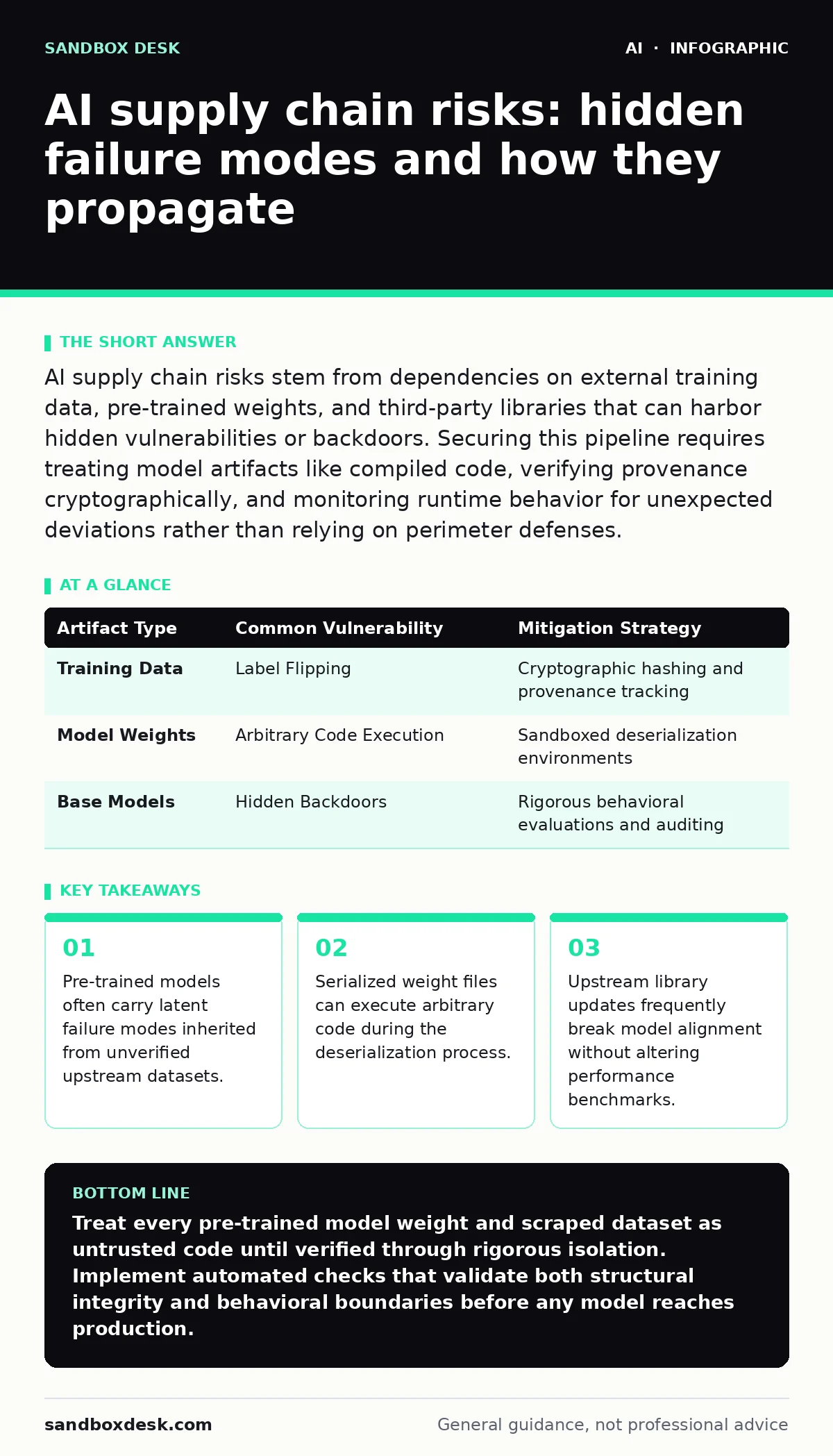
AI supply chain risks stem from dependencies on external training data, pre-trained weights, and third-party libraries that can harbor hidden vulnerabilities or backdoors. Securing this pipeline requires treating model artifacts like compiled code, verifying provenance cryptographically, and monitoring runtime behavior for unexpected deviations rather than relying on perimeter defenses.
What is an AI supply chain?
An AI supply chain encompasses every component, dataset, model weight, and library utilized to construct, train, and deploy a machine learning system. Unlike traditional software dependencies that rely on source code or compiled binaries, machine learning artifacts include probabilistic elements and opaque statistical weights. This complexity creates hidden dependencies where a single poisoned upstream component compromises downstream model outputs without triggering traditional integrity alarms.
How do poisoned training datasets enter the pipeline?
Poisoned training datasets enter the pipeline when developers ingest scraped web data, public repositories, or commercial datasets containing maliciously altered samples designed to induce specific errors. These anomalies manipulate the objective function during training, creating hidden triggers that remain dormant until activated by specific inputs at runtime. You cannot easily spot data poisoning through standard statistical summaries because the malicious samples often blend seamlessly into the variance of massive datasets.
| Artifact Type | Common Vulnerability | Mitigation Strategy |
|---|---|---|
| Training Data | Label Flipping | Cryptographic hashing and provenance tracking |
| Model Weights | Arbitrary Code Execution | Sandboxed deserialization environments |
| Base Models | Hidden Backdoors | Rigorous behavioral evaluations and auditing |
Why are serialized model weights dangerous?
Serialized model weights are dangerous because standard file formats for storing neural network parameters often allow the inclusion of executable script instructions alongside the numerical tensors. When your application loads a pre-trained model file, the underlying parsing library may execute embedded code with the permissions of the host process. This mechanism permits an attacker to achieve remote code execution simply by supplying a maliciously crafted model checkpoint.
Can pre-trained models contain hidden backdoors?
Pre-trained models can contain hidden backdoors implanted during the initial training phase by untrusted third parties who release publicly available base architectures. These backdoors cause the model to perform normally on standard evaluation benchmarks while producing attacker-chosen outputs when presented with a specific trigger pattern in the input data. Discovering these vulnerabilities requires specialized input perturbation testing that specifically searches for anomalous behavioral boundaries within the multi-dimensional latent space.
What happens when upstream dependencies change?
Upstream dependencies change when maintainers update libraries, tokenizers, or base models, which can subtly alter inference behavior without changing version numbers or throwing compilation errors. A minor adjustment to how text is tokenized upstream shifts the numerical representations fed into downstream layers, occasionally causing catastrophic failures in safety classifiers. Managing this volatility requires strict version pinning and continuous observation, topics closely related to practices used in AI model monitoring.
See also: What causes gen ai hallucinations and how to fix them
How do transitive dependencies affect model security?
Transitive dependencies affect model security by inheriting vulnerabilities from secondary and tertiary libraries used for data preprocessing, augmentation, and neural network pruning. If a utility library deep within your dependency tree contains a parsing flaw, your entire application inherits that exposure, even if your custom code remains pristine. Securing this layered architecture demands automated dependency graph generation that accounts for both software packages and imported model weights.
What are the limits of cryptographic provenance in AI?
Cryptographic provenance in AI verifies the origin and integrity of files, but it does not guarantee that the contents are safe, unbiased, or free from logical flaws. A digitally signed model weight file simply proves who built it and that it has not been modified in transit, leaving semantic vulnerabilities entirely undetected.
How do you audit an opaque machine learning pipeline?
Auditing an opaque machine learning pipeline requires probing the system with synthetic edge cases, analyzing intermediate activation layers, and measuring outputs against invariant safety properties. Because traditional code review techniques fail on statistical models, auditors rely on empirical stress testing to map the decision boundaries of the system. This empirical approach shares methodologies with adversarial examples research, where inputs are intentionally crafted to test model resilience under stress.
Key takeaways
- Pre-trained models often carry latent failure modes inherited from unverified upstream datasets.
- Serialized weight files can execute arbitrary code during the deserialization process.
- Upstream library updates frequently break model alignment without altering performance benchmarks.
Treat every pre-trained model weight and scraped dataset as untrusted code until verified through rigorous isolation. Implement automated checks that validate both structural integrity and behavioral boundaries before any model reaches production.
Frequently asked questions
Can a model be secure if the training data is kept secret?
Secret training data prevents external verification of provenance and increases the likelihood that poisoned samples or biased distributions remain hidden until deployment.
Do standard vulnerability scanners detect malicious AI weights?
Standard vulnerability scanners designed for traditional software struggle to identify malicious AI weights because the threat often lies in the semantic logic rather than known syntax errors.
Why do minor changes in input data cause catastrophic failures in deep learning?
High-dimensional vector spaces contain fragile decision boundaries where small input perturbations cross hyperplanes, leading to wildly different classification outcomes.
How often should an organization re-verify its upstream AI dependencies?
Upstream dependencies require re-verification every time a base model, dataset, or core processing library undergoes an update or when new threat intelligence emerges regarding supply chain vectors.
How this guide was produced: written by the Sandbox Desk editorial team with AI assistance, checked against the public references listed below, and reviewed when the facts change. See our editorial policy or report an error.