AI Threat Detection: Real Benefits and Hidden Costs
Machine learning detects novel patterns but creates blind spots when attackers mimic normal traffic, requiring human validation.

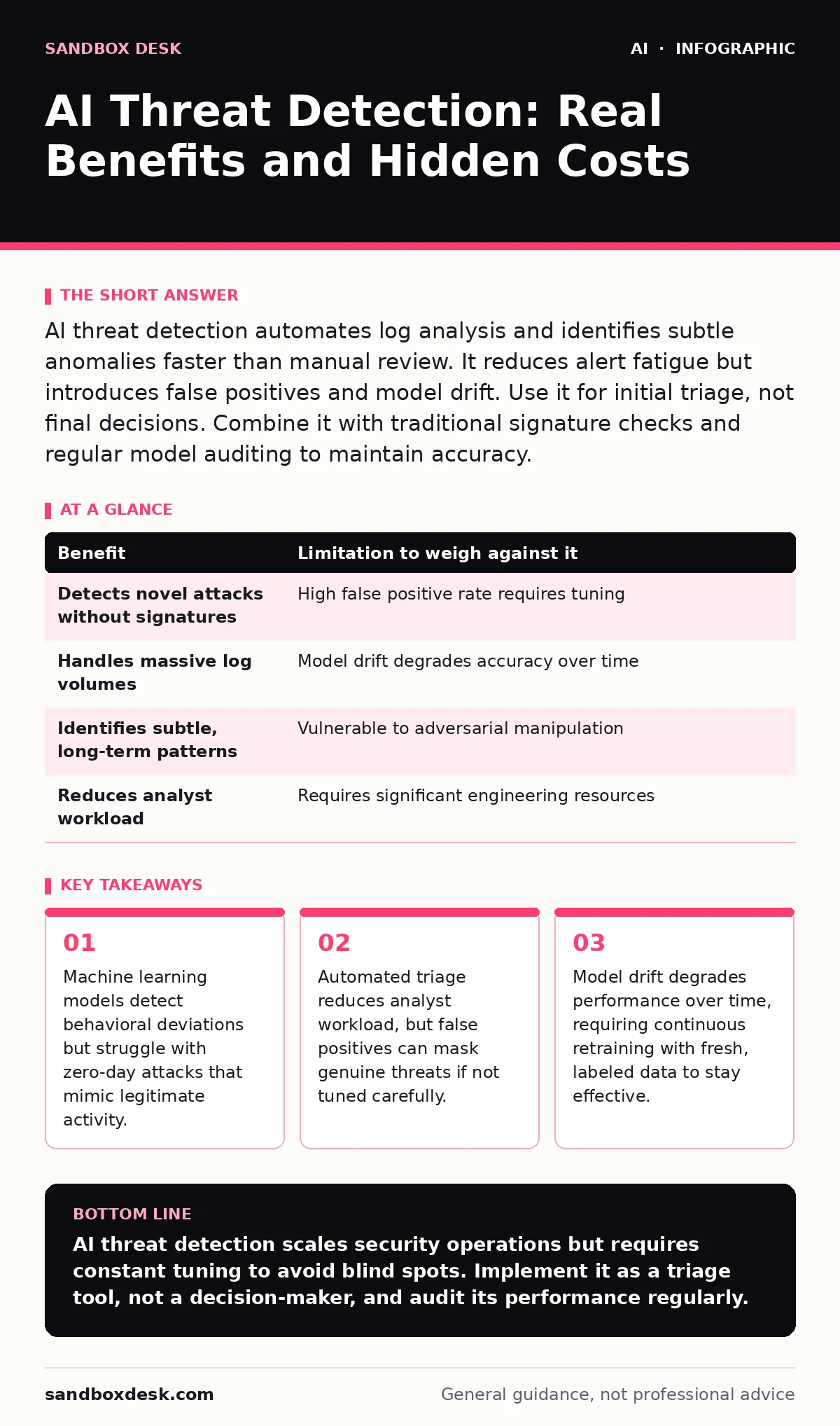
AI threat detection automates log analysis and identifies subtle anomalies faster than manual review. It reduces alert fatigue but introduces false positives and model drift. Use it for initial triage, not final decisions. Combine it with traditional signature checks and regular model auditing to maintain accuracy.
Pattern Recognition Beyond Signatures
Traditional security tools rely on known signatures. They block traffic that matches a database of identified threats. This approach fails against novel attacks that do not share characteristics with previous incidents. Machine learning models analyze behavioral patterns instead of static rules. They establish a baseline of normal activity for users, devices, and network segments. When activity deviates from this baseline, the system flags it for review.
Imagine a user account that typically accesses files between 9 AM and 5 PM. If that same account downloads large volumes of data at 3 AM, the model flags the anomaly. This detection happens regardless of whether the file itself contains known malware. The system identifies the unusual context rather than the malicious payload. This allows detection of insider threats and compromised credentials where the tool used is legitimate.
The strength of this approach lies in its ability to generalize. It does not need to see a specific attack before recognizing it as dangerous. It recognizes the shape of the deviation. This is particularly useful in environments where new software versions or temporary remote work arrangements shift baseline behavior frequently. However, the model only knows what it has been trained to recognize as normal. If your environment changes significantly, the model may flag legitimate new workflows as threats.
The Cost of False Positives
Every detection system generates errors. In AI-assisted threat detection, the primary cost is the false positive rate. A false positive occurs when the system flags benign activity as malicious. Security analysts must investigate these alerts. High volumes of false positives lead to alert fatigue. Analysts may begin ignoring alerts or skipping steps in the investigation process. This creates gaps in security coverage where real threats slip through unnoticed.
The trade-off is sensitivity versus precision. Increasing sensitivity catches more true threats but also more false alarms. Decreasing sensitivity reduces noise but misses subtle attacks. Most organizations start with high sensitivity to catch everything. They then spend significant engineering effort tuning the model to reduce noise. This tuning requires labeled data, which is often scarce or expensive to produce.
Consider a development environment where automated scripts frequently access unusual endpoints. An AI model might flag these script actions as reconnaissance or lateral movement. If the security team marks these as false positives, the model learns to ignore similar patterns. This is useful. But if an attacker mimics the script’s behavior, the model will not flag it. You have created a blind spot by teaching the system to trust a specific pattern of abuse.
Model Drift and Concept Shift
Security models are not static. The nature of attacks evolves, and the environment they operate in changes. This phenomenon is known as model drift. The statistical properties of the target variable change over time. The model trained on last year’s data may not accurately classify this year’s traffic. Concept shift is a specific type of drift where the relationship between features and labels changes.
For example, remote work became standard for many organizations. This shifted the baseline for normal network access. Models trained on pre-remote work data would flag legitimate remote access as anomalous. Without retraining, the model’s accuracy declines. Continuous monitoring of model performance is required to detect this degradation. You must measure precision and recall regularly to ensure the model remains useful.
This requirement adds operational complexity. You need a pipeline for collecting new data, labeling it, and retraining the model. This process consumes engineering resources. It also introduces risk if the new training data is noisy or biased. Poor quality data leads to poor model performance. The effort to maintain the model can outweigh the benefit of automated detection if not managed carefully. See AI model monitoring for strategies to track performance over time.
Adversarial Manipulation of Detection
Attackers are aware of AI detection systems. They adapt their tactics to evade detection. This is adversarial machine learning. Attackers can craft inputs that look benign to the model but are malicious in intent. They may add noise to network packets or adjust timing to fall within the model’s accepted range. This is similar to jailbreaking AI chatbots, where specific prompts bypass safety filters.
Suppose an attacker slowly increases the frequency of failed login attempts. The AI model uses a threshold to detect brute force attacks. If the attacker stays below that threshold, the model does not flag the activity. The attacker succeeds by understanding the model’s logic. This requires the attacker to reverse-engineer the detection algorithm. While difficult, it is possible for sophisticated threat actors.
To mitigate this, you must use multiple detection methods. Relying on a single AI model creates a single point of failure. Combine behavioral analysis with signature-based detection and anomaly scoring. If one method fails, others may catch the threat. Diversity in detection methods increases resilience against adversarial manipulation.
When It Is Worth It
AI-assisted threat detection is worth the investment when volume exceeds human capacity. If you generate millions of logs daily, manual review is impossible. AI tools can triage these logs, surfacing only the most suspicious events. This allows analysts to focus on high-value investigations. The benefit is speed and scale. You can monitor more assets and users than a small team could handle manually.
It is also valuable when detecting subtle, low-and-slow attacks. These attacks generate minimal noise per event. A single anomalous file access is insignificant. Thousands of such accesses over weeks indicate data exfiltration. AI models can aggregate these signals and detect the pattern. Human analysts are likely to miss these subtle correlations. The ability to see long-term trends is a key advantage of machine learning in security.
See also: Difference Between Fine Tuning and Transfer Learning for Models · 7 AI Model Monitoring Mistakes That Break Production Systems
When It Is Not Worth It
Do not use AI for environments with low log volume. If you have fewer than a thousand events daily, manual review is feasible and often more accurate. The cost of implementing and maintaining an AI system outweighs the benefit. You spend more time tuning the model than investigating threats. The complexity adds no value in small environments.
Avoid AI for critical, low-latency decisions. If you need to block traffic in real-time, AI models can be too slow or uncertain. False positives in real-time blocking can disrupt business operations. It is better to use deterministic rules for immediate blocking. Use AI for post-incident analysis or for generating alerts that require human confirmation. Never let an AI model automatically revoke access or terminate processes without human oversight.
See AI risk management for frameworks on evaluating the trade-offs of automated decision-making in security operations.
Balancing Automation and Oversight
The goal is not full automation. It is augmented detection. AI tools should support human analysts, not replace them. Use AI to prioritize alerts and provide context. Let humans make the final decision on containment and remediation. This balances speed with accuracy. It reduces the risk of automated errors causing business disruption.
Regularly audit the AI system’s decisions. Review a sample of both flagged and ignored events. Check for bias or drift. Ensure the model is not learning to ignore specific types of attacks. Maintain a feedback loop where analysts’ corrections improve the model. This continuous improvement process is vital for long-term effectiveness.
| Benefit | Limitation to weigh against it |
|---|---|
| Detects novel attacks without signatures | High false positive rate requires tuning |
| Handles massive log volumes | Model drift degrades accuracy over time |
| Identifies subtle, long-term patterns | Vulnerable to adversarial manipulation |
| Reduces analyst workload | Requires significant engineering resources |
Key takeaways
- Machine learning models detect behavioral deviations but struggle with zero-day attacks that mimic legitimate activity.
- Automated triage reduces analyst workload, but false positives can mask genuine threats if not tuned carefully.
- Model drift degrades performance over time, requiring continuous retraining with fresh, labeled data to stay effective.
- AI tools excel at pattern recognition but lack contextual understanding of business logic or intent behind actions.
AI threat detection scales security operations but requires constant tuning to avoid blind spots. Implement it as a triage tool, not a decision-maker, and audit its performance regularly.
Frequently asked questions
Can AI replace security analysts?
No. AI lacks contextual understanding and business logic awareness. It is a tool for augmentation, not replacement, requiring human oversight for final decisions.
How often should I retrain my detection model?
Retrain regularly, typically monthly or quarterly, depending on environment changes. Monitor performance metrics to detect drift before accuracy declines significantly.
Is AI detection effective against insider threats?
Yes, behavioral analysis is particularly strong for insider threats. It detects deviations from normal user behavior, such as unusual data access patterns or login times.
What is the biggest risk of using AI in security?
The biggest risk is false confidence. Relying solely on AI without human validation can lead to missed threats and operational disruptions from false positives.
How this guide was produced: written by the Sandbox Desk editorial team with AI assistance, checked against the public references listed below, and reviewed when the facts change. See our editorial policy or report an error.