Hacktivism Mistakes That Leave Your Infrastructure Exposed
Hacktivists exploit structural gaps in identity and data flow rather than complex software bugs to achieve maximum visibility with minimal technical effort.

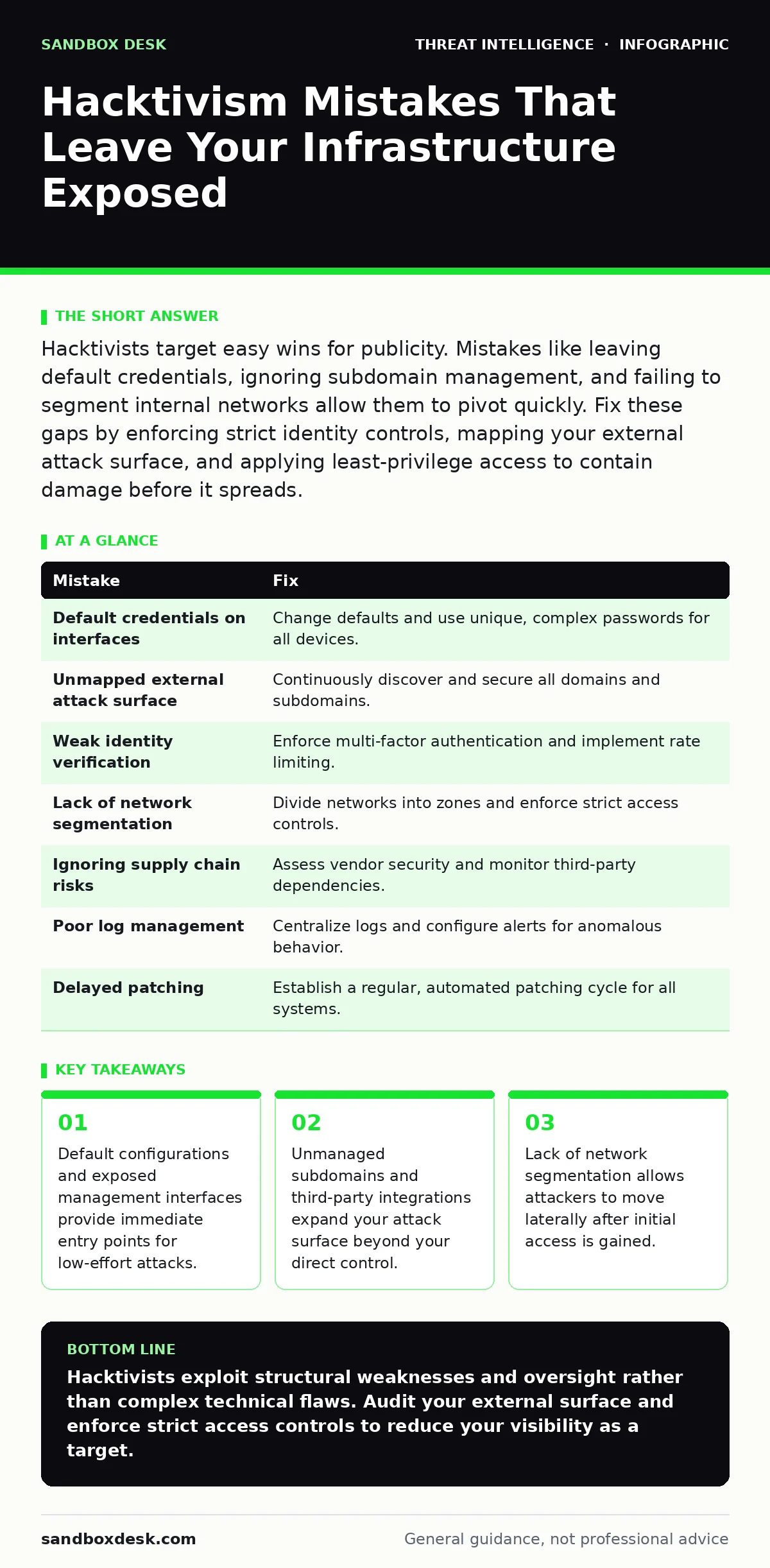
Hacktivists target easy wins for publicity. Mistakes like leaving default credentials, ignoring subdomain management, and failing to segment internal networks allow them to pivot quickly. Fix these gaps by enforcing strict identity controls, mapping your external attack surface, and applying least-privilege access to contain damage before it spreads.
Mistake 1: Leaving Default Credentials on Management Interfaces
Administrative interfaces for routers, firewalls, and web servers often ship with known default credentials. Attackers scan for these exposed ports and test common username and password combinations. When these defaults remain active, the attacker gains immediate administrative control without needing to exploit a software vulnerability.
Why it hurts:
Hacktivists seek speed and visibility. Gaining admin access through default credentials allows them to modify configurations, deface pages, or shut down services within minutes. This rapid success encourages further attacks and damages trust in your infrastructure reliability.
The fix:
Audit all network devices and applications before deployment. Change default passwords and disable default accounts. Use a password manager to store complex, unique credentials for each device. Regularly review access logs to detect unauthorized login attempts on these privileged interfaces.
Mistake 2: Failing to Map External Attack Surface
Your organization likely owns more domains and subdomains than you realize. Acquisitions, abandoned projects, and developer testing environments often leave DNS records pointing to forgotten servers. Hacktivists perform OSINT investigations to find these orphaned assets. These forgotten endpoints often lack patches or monitoring.
Why it hurts:
An attacker compromising a forgotten subdomain can use it as a staging ground. They may host malicious content or use the domain to send phishing emails that appear legitimate. This bypasses perimeter defenses that focus only on primary production domains.
The fix:
Implement continuous external attack surface management. Use automated tools to discover all domains associated with your organization. Verify that every discovered asset is intentional and properly secured. Decommission unused domains and DNS records to shrink the available entry points for attackers.
Mistake 3: Using Weak Identity Verification for Public-Facing Apps
Public-facing applications often rely on simple username and password authentication. Hacktivists target these interfaces because large datasets of leaked credentials are available online. If your application allows credential stuffing, attackers can automate login attempts using these leaked lists.
Why it hurts:
Once an attacker gains access to user accounts, they can access sensitive data or send spam on your behalf. This amplifies the impact of the breach and creates reputational damage. Users lose trust when their accounts are hijarded through weak verification methods.
The fix:
Enforce multi-factor authentication for all user accounts. Implement rate limiting on login endpoints to slow down automated attacks. Monitor for anomalous login patterns, such as multiple failed attempts from different locations. Block known malicious IP addresses and user agents at the edge.
Mistake 4: Neglecting to Segment Internal Networks
Many organizations operate with flat network architectures where all devices can communicate freely. Hacktivists exploit this by gaining access to one low-value device and moving laterally to critical systems. Without segmentation, a single compromise can lead to widespread data exposure.
Why it hurts:
Lateral movement allows attackers to reach sensitive databases and internal tools. They can escalate privileges and maintain persistence even after the initial entry point is discovered. This prolongs the incident and increases the cost of remediation.
The fix:
Divide your network into zones based on function and sensitivity. Enforce strict firewall rules between zones to limit traffic to only what is necessary. Implement zero trust principles where every connection is verified. This containment strategy limits the blast radius of any successful intrusion.
Mistake 5: Ignoring Third-Party Supply Chain Risks
Your applications depend on libraries, APIs, and services from external providers. Hacktivists often target these third parties because they may have weaker security postures. A vulnerability in a widely used library or a compromised vendor account can affect your systems without your direct involvement.
Why it hurts:
You inherit the security weaknesses of your suppliers. If a vendor suffers a breach, your data may be exposed or your services disrupted. This indirect attack vector is difficult to detect and mitigate because it lies outside your direct control.
The fix:
Assess the security practices of your critical vendors. Require them to adhere to specific security standards. Monitor for vulnerabilities in the open-source libraries you use. Update dependencies regularly and isolate third-party services to limit potential damage.
See also: Log Retention Strategy: Benefits, Limits, and When to Stop · Is Command the Same as Control in C2 Infrastructure?
Mistake 6: Lacking Proper Log Management and Monitoring
Many organizations collect logs but fail to analyze them effectively. Hacktivists rely on the assumption that their activities will go unnoticed. If your monitoring system does not alert on suspicious behavior, attackers can operate freely for extended periods.
Why it hurts:
Delayed detection allows attackers to exfiltrate data and alter systems. Without visible logs, you cannot reconstruct the attack path or understand the full scope of the compromise. This hinders incident response and legal compliance efforts.
The fix:
Centralize log collection from all systems and applications. Configure alerts for anomalous activities, such as unusual data transfers or privilege escalations. Retain logs for a sufficient period to support forensic analysis. Regularly test your detection rules to ensure they remain effective.
Mistake 7: Failing to Update and Patch Systems Promptly
Known vulnerabilities in software are published in databases that attackers monitor closely. Hacktivists use automated scanners to find systems running outdated software. If you do not patch these vulnerabilities quickly, you provide an easy entry point for exploitation.
Why it hurts:
Unpatched systems are low-hanging fruit. Attackers can exploit known flaws to gain initial access or escalate privileges. This negligence signals a lack of security hygiene and makes your organization an attractive target for opportunistic attacks.
The fix:
Establish a regular patching cycle for all operating systems and applications. Prioritize patches for critical vulnerabilities that are actively being exploited. Test patches in a staging environment before deployment to avoid disruptions. Automate patching where possible to reduce human error.
| Mistake | Fix |
|---|---|
| Default credentials on interfaces | Change defaults and use unique, complex passwords for all devices. |
| Unmapped external attack surface | Continuously discover and secure all domains and subdomains. |
| Weak identity verification | Enforce multi-factor authentication and implement rate limiting. |
| Lack of network segmentation | Divide networks into zones and enforce strict access controls. |
| Ignoring supply chain risks | Assess vendor security and monitor third-party dependencies. |
| Poor log management | Centralize logs and configure alerts for anomalous behavior. |
| Delayed patching | Establish a regular, automated patching cycle for all systems. |
Key takeaways
- Default configurations and exposed management interfaces provide immediate entry points for low-effort attacks.
- Unmanaged subdomains and third-party integrations expand your attack surface beyond your direct control.
- Lack of network segmentation allows attackers to move laterally after initial access is gained.
Hacktivists exploit structural weaknesses and oversight rather than complex technical flaws. Audit your external surface and enforce strict access controls to reduce your visibility as a target.
Frequently asked questions
How do hacktivists differ from state-sponsored attackers?
Hacktivists prioritize publicity and ideological messaging over financial gain or long-term espionage. They often use lower-effort techniques to achieve rapid, visible impact.
Can a small organization be targeted by hacktivists?
Yes, if the organization holds data that contradicts the activist's views or if it is associated with a larger target. Size does not provide immunity if the messaging opportunity exists.
What is the first step in responding to a hacktivist attack?
Isolate the affected systems to prevent further damage or data exfiltration. Preserve evidence for forensic analysis before attempting to restore services.
How does the Diamond Model of intrusion analysis help here?
It provides a framework for understanding the attacker's capabilities and infrastructure. This helps you identify specific indicators of compromise and predict future targets.
How this guide was produced: written by the Sandbox Desk editorial team with AI assistance, checked against the public references listed below, and reviewed when the facts change. See our editorial policy or report an error.