Next Generation Antivirus: How NGAV Works Beyond Signatures
Next generation antivirus detects threats by analyzing behavior rather than matching known file hashes, stopping zero-day attacks that traditional scanners miss.

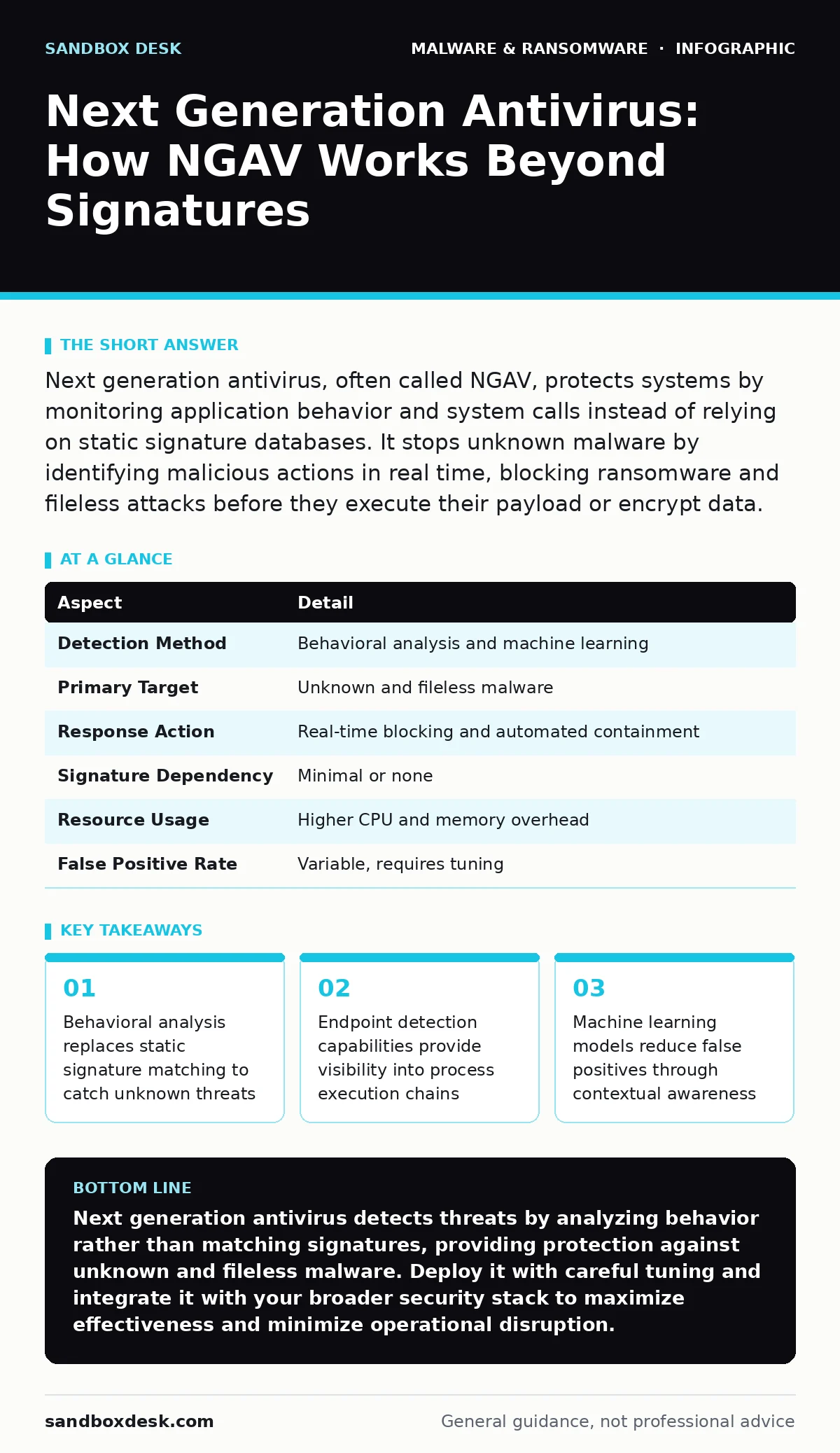
Next generation antivirus, often called NGAV, protects systems by monitoring application behavior and system calls instead of relying on static signature databases. It stops unknown malware by identifying malicious actions in real time, blocking ransomware and fileless attacks before they execute their payload or encrypt data.
The Evolution of Endpoint Protection
Imagine a security guard who only checks IDs against a list of known criminals. If a new thief arrives with a forged passport, the guard lets them in. Traditional antivirus software operates on this exact principle. It compares every file on your system against a database of known malicious signatures. This method works well for common, widespread threats but fails completely against new or modified code.
Next generation antivirus shifts the focus from what a file is to what a file does. Instead of asking if a file matches a known virus, the system asks if the file is performing actions that legitimate software should not perform. This behavioral approach allows the software to detect zero-day exploits, which are vulnerabilities attackers exploit before vendors release patches. The system remains effective even when the attacker obfuscates the code to hide its signature.
| Aspect | Detail |
|---|---|
| Detection Method | Behavioral analysis and machine learning |
| Primary Target | Unknown and fileless malware |
| Response Action | Real-time blocking and automated containment |
| Signature Dependency | Minimal or none |
| Resource Usage | Higher CPU and memory overhead |
| False Positive Rate | Variable, requires tuning |
How Next Generation Antivirus NGAV Functions
The core mechanism of next generation antivirus relies on continuous monitoring of system calls and process behavior. When an application requests access to a file or network resource, the NGAV engine intercepts this request. It evaluates the request against a model of normal behavior for that specific application. If a text editor suddenly attempts to modify system registry keys or contact a remote command and control server, the engine flags this as anomalous.
Machine learning algorithms power this evaluation. These models are trained on vast datasets of both malicious and benign behavior. They identify patterns that human analysts might miss, such as subtle timing variations in process execution or unusual memory allocation patterns. The system does not need a specific rule for every new threat. It generalizes from known malicious behaviors to detect novel attacks that share similar characteristics.
This approach requires deep integration with the operating system kernel. The NGAV agent must hook into system APIs to observe all activity. This depth of integration provides comprehensive visibility but also introduces performance overhead. The agent must process every system call without introducing noticeable latency for the user. Efficient implementation relies on optimized data structures and parallel processing to handle high volumes of events.
The Scope of Protection and Risk
Next generation antivirus affects every endpoint in your environment, including laptops, desktops, servers, and mobile devices. It protects against threats that bypass traditional perimeter defenses, such as firewalls and network intrusion detection systems. Attackers often gain initial access through phishing emails or compromised credentials, landing directly on the endpoint. Once inside, they deploy tools that traditional antivirus cannot detect.
The protection extends to fileless malware, which resides only in memory and never writes to disk. Since there is no file to scan, signature-based tools are blind to these attacks. NGAV monitors process injection techniques, such as PowerShell scripts or Windows Management Instrumentation commands, that attackers use to execute code in memory. It also detects living-off-the-land binaries, which are legitimate system tools abused for malicious purposes.
Ransomware remains a primary target for these systems. Ransomware operates by encrypting files, a behavior that is inherently malicious. NGAV can detect the rapid file modification patterns associated with encryption and block the process before significant damage occurs. However, the attacker may use legitimate encryption tools or custom scripts that mimic normal behavior, requiring the NGAV to distinguish between authorized administrative tasks and malicious encryption.
What People Usually Get Wrong
Many users believe that installing next generation antivirus eliminates the need for other security measures. This assumption is dangerous. NGAV is a detection and response tool, not a prevention mechanism for human error. It cannot stop a user from voluntarily entering credentials into a phishing site or clicking a malicious link. Security awareness and proper configuration remain necessary to reduce the attack surface.
Another common misconception is that NGAV never produces false positives. Behavioral analysis is inherently probabilistic. Legitimate software, such as backup utilities or deployment tools, may perform actions that resemble malware. If the NGAV model is not tuned correctly, it may block critical business applications. This requires ongoing monitoring and adjustment of detection rules to balance security with usability.
Users also often ignore the importance of endpoint visibility. NGAV generates detailed logs of all observed behavior. Without a system to aggregate and analyze these logs, the data is useless. Security teams must integrate NGAV telemetry into a security information and event management platform. This integration allows for correlation of events across multiple endpoints, revealing broader attack patterns that single-device analysis might miss.
Integration with Existing Security Stack
Next generation antivirus does not operate in isolation. It integrates with other security tools to provide a layered defense. For instance, it can share indicators of compromise with the firewall, blocking network connections to malicious domains identified on the endpoint. It also feeds data into threat intelligence platforms, enriching the context of observed behaviors with global threat data.
The relationship with antivirus software is complementary. Legacy antivirus tools may still be present in some environments, providing a baseline of signature-based protection. NGAV adds a layer of behavioral detection that catches what signatures miss. However, running multiple endpoint protection agents can cause conflicts and performance issues. Consolidating onto a single, modern platform is often more efficient and reliable.
Integration with incident response workflows is critical. When NGAV detects a threat, it should automatically trigger containment actions, such as isolating the infected device from the network. This isolation prevents lateral movement, where the attacker spreads to other systems. The system should also preserve forensic artifacts, such as memory dumps and process trees, for later analysis. This automation reduces the time between detection and response, limiting the impact of the breach.
See also: Behavior-Based Detection: 6 Common Misunderstandings and Fixes · Detecting Malware Targeting AI Infrastructure
Practical Steps for Deployment
Deploying next generation antivirus requires careful planning and testing. Begin by defining the scope of deployment, starting with high-risk endpoints such as servers and administrative workstations. This phased approach allows you to validate detection rules and tune false positives before rolling out to the entire organization. Monitor system performance closely during this phase to ensure that the NGAV agent does not degrade user productivity.
Configure the detection policies to match your environment’s risk tolerance. More aggressive settings increase detection rates but also raise the likelihood of false positives. Start with default recommendations and adjust based on observed behavior. Regularly review blocked events to identify legitimate activities that were mistakenly flagged. Update the machine learning models with local data to improve accuracy over time.
Ensure that your team has the skills to interpret NGAV alerts. Behavioral alerts require more context than simple signature matches. Analysts must understand the underlying system behavior to determine if an alert represents a true threat or a benign anomaly. Provide training on investigating process trees, analyzing network connections, and reviewing memory artifacts. This expertise is vital for effective incident response.
Limitations and Edge Cases
Next generation antivirus is not infallible. Advanced attackers may use techniques to evade behavioral detection. They might slow down their operations to mimic normal user behavior, a technique known as low-and-slow attacks. They may also use legitimate software to perform malicious actions, making it difficult for the NGAV to distinguish between authorized and unauthorized use.
Fileless attacks that rely entirely on in-memory execution can be challenging to detect. If the attacker uses standard system tools that do not exhibit obvious malicious behavior, the NGAV may not trigger an alert. This requires continuous updating of behavioral models and integration with other detection sources, such as network traffic analysis, to identify suspicious activity.
Performance overhead remains a concern, particularly on resource-constrained devices. The continuous monitoring and analysis required by NGAV consume CPU and memory resources. On older hardware or systems with limited resources, this can lead to noticeable slowdowns. Proper resource allocation and optimization of the NGAV agent are necessary to mitigate this impact.
Key takeaways
- Behavioral analysis replaces static signature matching to catch unknown threats
- Endpoint detection capabilities provide visibility into process execution chains
- Machine learning models reduce false positives through contextual awareness
- Integration with endpoint response allows automated containment of threats
Next generation antivirus detects threats by analyzing behavior rather than matching signatures, providing protection against unknown and fileless malware. Deploy it with careful tuning and integrate it with your broader security stack to maximize effectiveness and minimize operational disruption.
Frequently asked questions
Does next generation antivirus replace traditional antivirus?
Yes, it typically replaces traditional signature-based antivirus by offering superior detection capabilities against modern threats, though some organizations may run both during a transition period.
How does NGAV handle fileless malware?
NGAV monitors process behavior and system calls in real time, detecting malicious actions in memory even when no malicious file is written to disk.
Can NGAV stop ransomware before encryption starts?
NGAV can detect the behavioral patterns associated with ransomware, such as rapid file modification, and block the process before significant encryption occurs.
Is NGAV effective against zero-day exploits?
Yes, because it relies on behavioral analysis rather than known signatures, NGAV can detect and block zero-day exploits that have no prior record in signature databases.
How this guide was produced: written by the Sandbox Desk editorial team with AI assistance, checked against the public references listed below, and reviewed when the facts change. See our editorial policy or report an error.