Logic Bombs: Debunking 6 Common Myths About Triggered Malware
Logic bombs hide in plain sight within legitimate code, proving that signature-based detection often fails to catch them until the trigger condition is met.

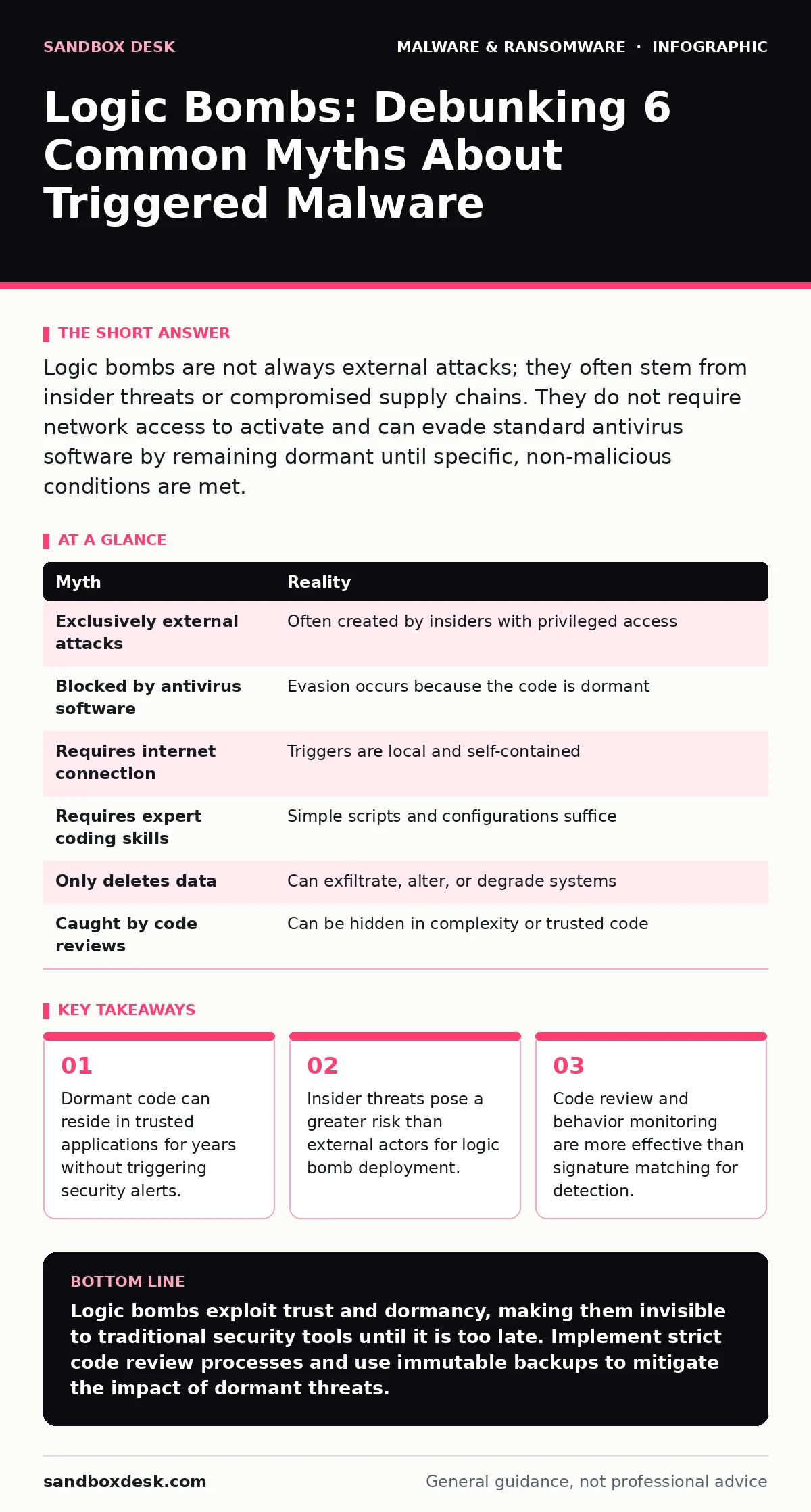
Logic bombs are not always external attacks; they often stem from insider threats or compromised supply chains. They do not require network access to activate and can evade standard antivirus software by remaining dormant until specific, non-malicious conditions are met.
Myth: Logic bombs are exclusively external attacks
Reality: The majority of logic bomb incidents originate from within the organization. While external actors certainly use this technique, the most damaging cases involve disgruntled employees, contractors, or compromised internal accounts. An insider has the necessary permissions to embed malicious logic directly into production code or system scripts without triggering perimeter defenses.
External attackers usually rely on exploits or social engineering to gain a foothold. An insider already holds the keys to the kingdom. They can insert a conditional statement into a billing module or a data processing script that activates when a specific date arrives or when their user account is disabled. This internal origin makes the threat harder to trace because the code changes often pass initial quality assurance checks.
Myth: Antivirus software will detect and block logic bombs
Reality: Traditional antivirus software relies on known signatures or heuristic analysis of active behavior. A logic bomb is inert until its trigger condition is satisfied. Until that moment, it looks like standard, benign code. The malicious payload does not execute, meaning there is no behavior to flag and no signature to match.
This limitation is why many organizations pair traditional tools with next-generation antivirus solutions that focus on file reputation and machine learning. Even then, a logic bomb hidden in a custom-compiled application may appear unique and unknown to the threat intelligence database. The code sits quietly in the binary, indistinguishable from legitimate functions to static scanners.
Myth: Logic bombs require an internet connection to activate
Reality: A logic bomb is a self-contained conditional statement within the code. It does not need to call home to a command-and-control server to decide when to strike. The trigger is local. It could be a specific time, a particular date, the presence of a certain file, or the absence of a user account.
Imagine a script that deletes database backups every Friday at midnight. It does not need the internet. It simply checks the system clock and the day of the week. This independence from network connectivity means that air-gapped systems are not immune. If the logic bomb was inserted before the system was isolated, it will still execute when the local conditions are met.
Myth: Only experienced programmers can create logic bombs
Reality: Creating a logic bomb does not require advanced coding skills. It requires access and the ability to modify a script or configuration file. A simple if statement in a batch file, a PowerShell script, or a cron job can act as a powerful logic bomb. The complexity lies in the concealment, not the execution.
Suppose an IT administrator adds a line to a maintenance script that wipes logs if a specific username is deleted. This is a logic bomb. It is syntactically simple. The danger comes from the lack of oversight and the trust placed in the individual who wrote the script. Automated tools can also generate these conditions if an attacker manipulates the configuration parameters of a deployment pipeline.
Myth: Logic bombs only target data deletion
Reality: While data destruction is the most dramatic outcome, logic bombs can perform a wide variety of harmful actions. They can exfiltrate sensitive data, create backdoor accounts, alter financial records, or degrade system performance gradually. The trigger determines the action, and the action is limited only by the privileges of the account running the code.
Consider a logic bomb that increases the logging level of a web server when a specific customer ID is accessed. This does not delete data. Instead, it causes a denial of service by filling up disk space with logs. This subtle form of sabotage can be harder to detect than a blatant file wipe. The impact is operational rather than destructive, making it a sophisticated tool for corporate espionage or competitive disruption.
See also: Next Generation Antivirus: How NGAV Works Beyond Signatures · How Next-Generation Antivirus Works: The Mechanics of Behavioral Analysis
Myth: Code reviews catch all logic bombs
Reality: Code reviews are effective but not foolproof. A logic bomb can be hidden in complex logic, obfuscated code, or third-party libraries. Reviewers may miss a subtle conditional statement buried deep in a large codebase. Furthermore, if the reviewer trusts the author, they may overlook suspicious patterns.
Static analysis tools can help identify suspicious patterns, but they produce false positives. The human element remains the weakest link. An insider can argue that a strange conditional statement is a debugging aid or a legacy feature. This social engineering aspect allows the logic bomb to survive the review process. Continuous integration pipelines should include behavioral testing, not just static checks.
| Myth | Reality |
|---|---|
| Exclusively external attacks | Often created by insiders with privileged access |
| Blocked by antivirus software | Evasion occurs because the code is dormant |
| Requires internet connection | Triggers are local and self-contained |
| Requires expert coding skills | Simple scripts and configurations suffice |
| Only deletes data | Can exfiltrate, alter, or degrade systems |
| Caught by code reviews | Can be hidden in complexity or trusted code |
Myth: Logic bombs are always easy to detect in logs
Reality: A well-crafted logic bomb operates silently until the trigger fires. There may be no network traffic, no unusual process creation, and no file integrity changes prior to activation. The logs will show normal system operation. This silence makes retrospective analysis difficult.
After the trigger, the logs may show the destructive action, but the cause is hidden in the code. Forensic investigators must analyze the binary or script to find the conditional statement. This is time-consuming and requires deep technical expertise. Immutable backups are critical here because they allow you to restore the system to a state before the logic bomb executed, bypassing the need to reverse-engineer the malware.
Myth: Logic bombs are a rare threat
Reality: Logic bombs are a common feature in ransomware kits and insider threat scenarios. They are not exotic malware. They are a simple programming construct used maliciously. The frequency of these attacks is higher than most organizations assume because many go undetected or are misattributed to accidental errors.
Understanding the mechanics of logic bombs helps you appreciate the value of file hashes in malware detection. By maintaining a baseline of known good hashes, you can detect when a legitimate file has been modified to include a logic bomb. This is a proactive measure that complements reactive security tools.
Key takeaways
- Dormant code can reside in trusted applications for years without triggering security alerts.
- Insider threats pose a greater risk than external actors for logic bomb deployment.
- Code review and behavior monitoring are more effective than signature matching for detection.
Logic bombs exploit trust and dormancy, making them invisible to traditional security tools until it is too late. Implement strict code review processes and use immutable backups to mitigate the impact of dormant threats.
Frequently asked questions
How do I detect a logic bomb in my code?
Use static analysis tools to identify suspicious conditional statements and ensure all code changes undergo peer review by developers who did not write the original code.
Can a logic bomb survive a system reboot?
Yes, if the logic bomb is embedded in a startup script, a service configuration, or a binary that runs on boot. It persists across reboots.
Are logic bombs considered ransomware?
Not necessarily. Ransomware encrypts files and demands payment. A logic bomb may delete data, create backdoors, or exfiltrate information without any ransom demand.
How do I protect against insider logic bombs?
Enforce the principle of least privilege, require multi-person approval for code deployments, and monitor for unusual changes to critical system files.
How this guide was produced: written by the Sandbox Desk editorial team with AI assistance, checked against the public references listed below, and reviewed when the facts change. See our editorial policy or report an error.