Account Takeover Fraud: Mechanisms, Detection and Mitigation
Attackers often bypass multi-factor authentication by exploiting session tokens rather than stealing passwords, rendering standard login alerts ineffective against established sessions.

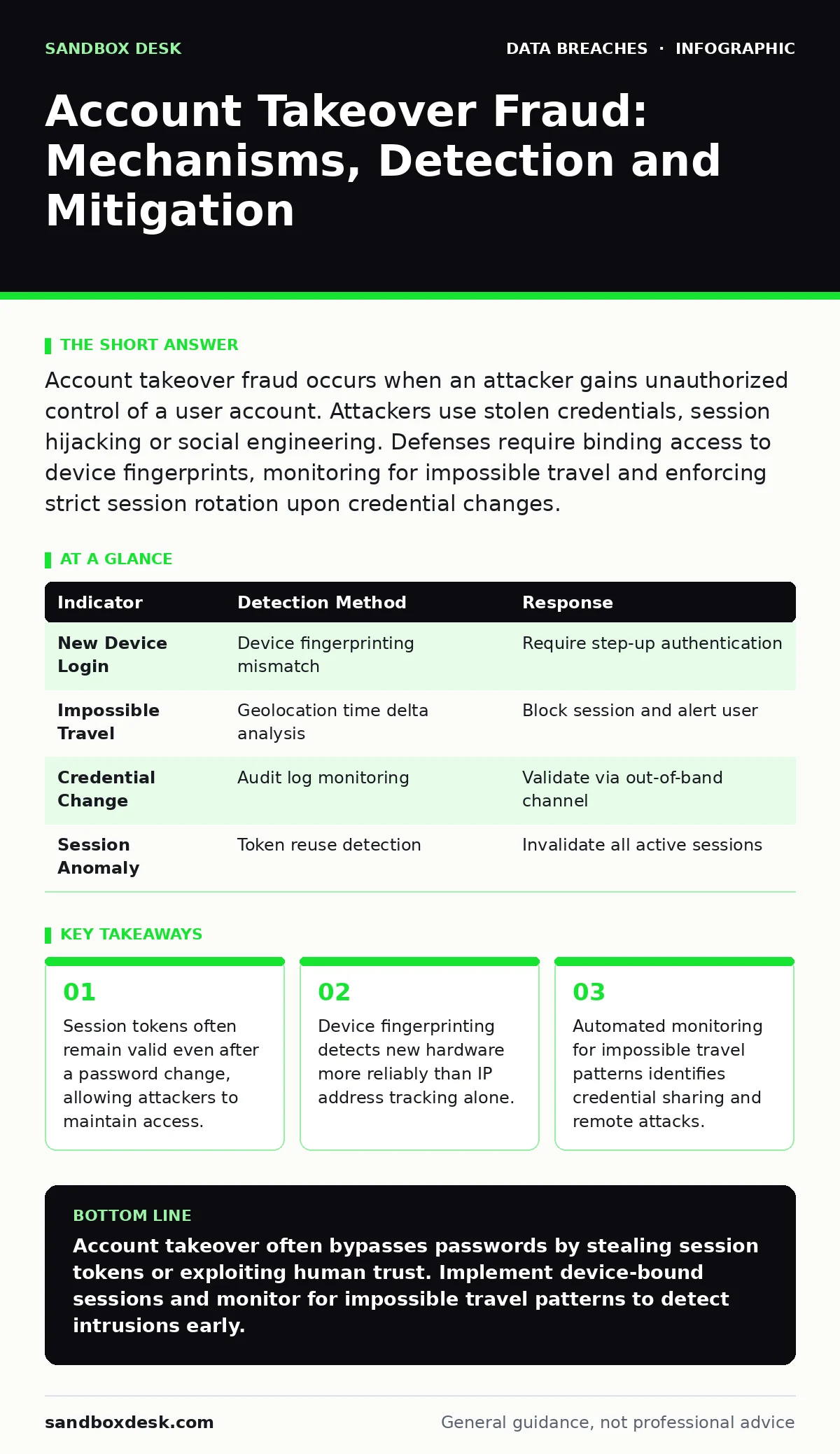
Account takeover fraud occurs when an attacker gains unauthorized control of a user account. Attackers use stolen credentials, session hijacking or social engineering. Defenses require binding access to device fingerprints, monitoring for impossible travel and enforcing strict session rotation upon credential changes.
What is account takeover fraud?
Account takeover fraud is the unauthorized assumption of control over a legitimate user’s digital identity. Attackers do not merely guess passwords. They exploit weak authentication flows, stolen credentials from prior breaches or social engineering to bypass security controls. The goal is not always immediate data theft. Attackers often seek long-term access to manipulate transactions, alter contact details or pivot to other systems. You lose control of your digital persona, and the attacker acts as you.
How do attackers gain initial access?
Attackers typically gain initial access through credential stuffing, phishing or malware. Credential stuffing involves using automated bots to test username and password pairs leaked from other breaches. Phishing tricks users into entering valid credentials on fake login pages. Malware installed on a device can capture keystrokes or browser cookies. The initial entry point is rarely a direct hack of the target system. It is usually a compromise of the user’s hygiene or a third-party data leak.
Why does multi-factor authentication fail to stop takeover?
Multi-factor authentication fails when attackers intercept the second factor or bypass the authentication flow entirely. SIM swap fraud allows attackers to redirect SMS codes to their own devices. Push notification fatigue trains users to approve random requests, granting access without scrutiny. Some attackers use session token theft to skip the login screen altogether. If the application trusts an existing valid session, the attacker never needs the password or second factor. MFA protects the door, not the room.
What is session hijacking and how does it work?
Session hijacking involves stealing the temporary token that proves a user is logged in. This token, often stored in a browser cookie, grants access without re-entering credentials. Attackers steal these tokens via cross-site scripting, malware or network sniffing on unsecured Wi-Fi. Once the attacker has the token, they impersonate the user perfectly. The server sees a valid session and grants access. This method bypasses password strength and multi-factor authentication entirely.
How can you detect an account takeover in progress?
You detect account takeover by monitoring for anomalous behavior patterns. Look for logins from new devices or unusual geographic locations. Impossible travel occurs when a user logs in from two distant locations in a timeframe that makes physical travel impossible. Sudden changes to security settings, such as adding new recovery emails or disabling alerts, are strong indicators. Automated systems should flag these events for review or immediate blocking.
| Indicator | Detection Method | Response |
|---|---|---|
| New Device Login | Device fingerprinting mismatch | Require step-up authentication |
| Impossible Travel | Geolocation time delta analysis | Block session and alert user |
| Credential Change | Audit log monitoring | Validate via out-of-band channel |
| Session Anomaly | Token reuse detection | Invalidate all active sessions |
See also: Email Account Compromise: How Attackers Steal Access and What You Can Do · Data Scraping Meaning: How Automated Extraction Works and What It Costs
What role do social engineering tactics play?
Social engineering tricks users into voluntarily surrendering access or bypassing security controls. Attackers pose as support staff to request password resets or verification codes. They may create a sense of urgency to prevent critical thinking. Users often comply because the request appears legitimate. This human element is difficult to patch with software alone. Training must focus on verifying the identity of the requester through established, out-of-band channels rather than trusting the context of the request.
How does credential stuffing differ from brute force?
Credential stuffing uses known valid username and password pairs from previous data breaches. Brute force attempts to guess passwords by trying many combinations. Credential stuffing is faster and more effective because the credentials are already verified. It relies on users reusing passwords across multiple services. Brute force relies on weak password complexity. Defenses against stuffing require blocking known leaked credentials and enforcing unique passwords, while defenses against brute force require rate limiting and account lockouts.
What are the limitations of IP-based security checks?
IP-based security checks are unreliable because IP addresses are dynamic and shared. Many users connect through cellular networks or corporate proxies that mask their true location. Attackers use residential proxies to appear as legitimate users. Relying solely on IP geolocation creates false positives for traveling users and false negatives for sophisticated attackers. Device fingerprinting and behavioral analysis provide more accurate risk scores than IP addresses alone.
How do you mitigate the risk of account takeover?
You mitigate account takeover risk by layering defenses that bind identity to the user and their device. Enforce multi-factor authentication using hardware keys or authenticator apps rather than SMS. Monitor sessions for anomalies and invalidate them upon credential changes. Educate users to recognize social engineering attempts. Ensure your systems detect and block credential stuffing attempts. No single control stops all attacks. Defense in depth ensures that if one layer fails, others remain active.
What is the impact of shadow IT on account security?
Shadow IT exposes accounts because unsanctioned applications often have weaker security controls. Users may store credentials or sensitive data in these tools without organizational oversight. If a shadow IT service suffers a breach, your organization’s accounts are compromised. You cannot secure what you do not know exists. Inventorying all applications and enforcing access policies reduces this hidden attack surface.
Key takeaways
- Session tokens often remain valid even after a password change, allowing attackers to maintain access.
- Device fingerprinting detects new hardware more reliably than IP address tracking alone.
- Automated monitoring for impossible travel patterns identifies credential sharing and remote attacks.
Account takeover often bypasses passwords by stealing session tokens or exploiting human trust. Implement device-bound sessions and monitor for impossible travel patterns to detect intrusions early.
Frequently asked questions
Can 2FA be bypassed if I use an authenticator app?
Authenticator apps are harder to bypass than SMS, but attackers can use social engineering to trick you into approving a login or steal the seed phrase via malware.
How long should session tokens remain valid?
Session tokens should have short expiration times and be invalidated immediately upon password changes or suspicious activity to limit the window for hijacking.
Does changing my password stop an ongoing takeover?
Only if your system is configured to invalidate all active sessions when a password changes. Otherwise, the attacker’s stolen session token remains valid.
What is the best way to verify a support request?
Hang up or close the chat and contact the organization through official channels listed on their website, never using contact details provided in the suspicious request.
How this guide was produced: written by the Sandbox Desk editorial team with AI assistance, checked against the public references listed below, and reviewed when the facts change. See our editorial policy or report an error.