Why Is AI Content Detection Accuracy Debated?
Detection tools measure statistical patterns, not truth, causing consistent false positives that disrupt legitimate workflows and erode trust in automated systems.

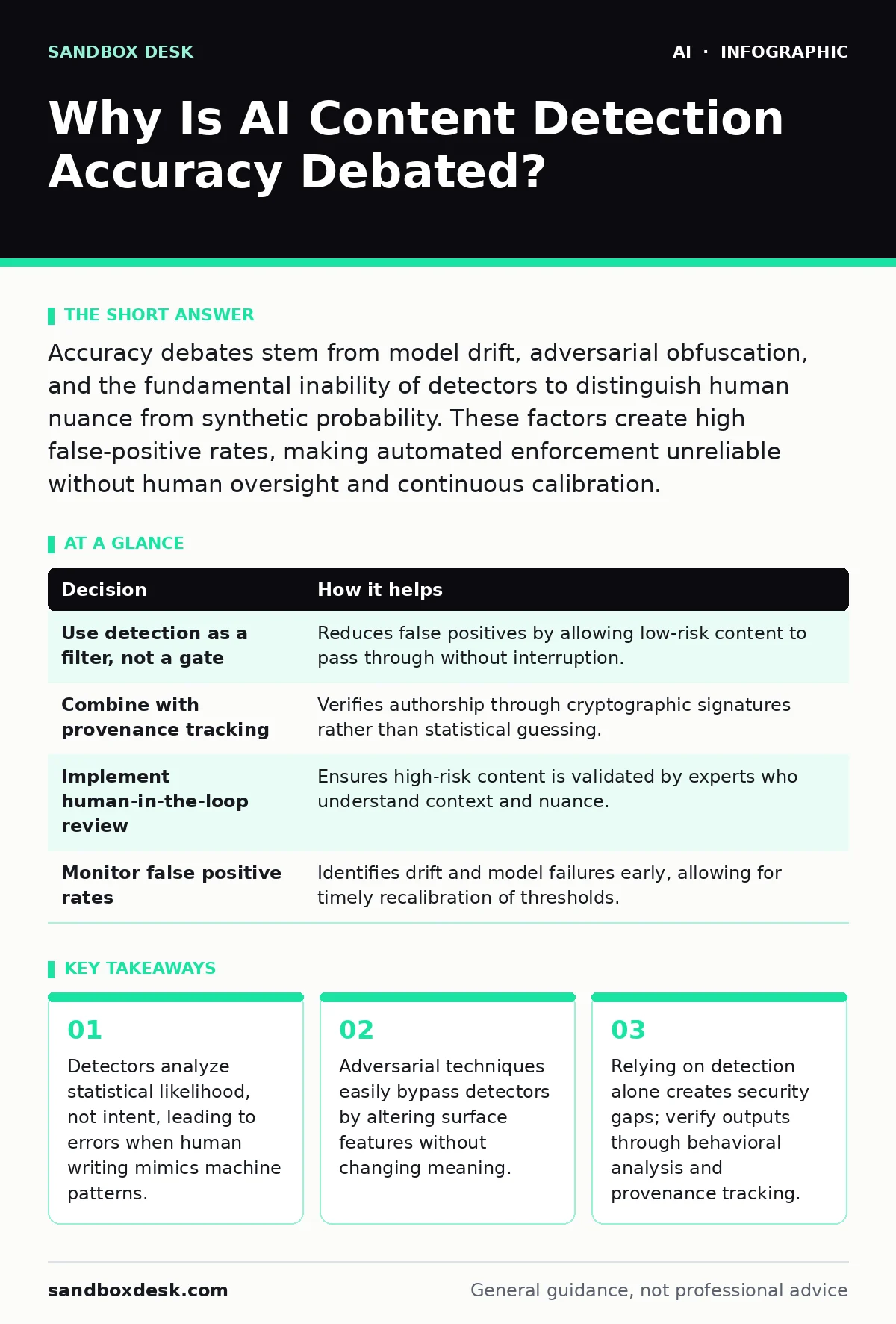
Accuracy debates stem from model drift, adversarial obfuscation, and the fundamental inability of detectors to distinguish human nuance from synthetic probability. These factors create high false-positive rates, making automated enforcement unreliable without human oversight and continuous calibration.
Why is artificial intelligence content detection accuracy debated
The debate over detection accuracy centers on the mismatch between what detectors measure and what users expect them to find. Detectors do not read meaning. They calculate the probability that a sequence of tokens matches the output distribution of a known large language model. This statistical approach fails when human writing becomes formulaic or when synthetic text is sufficiently randomized. The result is a tool that flags patterns, not authorship, creating inevitable friction in production environments.
Statistical convergence and the false positive trap
Human writers often adopt structures that mirror model outputs. Technical documentation, marketing copy, and standard emails follow predictable patterns. When a detector sees these patterns, it assigns a high probability of synthetic origin. This creates false positives for legitimate human work. The detector cannot distinguish between a human who writes clearly and a model that predicts the next word accurately. You cannot train a detector to recognize "humanity" because humanity has no unique statistical signature. The tool only recognizes deviation from expected randomness.
Adversarial obfuscation and surface noise
Detectors rely on surface features like perplexity and burstiness. Perplexity measures how surprised a model is by a text. Burstiness measures variation in sentence structure. Adversaries exploit these metrics by introducing noise. They swap synonyms, alter sentence lengths, or insert grammatical errors that humans make. These changes break the statistical pattern the detector expects. The text remains semantically identical to the original output. The detector sees random noise and assumes human authorship. This arms race ensures that detection accuracy decays as evasion techniques improve.
Model drift and training data overlap
Large language models train on internet data that includes previous model outputs. As synthetic content floods the web, future models learn to write like earlier models. The statistical boundary between human and machine blurs. Detectors trained on older data cannot distinguish new model outputs from human text because the distributions overlap. This phenomenon, known as model drift, means a detector that worked last year may fail today. You must retrain detection models continuously. Even then, the overlap creates a ceiling on maximum possible accuracy. No detector can achieve perfect separation when the underlying data sources merge.
The hidden cost of automated enforcement
Implementing detection as a gatekeeper introduces significant operational costs. False positives require manual review. Teams spend hours verifying flagged content. This review process slows down publication cycles. Developers and writers lose trust in the tool if it consistently flags their work. You create a bottleneck where human judgment becomes the limiting factor. The automation you sought to introduce is replaced by a manual checkpoint. The system adds latency without reducing risk. You pay for the tool and the labor to correct its errors.
See also: Explainable AI in Healthcare: Why Opacity Risks Patient Safety · How to Spot AI Hallucinations: Detect Fabricated Facts in Outputs
Context blindness in semantic analysis
Detectors lack context. They do not know who wrote the text, when it was written, or for what purpose. A detector sees a paragraph and outputs a score. It does not know if that paragraph came from a draft, a citation, or a final report. Without context, the score is meaningless. You must integrate detection into a broader workflow. Contextual metadata, such as editor history or collaboration logs, provides the necessary signals. The detector provides a signal; the workflow provides the meaning. Separating the two leads to misinterpretation of results.
Decision matrix for detection integration
| Decision | How it helps |
|---|---|
| Use detection as a filter, not a gate | Reduces false positives by allowing low-risk content to pass through without interruption. |
| Combine with provenance tracking | Verifies authorship through cryptographic signatures rather than statistical guessing. |
| Implement human-in-the-loop review | Ensures high-risk content is validated by experts who understand context and nuance. |
| Monitor false positive rates | Identifies drift and model failures early, allowing for timely recalibration of thresholds. |
What to do with that knowledge
You must shift from detection to verification. Detection answers "what does this look like?" Verification answers "who made this and how?" Use cryptographic signing for content that requires guaranteed provenance. This approach removes the need for statistical guessing. For less critical content, use detection as a triage tool. Flag anomalies for review rather than blocking them automatically. Integrate these checks into your CI/CD pipeline. Automate the flagging, but humanize the decision.
Secure your AI supply chain by validating inputs and outputs. Check for insecure AI plugins and agents that might inject synthetic content into your workflows. Understand the risks discussed in agentic AI guides where autonomous systems generate content without human oversight. This layer of defense protects against both accidental leakage and malicious injection.
Long-term resilience strategies
Build systems that adapt to model changes. Regularly update your detection models with new training data. Monitor the performance of your detectors over time. Track false positive and false negative rates separately. If one rises, adjust your thresholds. Do not rely on a single detector. Use an ensemble of models that employ different statistical methods. This diversity reduces the impact of any single model's failure. Combine technical controls with policy. Define clear guidelines for AI use in your organization. Transparency reduces the incentive to hide synthetic content.
Consider the regulatory environment. The EU AI Act and other frameworks may impose requirements on transparency and risk management. Align your technical controls with these legal expectations. This alignment ensures that your security measures support compliance rather than conflict with it. Refer to AI risk management practices to ensure a holistic approach.
Key takeaways
- Detectors analyze statistical likelihood, not intent, leading to errors when human writing mimics machine patterns.
- Adversarial techniques easily bypass detectors by altering surface features without changing meaning.
- Relying on detection alone creates security gaps; verify outputs through behavioral analysis and provenance tracking.
Frequently asked questions
Can I tune a detector to stop false positives?
You can adjust thresholds to reduce false positives, but this increases false negatives. No tuning eliminates both errors simultaneously because the underlying statistical overlap remains.
Does watermaking solve the detection problem?
Watermarking adds a signal to synthetic text, but it can be removed or altered. It is not tamper-proof. Detection of watermarks is also subject to the same statistical challenges as other methods.
How do I detect jailbreaking AI chatbots?
Jailbreaking involves prompting techniques to bypass safety filters. Detecting this requires monitoring input patterns for adversarial phrasing, not just output content. See guides on jailbreaking AI chatbots for specific patterns.
Is machine learning in cybersecurity different here?
Yes, traditional ML detects known malicious patterns. AI content detection tries to distinguish authorship styles. The latter is a much harder problem with no ground truth for "human" writing. BOTTOM LINE: AI content detection measures statistical probability, not authorship, making it inherently unreliable for automated enforcement. Integrate detection as a triage tool within a broader verification workflow that includes human review and cryptographic provenance.
How this guide was produced: written by the Sandbox Desk editorial team with AI assistance, checked against the public references listed below, and reviewed when the facts change. See our editorial policy or report an error.