Machine Learning for Fraud Detection: How Algorithms Spot Anomalies
Fraud detection models do not identify bad actors directly. They measure how far a transaction deviates from the statistical norm of accepted behavior.

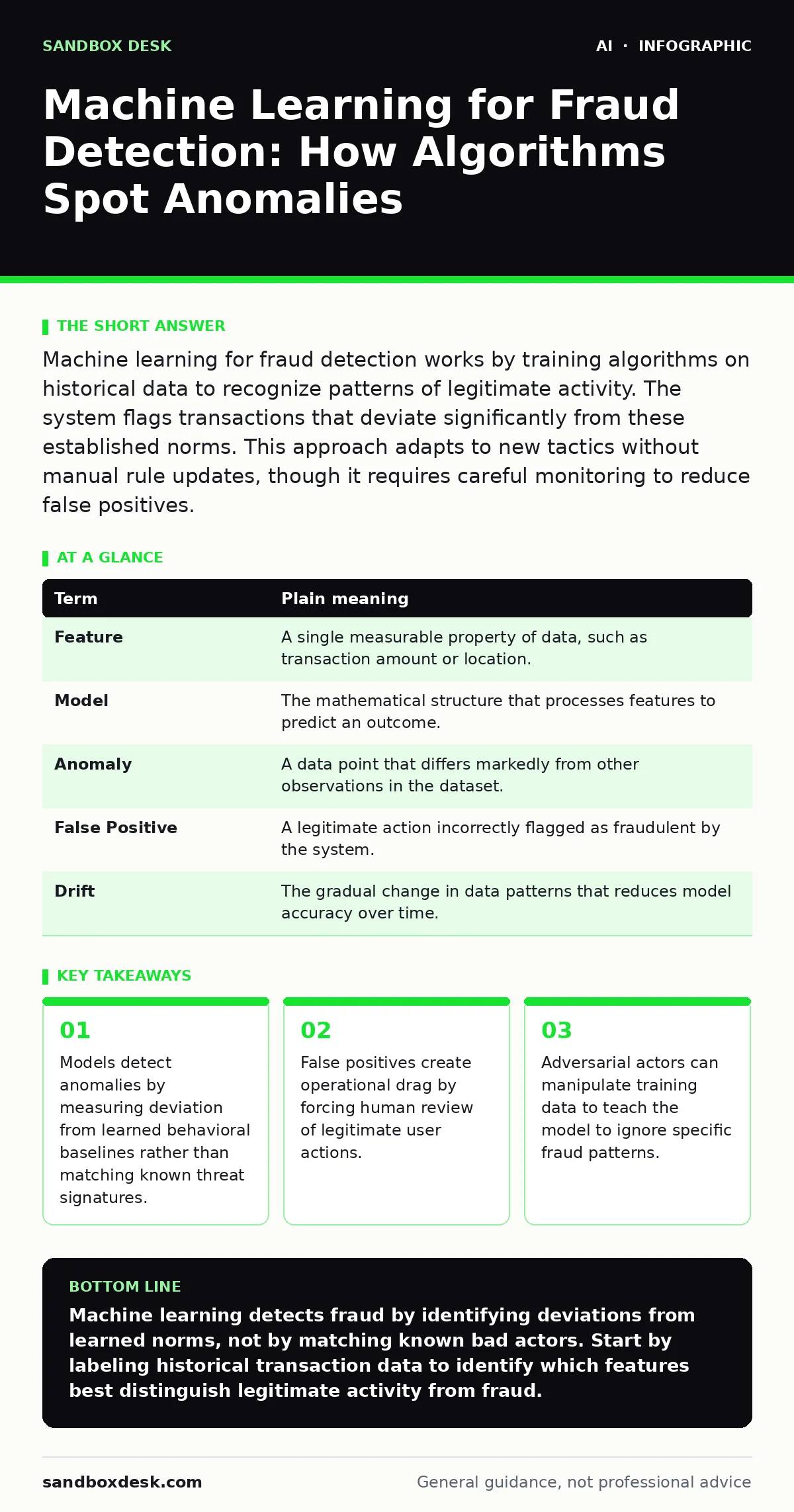
Machine learning for fraud detection works by training algorithms on historical data to recognize patterns of legitimate activity. The system flags transactions that deviate significantly from these established norms. This approach adapts to new tactics without manual rule updates, though it requires careful monitoring to reduce false positives.
The Airport Security Metaphor
Imagine an airport security checkpoint that stops every passenger for a thorough pat-down. This approach is secure but paralyzes travel. Now imagine a system that scans passengers and only stops those carrying unusual items. This is how machine learning handles fraud detection. It does not check every transaction against a static list of banned behaviors. Instead, it learns what normal travel looks like and flags the outliers.
The system builds a profile of typical behavior for each user. If a frequent flyer suddenly books a one-way ticket to a conflict zone at 3 AM, the system raises an alarm. The analogy holds because the model cares about deviation, not intent. It cannot read the passenger's mind, but it can measure how strange the request is compared to history.
Defining the Detection Mechanism
You need a shared vocabulary to understand how these systems operate. The terms below appear frequently in technical documentation and risk reports. Understanding them helps you evaluate the tools your organization uses.
| Term | Plain meaning |
|---|---|
| Feature | A single measurable property of data, such as transaction amount or location. |
| Model | The mathematical structure that processes features to predict an outcome. |
| Anomaly | A data point that differs markedly from other observations in the dataset. |
| False Positive | A legitimate action incorrectly flagged as fraudulent by the system. |
| Drift | The gradual change in data patterns that reduces model accuracy over time. |
Why Rules Fail Against Novel Tactics
Traditional fraud prevention relies on hard-coded rules. A rule might state that any purchase over a certain amount requires verification. This works for obvious errors. It fails when fraudsters act within the limits. They know the rules, so they stay just under the threshold. This is known as adversarial adaptation.
Machine learning models do not use fixed thresholds. They use probability distributions. A transaction is not simply allowed or blocked. It is assigned a risk score based on how likely it is to be fraud. This allows the system to catch subtle patterns that humans cannot define in advance. However, this flexibility introduces complexity in debugging.
The Hidden Cost of False Positives
Every fraud model produces false positives. These are legitimate users who are blocked or challenged. For a business, this is a direct loss of revenue and customer trust. A user who cannot complete a purchase will leave. They may not return.
The trade-off is between security and friction. Tightening the model reduces fraud but increases false positives. Loosening it improves user experience but allows more fraud through. You must find the balance that aligns with your business goals. This is not a technical setting alone. It is a business decision.
Adversarial Training and Data Poisoning
Fraudsters can attack the model itself. This is not a breach of your server. It is a manipulation of the data the model learns from. If attackers submit many slightly fraudulent transactions that you approve, the model learns that this behavior is normal. This is called data poisoning.
The model becomes blind to this specific type of fraud. It no longer flags the pattern because it has been trained to accept it. This makes the system vulnerable to targeted attacks. You must monitor the input data for statistical shifts. > EXAMPLE: A sudden influx of transactions from a new geographic region with similar metadata may signal a coordinated poisoning attempt.
See also: How Large Language Models Work: Mechanics, Limits, and Reality · How Machine Learning Changes Cybersecurity Decision Making
Monitoring Model Performance Over Time
A model is not a set-and-forget tool. The world changes, and so does fraud. What was normal last year may be suspicious today. This is known as concept drift. If you do not update the model, its accuracy degrades.
You need a process for continuous evaluation. This involves comparing model predictions against actual outcomes. If the model starts approving known fraud, it needs retraining. This process requires clean labels and consistent data pipelines. For deeper insights into maintaining system integrity, see the guide on AI model monitoring. It covers the specific metrics you should track to ensure your model remains effective.
A First Practical Step for Beginners
You do not need to build a model from scratch to start. Begin by labeling your historical data. Mark transactions as either fraud or legitimate. This labeled dataset is the foundation of any supervised learning approach. Without accurate labels, the model cannot learn.
- Export a sample of past transactions.
- Manually review and label a subset as fraud or clean.
- Analyze the features that differ between the two groups.
This manual step reveals which data points matter. It also highlights gaps in your data collection. If you lack features like device ID or IP reputation, the model will struggle. Addressing these gaps improves the final system.
Key takeaways
- Models detect anomalies by measuring deviation from learned behavioral baselines rather than matching known threat signatures.
- False positives create operational drag by forcing human review of legitimate user actions.
- Adversarial actors can manipulate training data to teach the model to ignore specific fraud patterns.
Machine learning detects fraud by identifying deviations from learned norms, not by matching known bad actors. Start by labeling historical transaction data to identify which features best distinguish legitimate activity from fraud.
Frequently asked questions
How do I know if my model is biased?
Test the model on different user segments. If it flags one group more often than another without a valid reason, it is biased.
Can machine learning catch all fraud?
No. It catches patterns it has seen or similar variations. Novel, one-off attacks may slip through until the model learns them.
What data do I need to train a model?
You need historical transaction data with accurate labels indicating whether each transaction was fraud or legitimate.
How often should I retrain the model?
Retrain when performance metrics drop or when you detect significant shifts in transaction patterns or business rules.
How this guide was produced: written by the Sandbox Desk editorial team with AI assistance, checked against the public references listed below, and reviewed when the facts change. See our editorial policy or report an error.