How Large Language Models Change Security Decision Making
Large language models shift security from rule-based filtering to probabilistic reasoning, exposing new risks in how teams validate automated decisions and handle sensitive context.

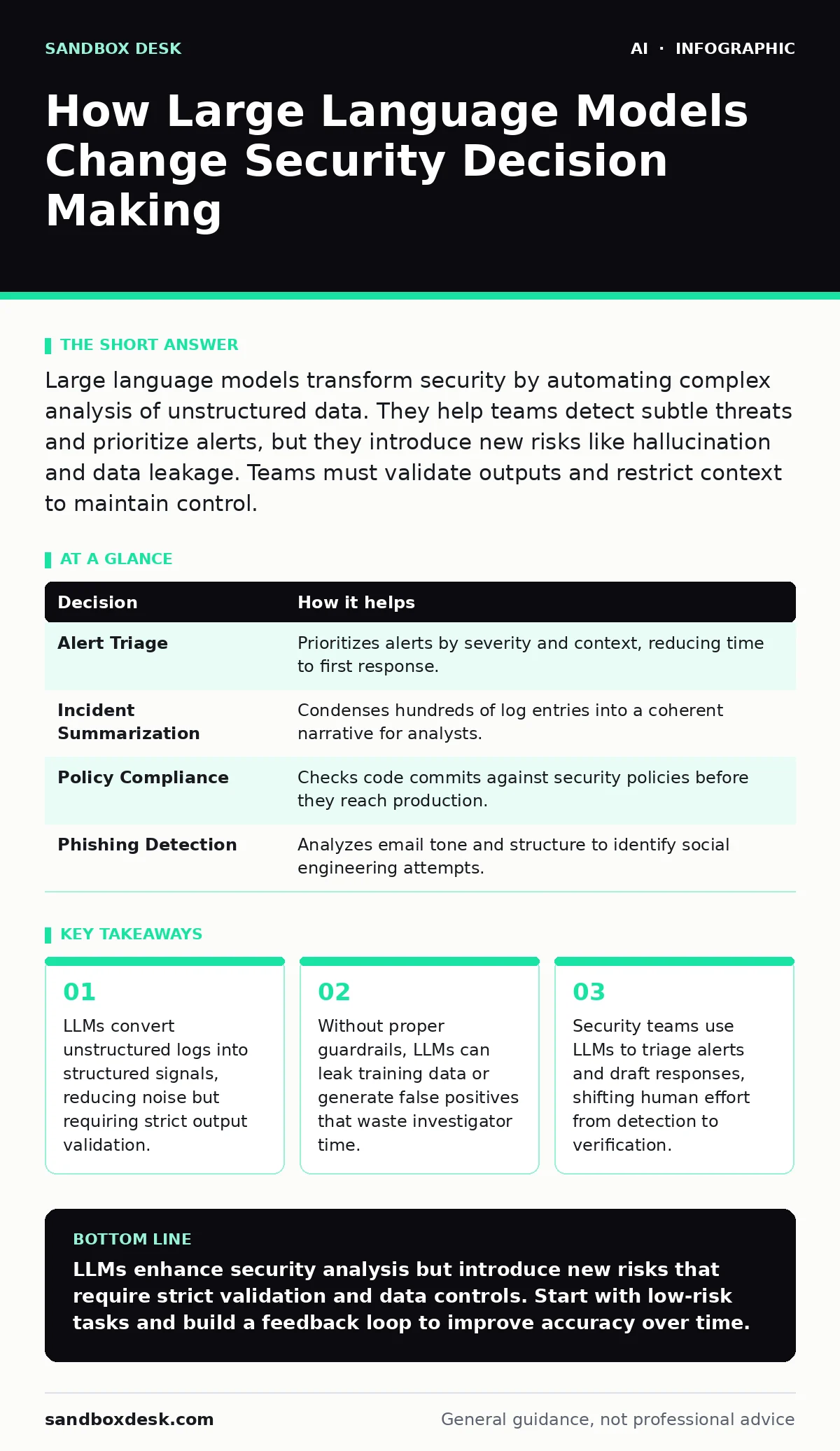
Large language models transform security by automating complex analysis of unstructured data. They help teams detect subtle threats and prioritize alerts, but they introduce new risks like hallucination and data leakage. Teams must validate outputs and restrict context to maintain control.
The Shift from Rules to Reasoning
Traditional security tools rely on deterministic rules. If a file hash matches a known bad signature, the system blocks it. This approach is precise but brittle. It fails against novel attacks that do not match existing patterns. Large language models operate differently. They process natural language and code to identify intent and context. This allows them to spot anomalies that rule-based systems miss.
Imagine a security team reviewing thousands of daily alerts. A rule-based system flags every outbound connection to a non-standard port. An LLM can read the surrounding log entries and determine if the connection is part of a legitimate software update or a data exfiltration attempt. This distinction reduces alert fatigue. However, the model does not "know" truth. It predicts the next likely token based on patterns. You must treat its output as a hypothesis, not a fact.
Decisions Informed by Probabilistic Output
Security decisions often require speed and accuracy. LLMs assist in both, but with trade-offs. They excel at synthesizing information from multiple sources. This helps analysts form a quick understanding of an event. You must decide which decisions to automate and which to keep manual. High-risk actions, like blocking network traffic, should remain under human control. Low-risk tasks, like categorizing tickets, can be automated.
The model helps by providing a recommended action and a confidence score. You use this score to determine the level of human review required. A high confidence score might allow automated closure of a low-severity alert. A low score triggers immediate analyst review. This tiered approach balances efficiency with safety. It prevents the system from acting on hallucinations. Hallucination occurs when the model generates plausible but incorrect information.
| Decision | How it helps |
|---|---|
| Alert Triage | Prioritizes alerts by severity and context, reducing time to first response. |
| Incident Summarization | Condenses hundreds of log entries into a coherent narrative for analysts. |
| Policy Compliance | Checks code commits against security policies before they reach production. |
| Phishing Detection | Analyzes email tone and structure to identify social engineering attempts. |
The Cost of Unchecked Automation
Without proper controls, LLMs introduce new failure modes. The most common is context pollution. This happens when sensitive data in the input influences the output in unexpected ways. If you feed the model internal credentials or proprietary code, it might reproduce them in its response. This is a form of training data leakage. Even if the model is not retrained on your data, the context window retains the information for the duration of the session.
Another risk is prompt injection. An attacker can embed instructions in user input that override the system’s safety guidelines. Suppose a customer support chatbot uses an LLM to answer questions. An attacker submits a request that includes a hidden command to ignore previous instructions. The model might then reveal internal documentation or execute unauthorized actions. You must sanitize all inputs before they reach the model. This involves stripping out unexpected structures and validating data types.
How Teams Integrate LLMs into Workflows
Teams use LLMs as force multipliers, not replacements. Analysts still make the final call. The model handles the tedious parts of the job. For example, it can draft incident reports based on raw logs. It can suggest containment steps based on similar past incidents. This frees analysts to focus on complex threat hunting.
Integration requires a clear feedback loop. When an analyst corrects the model, that correction should be recorded. This data helps refine the system over time. You might use fine-tuning to adjust the model’s behavior for your specific environment. Fine-tuning involves training the model on your own data to improve its relevance. However, this adds complexity and cost. Start with prompt engineering. Use clear, specific instructions to guide the model’s output. Only move to fine-tuning if prompt engineering fails to meet your accuracy needs.
Validating Model Outputs
You cannot trust the model blindly. Every output must be validated. This means checking facts, verifying logic, and ensuring compliance. For security tasks, this validation is critical. A false negative means an attack goes undetected. A false positive wastes resources. You need a system that flags low-confidence outputs for human review.
Consider using a secondary model to audit the primary model’s output. This is known as a critic model. The critic checks for consistency, safety, and accuracy. It can flag responses that contain harmful content or logical errors. This adds a layer of defense. It does not eliminate risk, but it reduces the likelihood of errors reaching the end user. You must also monitor for drift. Model performance can degrade over time as data patterns change. Regular re-evaluation ensures the model remains effective.
See also: AI Risk Management: Concrete Benefits and Hidden Limits · Treat AI Models as Untrusted Insiders: 8 Security Practices
Managing Data Privacy and Compliance
LLMs process large amounts of data. This raises privacy concerns. You must ensure that sensitive data is not stored or used in ways that violate regulations. This includes the EU AI Act, which sets strict requirements for high-risk AI systems. You need to classify your data and apply appropriate controls. Anonymization helps, but it is not always sufficient. LLMs can sometimes re-identify individuals from anonymized data.
Use data minimization principles. Only send the data the model needs to perform its task. Strip out unnecessary details. Use synthetic data for testing and development. Synthetic data mimics the statistical properties of real data without containing actual sensitive information. This allows you to train and test your models safely. You must also document your data handling practices. Transparency builds trust and helps with compliance audits.
Building a Resilient Security Posture
LLMs are powerful tools, but they are not magic. They require careful integration and ongoing management. You must understand their limitations. They are probabilistic, not deterministic. They can make mistakes. You must design your systems to handle these mistakes gracefully. This means having fallback procedures and human oversight.
Start small. Identify a specific, low-risk task where the LLM can add value. Test it thoroughly. Measure its performance. Iterate based on feedback. As you gain confidence, expand its use. Always prioritize security and privacy. The benefits of LLMs are significant, but only if you manage the risks. By following these principles, you can harness the power of large language models to improve your security posture.
Key takeaways
- LLMs convert unstructured logs into structured signals, reducing noise but requiring strict output validation.
- Without proper guardrails, LLMs can leak training data or generate false positives that waste investigator time.
- Security teams use LLMs to triage alerts and draft responses, shifting human effort from detection to verification.
LLMs enhance security analysis but introduce new risks that require strict validation and data controls. Start with low-risk tasks and build a feedback loop to improve accuracy over time.
Frequently asked questions
How do I prevent prompt injection attacks?
Sanitize all user inputs, use strict output validation, and consider using a separate model to audit responses for safety and compliance.
Is it safe to send logs to a public LLM?
Generally no. Public LLMs may use your data for training. Use private, isolated models or ensure strict data isolation and egress controls.
What is the biggest risk of using LLMs in security?
Hallucination and data leakage. The model may generate incorrect information or expose sensitive data if not properly constrained and validated.
How this guide was produced: written by the Sandbox Desk editorial team with AI assistance, checked against the public references listed below, and reviewed when the facts change. See our editorial policy or report an error.