Detect API Vulnerabilities: Signals, Tools and Hidden Blind Spots
Most API failures hide in successful responses rather than errors, requiring you to map the implicit state machine behind the interface.

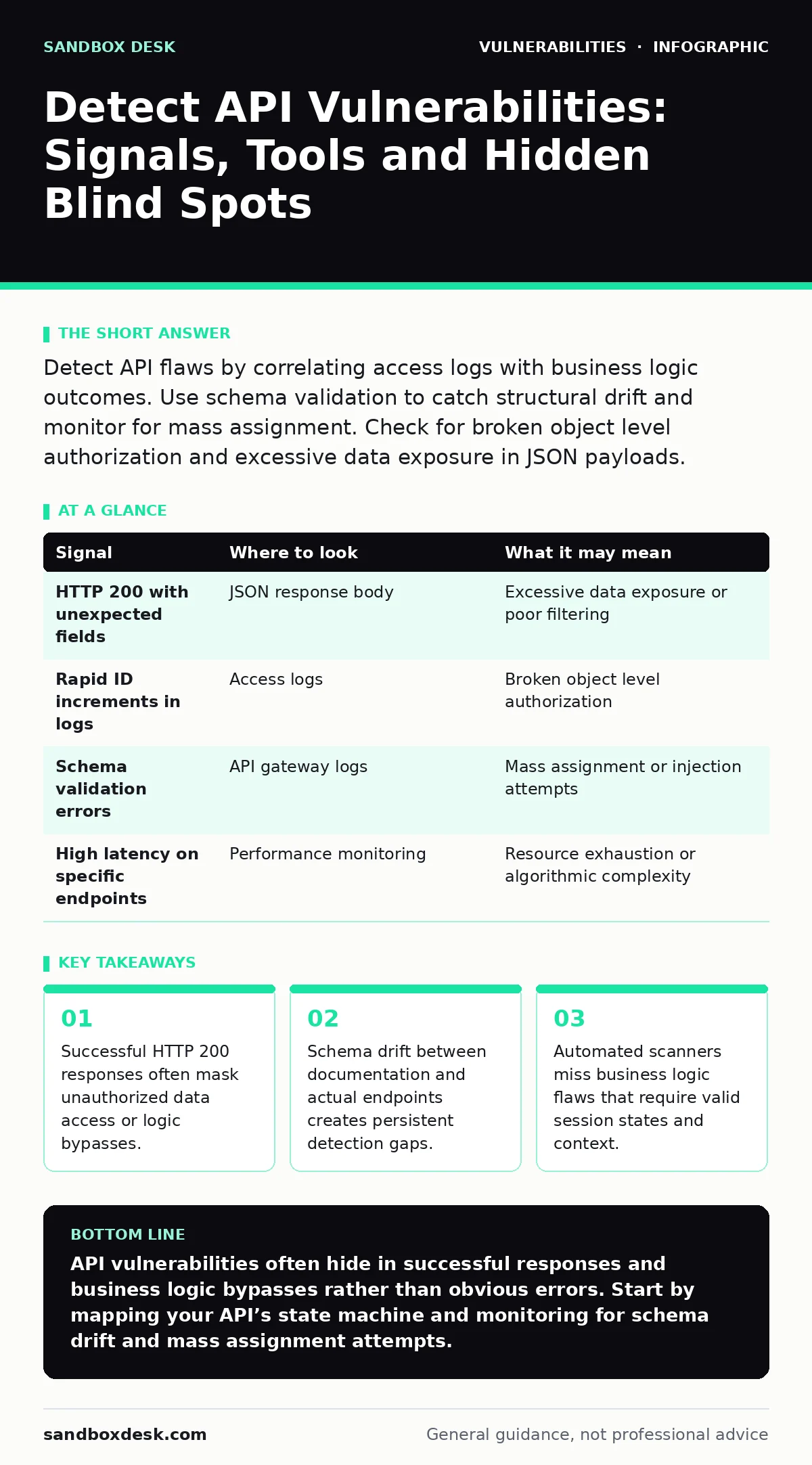
Detect API flaws by correlating access logs with business logic outcomes. Use schema validation to catch structural drift and monitor for mass assignment. Check for broken object level authorization and excessive data exposure in JSON payloads.
Tracing State Changes in Access Logs
APIs manage state through tokens and sessions rather than direct browser interactions. You must look beyond standard web server logs to application-level audit trails. Standard HTTP logs show request methods and status codes, but they rarely capture the specific resources accessed or the data modified.
Imagine an endpoint that allows a user to update their profile. The log entry shows a POST request with a 200 OK status. This looks normal. However, if the payload contained fields the user should not have permission to change, the log might not flag it unless the application explicitly records field-level changes.
You need to configure your logging to capture the X-API-Key or authentication token hash, not the raw secret. Correlate these tokens with the user identity at the time of the request. This correlation helps you identify if a single token is being used to access resources belonging to different users, a sign of broken object level authorization.
Analyzing Response Payloads for Leakage
The most common API vulnerability is excessive data exposure. You send a request for a user’s name, but the API returns the name, email, password hash, and internal database ID. This happens because the backend returns the entire database object instead of a filtered view.
You can detect this by comparing the API documentation against the actual response. If the documentation lists five fields but the JSON response contains fifteen, you have a vulnerability. This discrepancy often indicates that the API layer is not filtering data before it leaves the server.
Automated tools can scan for known sensitive patterns like credit card numbers or social security numbers in responses. However, these tools miss context-specific leaks. For example, an internal employee ID might not look sensitive to a scanner, but it could allow an attacker to enumerate valid accounts. You must manually review response structures for fields that do not serve the immediate client need.
| Signal | Where to look | What it may mean |
|---|---|---|
| HTTP 200 with unexpected fields | JSON response body | Excessive data exposure or poor filtering |
| Rapid ID increments in logs | Access logs | Broken object level authorization |
| Schema validation errors | API gateway logs | Mass assignment or injection attempts |
| High latency on specific endpoints | Performance monitoring | Resource exhaustion or algorithmic complexity |
Detecting Logic Flaws Through Behavior
APIs are not just data pipes; they implement business rules. A common flaw is bypassing these rules by manipulating the request sequence or parameters. For example, a checkout API might allow a user to set the price of an item to zero if they modify the JSON payload.
You detect this by testing the API with valid credentials but invalid business logic. Change the quantity to a negative number or the currency to an unsupported code. If the API processes the request without error, it lacks proper server-side validation.
This type of testing requires a map of the API’s state machine. You need to know what actions are allowed in what order. If the API allows a user to cancel an order after it has been shipped, you have a business logic vulnerability. These flaws are invisible to static code analysis because the code itself is syntactically correct.
Leveraging Schema Validation
Every API should have a defined schema that describes the expected structure of requests and responses. This schema acts as a contract between the client and the server. When the actual data deviates from this schema, it often indicates a vulnerability or a misconfiguration.
You can use schema validation tools to check incoming requests against the defined schema. If a request contains extra fields that are not in the schema, the API should reject it. If it accepts them, you have a mass assignment vulnerability. This allows attackers to update fields they should not touch, such as setting their own account status to "admin".
Schema drift is a common issue. Developers update the backend code but forget to update the schema definition. This creates a gap where the API accepts data it should not. Regularly compare your schema definitions with the actual API behavior to catch this drift.
Monitoring for Mass Assignment
Mass assignment occurs when an API accepts data that it should not process. This often happens with frameworks that automatically bind request parameters to model objects. If the binding is not restricted, an attacker can inject additional parameters.
For example, a user registration endpoint might accept "username" and "email". If the backend model also has an "is_admin" field, an attacker can include "is_admin": true in the request. If the API does not explicitly whitelist allowed fields, it will update the user’s role.
You detect this by reviewing the framework configuration. Ensure that data binding is opt-in rather than opt-out. Log all requests that contain fields not defined in the schema. These logs are your primary source for identifying mass assignment attempts.
Common Blind Spots in Detection
Most detection efforts focus on authentication and input validation. They miss the subtle ways APIs leak information or bypass logic. One major blind spot is the assumption that a valid token grants only the expected permissions.
Another blind spot is the lack of monitoring for successful requests. Security teams often filter for error codes like 401 or 500. They ignore 200 OK responses that contain unauthorized data. You must monitor for anomalies in successful transactions, such as unusual data volumes or access to high-value resources.
Related resources like the National Vulnerability Database can help you identify known library vulnerabilities, but they do not cover custom logic flaws. Similarly, while a secure software development lifecycle helps prevent issues, it does not detect them in production. You need runtime protection and continuous monitoring.
Integrating Findings into Workflow
Detection is useless without action. When you find a vulnerability, you must assess its impact. Use a CVSS score to prioritize remediation, but adjust for your specific business context. A low-score vulnerability in a public-facing API might be more critical than a high-score issue in an internal tool.
Integrate your findings into your incident response process. Define clear steps for containing the issue, such as disabling the affected endpoint or rotating API keys. Communicate with the development team to fix the root cause, not just the symptom.
Review your access controls to ensure they follow least privilege access principles. Ensure that API keys and tokens have the minimum permissions required. Regularly audit these permissions to prevent drift.
Key takeaways
- Successful HTTP 200 responses often mask unauthorized data access or logic bypasses.
- Schema drift between documentation and actual endpoints creates persistent detection gaps.
- Automated scanners miss business logic flaws that require valid session states and context.
API vulnerabilities often hide in successful responses and business logic bypasses rather than obvious errors. Start by mapping your API’s state machine and monitoring for schema drift and mass assignment attempts.
Frequently asked questions
How do I detect broken object level authorization?
Monitor access logs for patterns where a single user token accesses resources belonging to multiple different user IDs.
What is the difference between schema validation and input validation?
Schema validation checks the structure and type of data, while input validation checks the content and business rules of the data.
How this guide was produced: written by the Sandbox Desk editorial team with AI assistance, checked against the public references listed below, and reviewed when the facts change. See our editorial policy or report an error.