Explainable AI: How to Audit Black Box Decisions
Most models hide their reasoning, but you can reconstruct the decision path by isolating input variables and tracking output shifts over time.

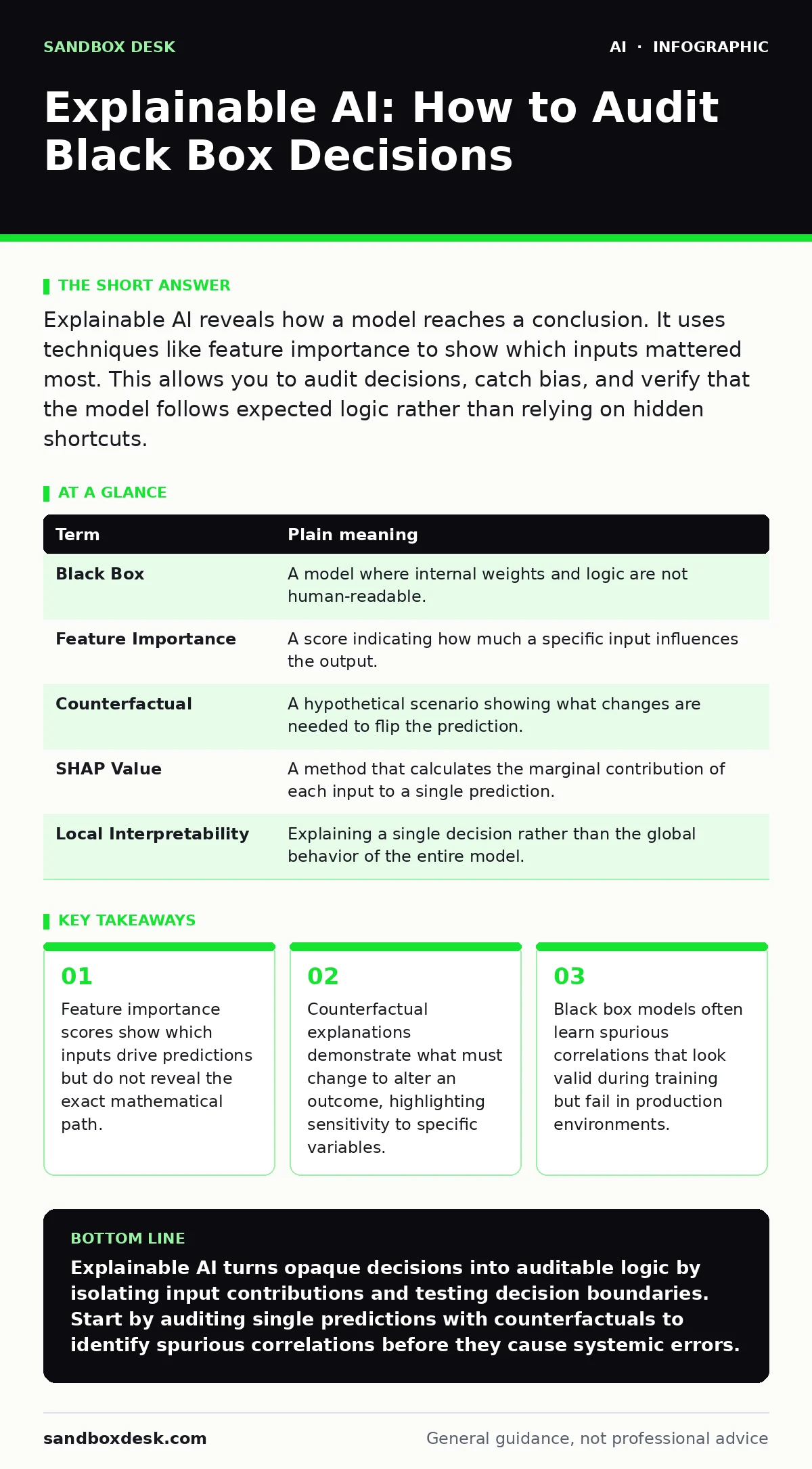
Explainable AI reveals how a model reaches a conclusion. It uses techniques like feature importance to show which inputs mattered most. This allows you to audit decisions, catch bias, and verify that the model follows expected logic rather than relying on hidden shortcuts.
The Kitchen Analogy
Imagine a master chef who creates a perfect dish. You taste it and know it is good, but you do not know the recipe. This is a black box model. It produces an output, but the internal logic remains hidden. Explainable AI is the process of reverse-engineering that dish. You are not asking for the secret sauce. You are asking which ingredients changed the flavor the most.
If you remove the salt, does the dish become bland? If you swap beef for chicken, does the texture change? By systematically removing or swapping inputs, you map the model’s dependencies. This approach works for any predictive system, regardless of its underlying architecture. It turns an opaque decision into a series of observable cause-and-effect relationships.
Defining the Mechanism
To discuss these methods precisely, you need a shared vocabulary. Many terms in this field are used loosely. The table below clarifies the distinct mechanisms available to you.
| Term | Plain meaning |
|---|---|
| Black Box | A model where internal weights and logic are not human-readable. |
| Feature Importance | A score indicating how much a specific input influences the output. |
| Counterfactual | A hypothetical scenario showing what changes are needed to flip the prediction. |
| SHAP Value | A method that calculates the marginal contribution of each input to a single prediction. |
| Local Interpretability | Explaining a single decision rather than the global behavior of the entire model. |
Feature importance gives you a global view. It tells you which variables generally matter most across all data. SHAP values (SHapley Additive exPlanations) provide a local view. They break down a single prediction into contributions from each feature. You need both to understand the full picture. One shows the forest; the other shows the tree.
The Correlation Trap
The most common point of confusion is equating importance with causation. A model might rely heavily on a variable that is statistically correlated with the outcome but has no causal link. This is a spurious correlation.
Suppose a model predicts loan default based on zip code. The feature importance for zip code might be high. This does not mean location causes default. It likely means location proxies for income or credit history, which are restricted or excluded variables. If you rely only on feature importance, you might miss this proxying behavior. You must check for training data leakage, where the model accidentally uses information it should not have.
When you audit these dependencies, you might find the model is using a shortcut. It is not learning the skill you intended. It is learning a pattern that exists only in your specific dataset. This is why AI model monitoring is necessary after deployment. The model’s reasoning can drift as real-world data changes.
Counterfactual Explanations
Feature importance tells you what mattered. Counterfactuals tell you what needs to change. This is critical for actionable feedback. If a model rejects a user, a counterfactual explanation shows the minimum changes required for approval.
Imagine the model rejected a loan application. It reveals how sensitive the model is to specific inputs. If a tiny change in one variable flips the decision, the model may be unstable.
This method also helps identify bias. If the counterfactual requires an unrealistic change, such as "change gender to male," you have found a discriminatory pattern. You cannot fix what you cannot see. Counterfactuals make the invisible logic visible. They force you to confront the practical implications of the model’s thresholds.
The Cost of Transparency
Explainability is not free. Adding explanation layers increases computational load. SHAP values, for instance, require running the model multiple times for each prediction. This latency can be unacceptable in real-time systems. You must balance the need for insight with performance constraints.
Furthermore, some explanation methods are approximations. They do not show the true internal state of the model. They show a surrogate interpretation. This surrogate might differ slightly from the actual reasoning. You are looking at a map, not the territory. Always validate explanations against known ground truth where possible.
For high-stakes decisions, consider AI risk management frameworks. These frameworks require you to document how you validate model behavior. They do not prescribe a specific tool. They demand a process for verifying that the model behaves as expected under edge cases.
See also: How to Spot AI Hallucinations: Detect Fabricated Facts in Outputs · Malware Targeting AI Infrastructure: Threats and Defense
Try This Now
- Select a single prediction from your model that feels surprising or incorrect. Do not look at the aggregate metrics. Focus on one instance.
- Generate a counterfactual explanation for that instance. Identify the minimum change in inputs that would flip the output to the expected class.
- Check if the required change is realistic and fair. If the model requires an impossible change, flag the prediction for manual review and investigate the feature engineering pipeline.
Integration with Security
Explainability is also a security tool. Adversaries can craft inputs to fool models. By understanding which features drive decisions, you can detect adversarial attacks. If an input looks normal but triggers an extreme shift in feature importance, it may be an attack.
This relates to securing AI agents that make autonomous decisions. If an agent cannot explain its reasoning, you cannot trust its actions in a security context. You must define clear boundaries for agent behavior. Insecure AI plugins and agents often lack these boundaries, allowing them to act on misleading inputs.
You should also review AI usage policies at work to ensure that employees understand the limits of model explanations. Explanations are aids, not replacements for human judgment. They reduce uncertainty but do not eliminate it.
Key takeaways
- Feature importance scores show which inputs drive predictions but do not reveal the exact mathematical path.
- Counterfactual explanations demonstrate what must change to alter an outcome, highlighting sensitivity to specific variables.
- Black box models often learn spurious correlations that look valid during training but fail in production environments.
Explainable AI turns opaque decisions into auditable logic by isolating input contributions and testing decision boundaries. Start by auditing single predictions with counterfactuals to identify spurious correlations before they cause systemic errors.
Frequently asked questions
Does explainable AI make a model less accurate?
No, explainability is an analysis layer, not a model modification. It does not change the model’s weights or predictions. It only adds computational overhead for generating the explanations.
Can I use explainability to prove my model is fair?
Explainability can reveal bias by showing which features drive decisions. It cannot prove fairness on its own. You must combine explanation metrics with formal fairness audits and diverse testing data.
Is explainability required by law?
Regulations like the EU AI Act require transparency for high-risk AI systems. The specific level of detail varies by jurisdiction and risk category. You must consult local legal counsel for precise requirements.
How do I handle real-time latency with explanations?
Compute explanations asynchronously for non-critical paths. For real-time decisions, use lightweight proxies or pre-computed explanations for common scenarios. Prioritize explanation speed based on the criticality of the decision.
How this guide was produced: written by the Sandbox Desk editorial team with AI assistance, checked against the public references listed below, and reviewed when the facts change. See our editorial policy or report an error.