Threat Intelligence vs Threat Hunting: The Structural Difference
Intelligence provides the context for known threats while hunting relies on assumption-driven searches to find hidden activity that data alone cannot reveal.

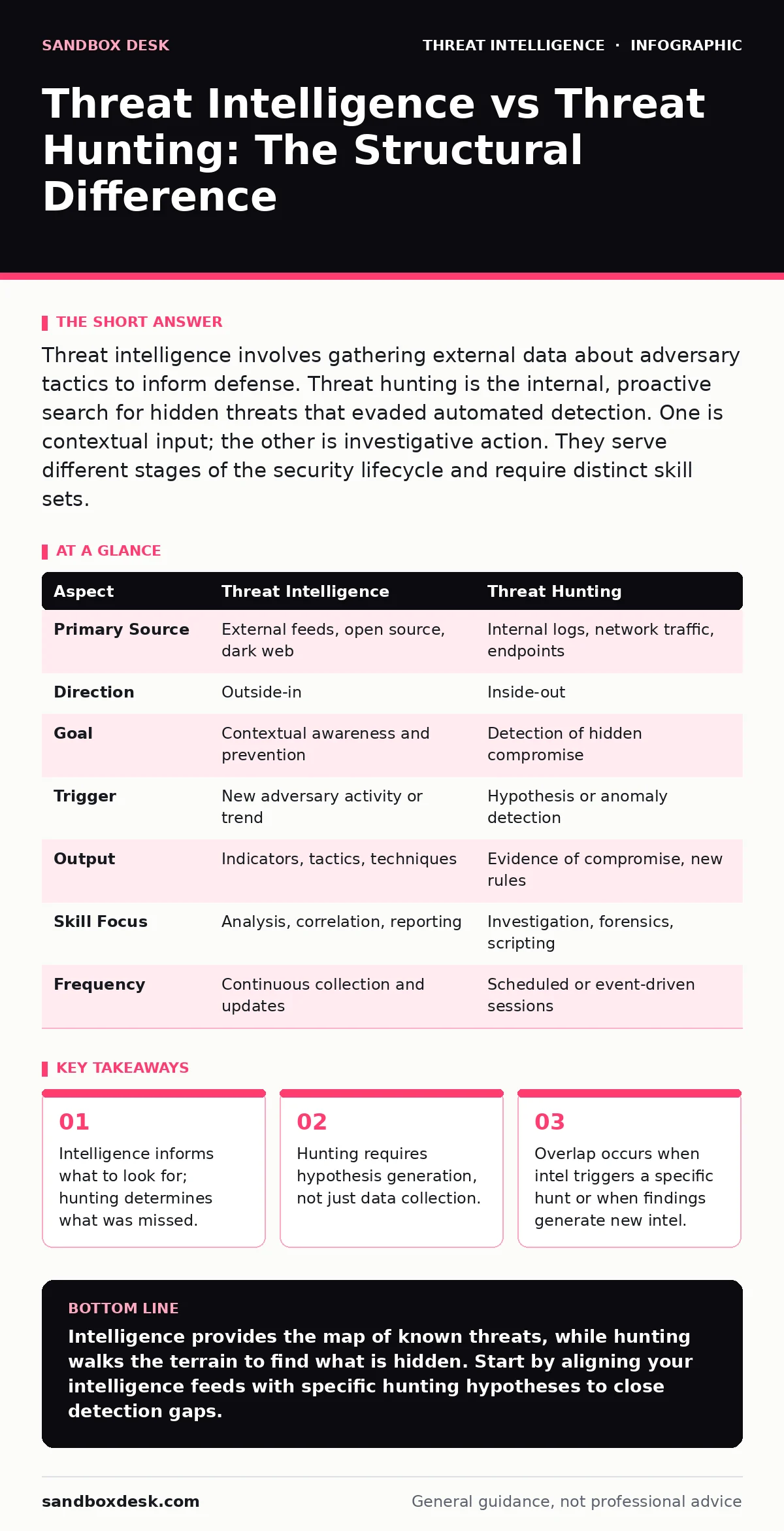
Threat intelligence involves gathering external data about adversary tactics to inform defense. Threat hunting is the internal, proactive search for hidden threats that evaded automated detection. One is contextual input; the other is investigative action. They serve different stages of the security lifecycle and require distinct skill sets.
The Core Distinction Between Context and Action
Threat intelligence and threat hunting operate at different layers of security operations, though they are frequently conflated in casual discussion. Intelligence is the curated information about adversaries, their motivations, and their methods. It answers the question of who might attack and how. Hunting is the manual investigation of internal data to find evidence of compromise. It answers the question of who is already inside.
You cannot hunt effectively without context, and intelligence is useless if you never act on it. The difference lies in directionality. Intelligence flows from the outside in, providing signals. Hunting flows from the inside out, searching for anomalies. One supplies the map; the other walks the terrain.
Defining Threat Intelligence
Threat intelligence is structured data about a threat or threat actor. It is not raw data. Raw data is a log entry or a packet capture. Intelligence is that data analyzed, contextualized, and formatted for decision-making. It tells you that a specific group uses a particular tool or technique.
This process reduces noise. You filter alerts based on known indicators of compromise. You prioritize vulnerabilities based on which groups are actively exploiting them. The output is often seen in threat intelligence reports, which summarize trends and tactics. This allows defenders to harden systems before an attack occurs.
Defining Threat Hunting
Threat hunting is the proactive search for security threats that bypass existing detection capabilities. It assumes a breach has occurred or that blind spots exist. Hunters start with a hypothesis. They look for patterns that suggest malicious activity.
This is not automated monitoring. It is human-led investigation. You examine network traffic, endpoint logs, and user behavior. You look for deviations from the norm. The goal is to reduce the time to detect and respond. Hunting turns passive data into active evidence. It finds the needle in the haystack that scanners missed.
Comparative Analysis of Methods
The following table outlines the structural differences between these two disciplines.
| Aspect | Threat Intelligence | Threat Hunting |
|---|---|---|
| Primary Source | External feeds, open source, dark web | Internal logs, network traffic, endpoints |
| Direction | Outside-in | Inside-out |
| Goal | Contextual awareness and prevention | Detection of hidden compromise |
| Trigger | New adversary activity or trend | Hypothesis or anomaly detection |
| Output | Indicators, tactics, techniques | Evidence of compromise, new rules |
| Skill Focus | Analysis, correlation, reporting | Investigation, forensics, scripting |
| Frequency | Continuous collection and updates | Scheduled or event-driven sessions |
When to Prioritize Intelligence
Choose threat intelligence when you need to understand the broader environment. It helps you answer strategic questions. Which threats are most relevant to your industry? What new techniques are emerging?
Use intelligence to tune your detection rules. If a new MITRE ATT&CK Navigator profile shows a rise in specific tactics, you can adjust your alerts. It supports blue team operations by providing a baseline of normal versus abnormal. Intelligence tells you what to expect. It prevents you from chasing ghosts.
See also: Pass-the-Ticket Attacks: Risks and Protection for Small Businesses
When to Prioritize Hunting
Choose threat hunting when you suspect a blind spot. Automated tools have thresholds. They miss low-and-slow attacks. They miss novel techniques. Hunting fills these gaps.
Use hunting when intelligence suggests a specific threat is active. If a report mentions a new DCSync attacks variant, you hunt for the specific network signatures. You look for the abuse of privileged accounts. You examine remote desktop abuse patterns. Hunting validates whether the theoretical threat is present in your environment. It turns suspicion into certainty.
Where the Two Disciplines Overlap
The boundary between intelligence and hunting is porous. They feed into each other. A hunter finds a new malware strain. This finding becomes intelligence. An intelligence analyst sees a new phishing campaign. This triggers a hunt for compromised credentials.
This loop is critical. Without hunting, intelligence remains theoretical. Without intelligence, hunting is aimless. You might spend weeks searching for a threat that does not target your sector. Context directs effort. Effort generates new context.
Practical Integration Strategies
Integrate these practices by aligning your tools and processes. Use intelligence platforms to ingest feeds. Use security information and event management systems to store logs. Ensure hunters have access to both.
A hunter should start with a hypothesis derived from intelligence. An analyst should use hunting results to refine intelligence. This creates a feedback loop. It reduces alert fatigue. It improves detection accuracy.
The Hidden Cost of Separation
Keeping these functions separate creates silos. Intelligence teams may produce reports that hunters cannot use. Hunters may find threats that analysts do not understand. This fragmentation wastes resources.
Collaboration is necessary. Hunters need context. Analysts need ground truth. Ensure they share workflows. Ensure they share data. This integration is not optional. It is the difference between reactive and proactive security.
Key takeaways
- Intelligence informs what to look for; hunting determines what was missed.
- Hunting requires hypothesis generation, not just data collection.
- Overlap occurs when intel triggers a specific hunt or when findings generate new intel.
Intelligence provides the map of known threats, while hunting walks the terrain to find what is hidden. Start by aligning your intelligence feeds with specific hunting hypotheses to close detection gaps.
Frequently asked questions
Can a single person perform both tasks?
Yes, but it requires distinct mindsets. Analysis requires broad context. Hunting requires deep technical investigation. Context switching can reduce effectiveness.
Do I need commercial tools to hunt?
No. Open standards and native logging capabilities are sufficient. The value lies in the hypothesis and the investigator's skill, not the software.
How often should hunting occur?
It should be continuous. Dedicate specific time for hypothesis-driven searches. Integrate findings into regular **adversary emulation** exercises.
Is threat intelligence only for large organizations?
No. Small organizations benefit from curated, relevant feeds. Focus on high-impact threats. Ignore noise. Relevance matters more than volume.
How this guide was produced: written by the Sandbox Desk editorial team with AI assistance, checked against the public references listed below, and reviewed when the facts change. See our editorial policy or report an error.