DNS Tunneling Definition: How Data Exfiltrates Through Name Resolution
Attackers hide command channels inside standard domain name queries, bypassing firewalls that trust recursive resolvers and ignore payload inspection.

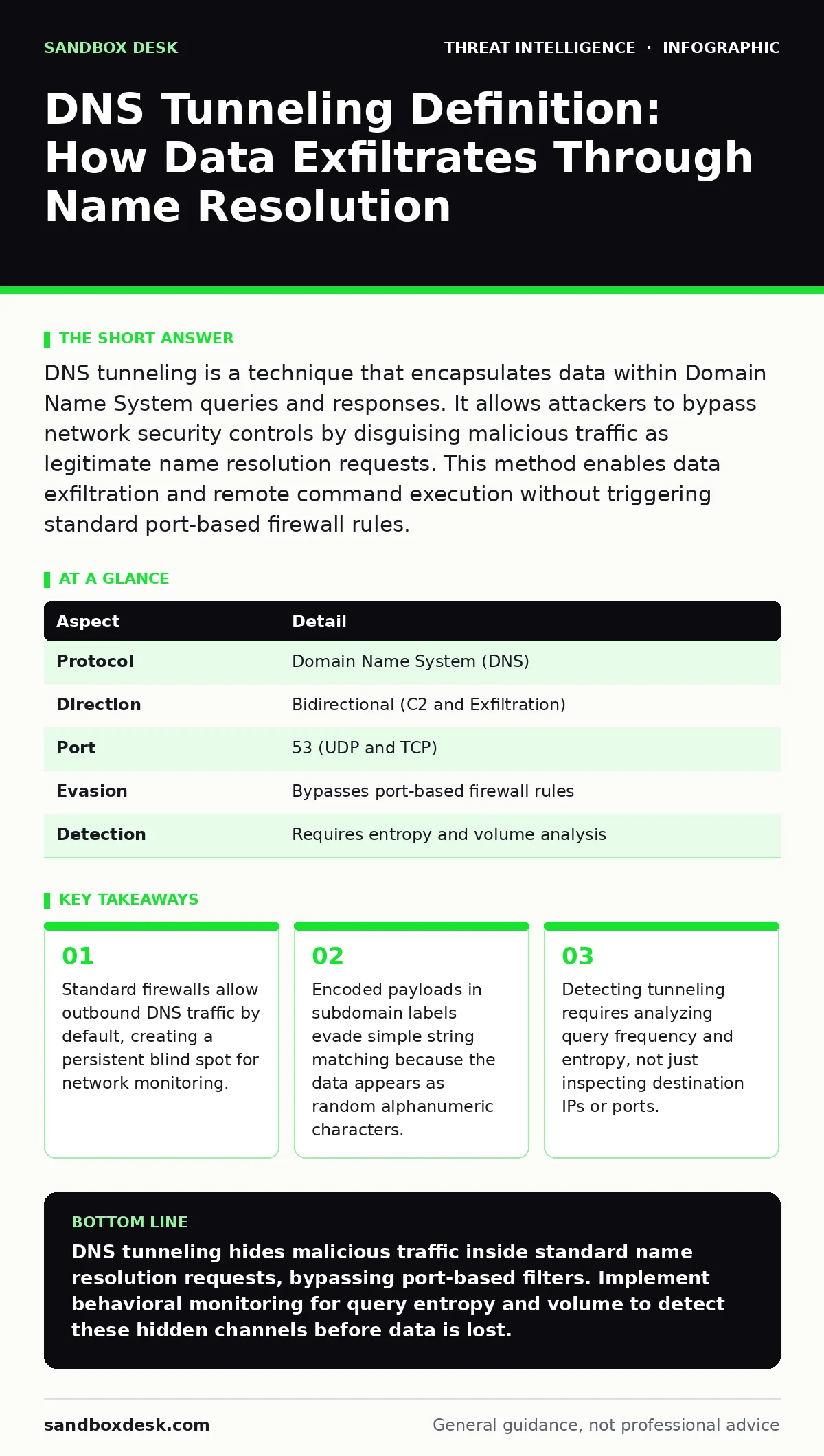
DNS tunneling is a technique that encapsulates data within Domain Name System queries and responses. It allows attackers to bypass network security controls by disguising malicious traffic as legitimate name resolution requests. This method enables data exfiltration and remote command execution without triggering standard port-based firewall rules.
The Postal Service Analogy
Imagine a secure facility that only allows outgoing mail through a single, heavily monitored gate. Guards check every envelope for contraband, but they trust the postal service itself. An employee decides to hide microfilm inside the return address field of hundreds of standard letters. The guards see valid addresses and let them pass. The postal carrier delivers the letters, and the recipient reads the hidden message. DNS tunneling operates on this exact principle. It uses the trusted infrastructure of the Domain Name System to smuggle data out of a restricted network.
| Aspect | Detail |
|---|---|
| Protocol | Domain Name System (DNS) |
| Direction | Bidirectional (C2 and Exfiltration) |
| Port | 53 (UDP and TCP) |
| Evasion | Bypasses port-based firewall rules |
| Detection | Requires entropy and volume analysis |
DNS Tunneling Definition
DNS tunneling is the practice of encapsulating data from other protocols within DNS queries and responses. The Domain Name System translates human-readable hostnames into IP addresses. Attackers abuse this translation process by encoding their data into the subdomain portion of a hostname. The DNS server returns the data in the response payload. To a casual observer, the traffic looks like normal website lookups. The mechanism relies on the fact that most networks permit outbound DNS traffic to ensure internet connectivity. Blocking port 53 breaks almost all modern applications.
How the Mechanism Works
The process begins with data encoding. The attacker takes the information they wish to send, such as a shell command or stolen file, and converts it into a format compatible with DNS labels. Base32 or Base64 encoding is common because these schemes use alphanumeric characters allowed in domain names. The encoded string becomes a subdomain of a domain the attacker controls. For example, a query might look like aGVsbG8.data.attacker.com. The victim machine sends this query to its configured recursive resolver. The resolver forwards it to the authoritative server. The authoritative server decodes the subdomain, processes the command, and returns the result in the answer section or via a TXT record. The victim receives the response and decodes it locally.
Who It Affects and Why It Persists
Any organization that allows recursive DNS resolution is vulnerable. This includes corporate networks, cloud environments, and home networks. The persistence of this threat stems from the fundamental design of DNS. It is a stateless, request-response protocol designed for speed, not security. Firewalls often whitelist port 53 entirely. Deep packet inspection tools may struggle to parse the high volume of small DNS packets. Attackers exploit this trust to maintain persistence. Even if they lose direct TCP connectivity, they can still communicate through DNS. This makes cleanup difficult because the channel is invisible to standard network monitoring tools.
What People Usually Get Wrong
Security teams often believe that blocking external DNS servers prevents tunneling. This is incorrect. Attackers can tunnel through internal recursive resolvers. The internal resolver forwards the query to the external authoritative server. The tunnel exists between the internal machine and the authoritative server, not necessarily the internal resolver. Another common misconception is that large data transfers are obvious. Tunneling can be slow and steady. It mimics the behavior of legitimate software updates or telemetry. Low-and-slow exfiltration avoids triggering volume-based alerts. You must analyze the structure of the queries, not just the amount of data.
See also: Pass-the-Ticket Attacks: Risks and Protection for Small Businesses
Detection Strategies for Developers
Detection requires shifting from signature-based matching to behavioral analysis. Standard signatures fail because the encoded payloads change with every query. You need to monitor for high entropy in subdomain labels. Legitimate subdomains usually follow predictable patterns, like www or mail. Tunneling subdomains look like random strings of letters and numbers. High query frequency to a single domain is another indicator. Normal users do not query the same obscure domain hundreds of times per minute. Implementing DNS logging at the resolver level is critical. You must capture the full query name, not just the root domain. Analyze these logs for statistical anomalies.
Mitigation and Control Measures
Mitigation focuses on restricting what DNS can do. Split-horizon DNS separates internal and external resolution. Internal queries are answered by internal servers. External queries are forwarded through a controlled proxy. This proxy can inspect and filter traffic. DNS Security Extensions (DNSSEC) do not prevent tunneling. They only verify the authenticity of the response.
They do not inspect the content of the query. Application-layer firewalls can block DNS queries that exceed standard label lengths. However, attackers can use shorter labels and more queries. The most effective control is to restrict outbound DNS to known, trusted resolvers. Monitor for queries to newly registered domains. These are often used for tunneling because they lack a reputation history.
Integration with Broader Security Operations
DNS tunneling often accompanies other advanced techniques. It provides the command and control channel for malware that uses Kerberoasting to harvest credentials. The stolen tickets are exfiltrated via DNS because they are large and sensitive. In blue team operations, monitoring DNS helps identify the initial compromise. The first sign is often a spike in queries to a suspicious domain.
Incident responders use these logs to trace the infection vector. Incident response runbooks should include steps for isolating hosts that generate high-entropy DNS queries. This prevents further data loss while investigators analyze the payload. Understanding threat intelligence reports helps you recognize domains associated with known tunneling frameworks. You can add these domains to your blocklist proactively.
The Hidden Cost of Complexity
Implementing strict DNS controls introduces operational friction. Developers may need to update configuration files to point to internal resolvers. Applications that hardcode public DNS servers will fail. You must audit your infrastructure for hardcoded endpoints. This audit takes time and resources. The trade-off is between security and convenience. Loose DNS policies are convenient but risky. Strict policies are secure but complex. You must find a balance that fits your operational capacity. Document your DNS architecture clearly. Ensure your team understands how split-horizon DNS works. This reduces the risk of misconfiguration during incidents.
Summary of Actions
Review your DNS logging capabilities immediately. Ensure you capture full query names. Analyze your logs for high-entropy subdomains. Check for unusual query volumes to single domains. Restrict outbound DNS to trusted resolvers. Implement DNSSEC to prevent spoofing, though it does not stop tunneling. Train your security team to recognize behavioral anomalies. Integrate DNS monitoring into your incident response runbooks. Treat DNS as a potential command channel, not just a lookup service. This mindset shift is the first step toward effective defense.
Key takeaways
- Standard firewalls allow outbound DNS traffic by default, creating a persistent blind spot for network monitoring.
- Encoded payloads in subdomain labels evade simple string matching because the data appears as random alphanumeric characters.
- Detecting tunneling requires analyzing query frequency and entropy, not just inspecting destination IPs or ports.
DNS tunneling hides malicious traffic inside standard name resolution requests, bypassing port-based filters. Implement behavioral monitoring for query entropy and volume to detect these hidden channels before data is lost.
Frequently asked questions
Can DNS tunneling bypass a next-generation firewall?
Yes, if the firewall only inspects ports and not the DNS payload content. Many firewalls allow port 53 traffic without deep inspection of the query strings.
Does DNSSEC prevent DNS tunneling?
No, DNSSEC verifies the authenticity of DNS responses but does not inspect the content of queries or responses for malicious payloads.
How do I distinguish tunneling from legitimate software telemetry?
Legitimate telemetry usually goes to well-known, established domains. Tunneling often uses newly registered domains with high-entropy, random-looking subdomain labels.
Is UDP or TCP DNS more common for tunneling?
UDP is common for small commands due to lower overhead. TCP is used for larger data transfers because UDP has a smaller packet size limit.
How this guide was produced: written by the Sandbox Desk editorial team with AI assistance, checked against the public references listed below, and reviewed when the facts change. See our editorial policy or report an error.