DoS vs DDoS: How to Choose the Right Attack Simulation
Single-source denial of service tests reveal infrastructure resilience, while distributed tests expose your ability to filter malicious traffic from legitimate users.

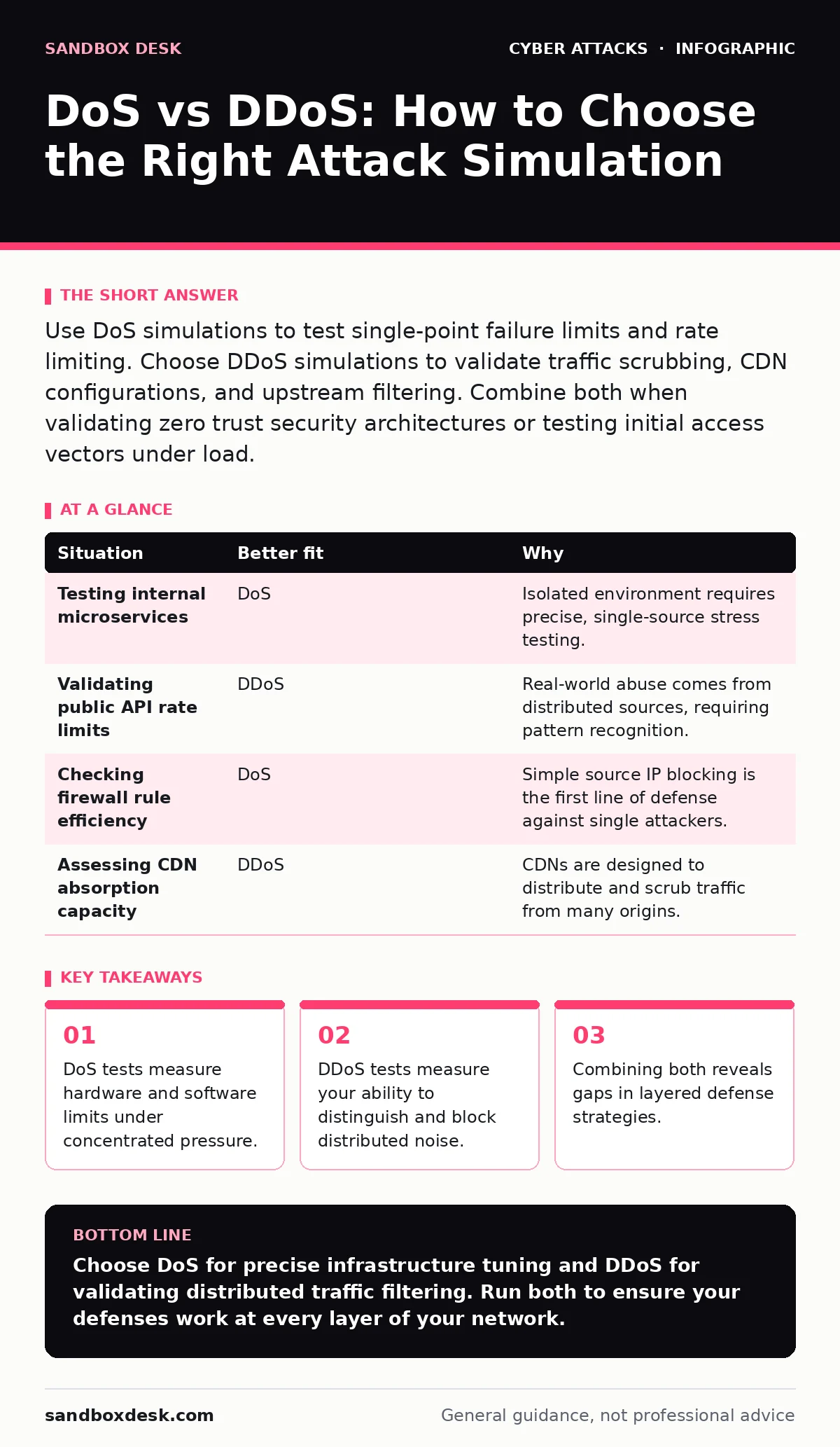
Use DoS simulations to test single-point failure limits and rate limiting. Choose DDoS simulations to validate traffic scrubbing, CDN configurations, and upstream filtering. Combine both when validating zero trust security architectures or testing initial access vectors under load.
Defining the Source of Pressure
The distinction between Denial of Service (DoS) and Distributed Denial of Service (DDoS) lies in the origin of the traffic. A DoS attack originates from a single source or a very small number of sources. This creates a predictable pattern that your network can analyze. You are testing whether a single point of failure can withstand sustained, concentrated pressure.
A DDoS attack uses many compromised devices to generate traffic. This mimics real-world scenarios where malicious traffic comes from thousands of locations. The challenge here is not just volume, but diversity. Your defenses must separate this noise from legitimate user activity without causing collateral damage.
Assessing Infrastructure Resilience
When you run a DoS simulation, you are testing the limits of your specific hardware or software stack. You send packets from one IP address until the service degrades or stops. This reveals how your server handles connection exhaustion or resource starvation. It is a linear test. If the system breaks, you know exactly where the bottleneck is.
This approach favors environments where you control the entire stack. It helps you tune firewall rules and connection timeouts. However, it does not test your ability to handle geographic dispersion. It assumes the attacker is standing right outside your door, not hiding behind a global network of bots.
Validating Traffic Filtering
DDoS simulations require a different mindset. You cannot simply block the source IP because there are too many of them. Instead, you test your traffic filtering mechanisms. This includes Content Delivery Networks (CDNs), anycast routing, and behavioral analysis tools. The goal is to ensure that legitimate users can still access your service while malicious traffic is absorbed or dropped.
This scenario favors organizations with complex public-facing applications. It tests the intelligence of your defense, not just its strength. You are checking if your systems can recognize patterns of abuse across multiple sources. If your filtering is too aggressive, you risk blocking real users. If it is too passive, the service goes down.
When Single Sources Suffice
DoS simulations are better when you need to validate specific protocol implementations. For instance, you might want to test how your application handles a flood of HTTP requests versus a flood of TCP syn packets. These are distinct mechanisms that stress different parts of your system. A single-source test allows you to isolate and measure these effects precisely.
It is also useful for internal services that do not face the public internet. If a service is only accessible within your data center, the threat model changes. You are less concerned with distributed botnets and more concerned with insider threats or misconfigured applications. In these cases, the complexity of a DDoS test adds noise without value.
| Situation | Better fit | Why |
|---|---|---|
| Testing internal microservices | DoS | Isolated environment requires precise, single-source stress testing. |
| Validating public API rate limits | DDoS | Real-world abuse comes from distributed sources, requiring pattern recognition. |
| Checking firewall rule efficiency | DoS | Simple source IP blocking is the first line of defense against single attackers. |
| Assessing CDN absorption capacity | DDoS | CDNs are designed to distribute and scrub traffic from many origins. |
Combining Both Approaches
Using both DoS and DDoS simulations provides a holistic view of your security posture. You might start with a DoS test to identify weak points in your application code. Then, you use a DDoS test to see if your network infrastructure can mitigate the attack before it reaches the application. This layered approach mirrors how real attackers often operate. They might start with a focused probe before escalating to a distributed assault.
This combination is particularly relevant for organizations implementing zero trust security. It tests whether your verification mechanisms hold up under stress. It also helps in understanding the interplay between different security tools. For instance, you might find that intrusion detection systems flag the DoS traffic but fail to recognize the DDoS pattern.
Aligning with Threat Models
Your choice should reflect the threats you actually face. If your application is a target for whaling attacks or callback phishing, the infrastructure load might not be your primary concern. However, if you offer critical infrastructure or high-value data, DDoS is a likely distraction tactic. It creates chaos while attackers look for initial access through other means.
Consider how web filtering and other perimeter controls interact with these tests. A robust filtering strategy should mitigate DDoS traffic without impacting user experience. By simulating both types of attacks, you can refine these controls. You ensure that your defenses are not just strong, but also intelligent and adaptive.
Key takeaways
- DoS tests measure hardware and software limits under concentrated pressure.
- DDoS tests measure your ability to distinguish and block distributed noise.
- Combining both reveals gaps in layered defense strategies.
Choose DoS for precise infrastructure tuning and DDoS for validating distributed traffic filtering. Run both to ensure your defenses work at every layer of your network.
Frequently asked questions
Can a single IP perform a DDoS attack?
No, a single IP performs a DoS attack. DDoS requires multiple distributed sources to overwhelm defenses that rely on source-based filtering.
Is DoS easier to mitigate than DDoS?
Yes, DoS is easier to mitigate because you can often block the single source IP. DDoS requires more complex filtering to distinguish malicious from legitimate traffic.
Do I need special tools for DDoS simulation?
Standard load testing tools can simulate DoS, but DDoS simulation often requires specialized platforms that can generate traffic from multiple geographic locations.
How does this relate to Bluetooth attacks?
It does not. Bluetooth attacks are physical proximity threats, while DoS and DDoS are network-layer disruptions. They require entirely different mitigation strategies.
How this guide was produced: written by the Sandbox Desk editorial team with AI assistance, checked against the public references listed below, and reviewed when the facts change. See our editorial policy or report an error.