Social Engineering vs Phishing: The Structural Difference
Phishing is a single vector within the broader discipline of social engineering, which manipulates human psychology to bypass technical controls and access sensitive systems.

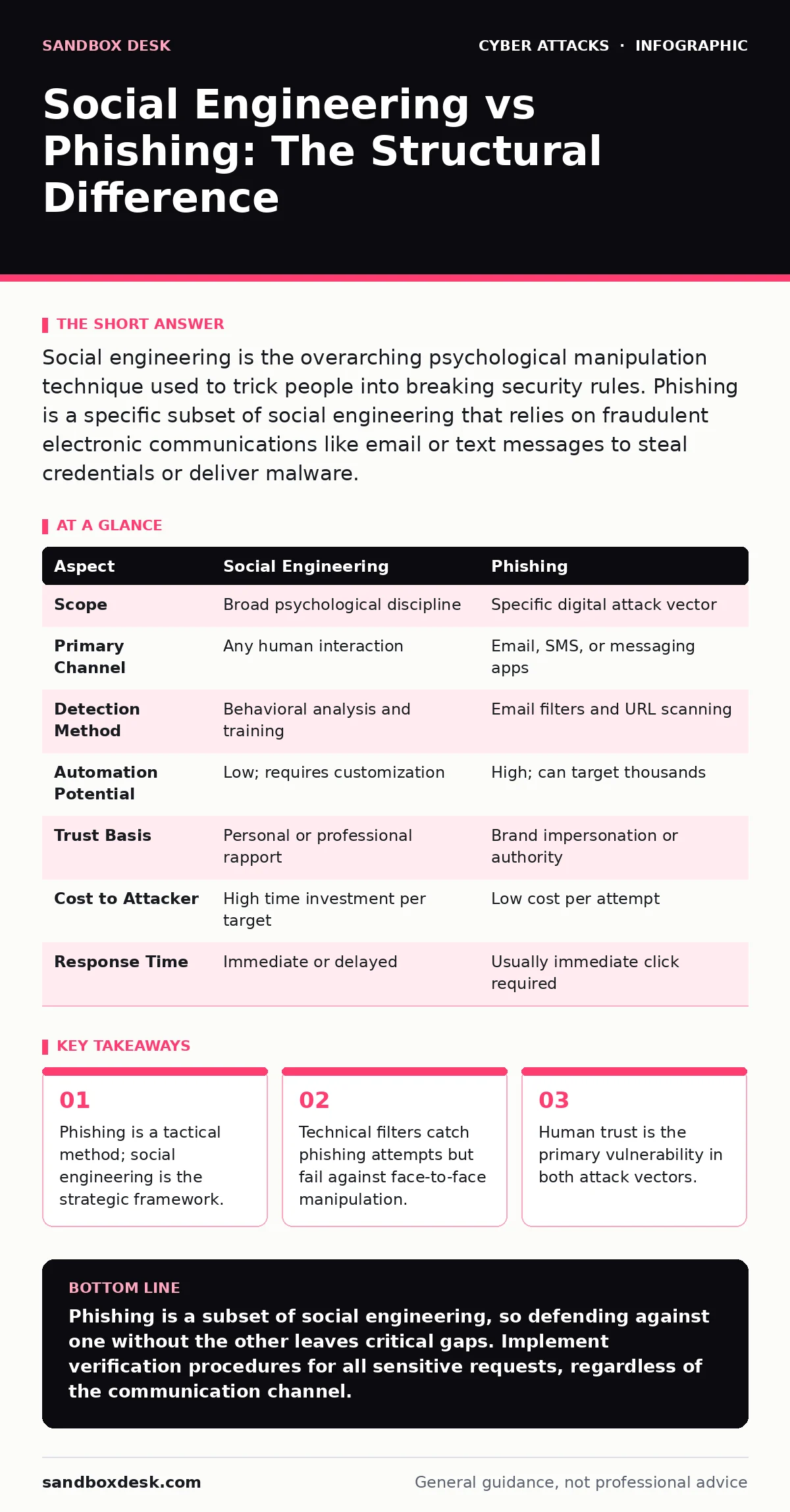
Social engineering is the overarching psychological manipulation technique used to trick people into breaking security rules. Phishing is a specific subset of social engineering that relies on fraudulent electronic communications like email or text messages to steal credentials or deliver malware.
Defining the Manipulation Mechanism
Social engineering exploits human psychology rather than software vulnerabilities. Attackers manipulate targets into performing actions or revealing information that compromises security. The attacker leverages urgency, authority, or curiosity to bypass logical decision-making processes. This approach targets the weakest link in any security chain: the person. Technical controls cannot fully prevent a person from willingly handing over access. The goal is to make the victim believe the action is normal, necessary, or urgent.
Phishing is a specific implementation of social engineering. It uses digital communication channels to deliver the manipulative message. The attacker sends a fraudulent message that appears to come from a trusted source. The message usually contains a malicious link or attachment. The victim must take an action, such as clicking a link or entering credentials, for the attack to succeed. Phishing relies on the victim not noticing discrepancies in the sender’s address or the URL structure.
Point-by-Point Comparison
| Aspect | Social Engineering | Phishing |
|---|---|---|
| Scope | Broad psychological discipline | Specific digital attack vector |
| Primary Channel | Any human interaction | Email, SMS, or messaging apps |
| Detection Method | Behavioral analysis and training | Email filters and URL scanning |
| Automation Potential | Low; requires customization | High; can target thousands |
| Trust Basis | Personal or professional rapport | Brand impersonation or authority |
| Cost to Attacker | High time investment per target | Low cost per attempt |
| Response Time | Immediate or delayed | Usually immediate click required |
When to Focus on Social Engineering Defense
Defense against broad social engineering requires cultural shifts. You must address the underlying psychological triggers that attackers exploit.
- Choose the first when you need to protect against physical security breaches.
- Choose the first when attackers are likely to impersonate IT staff in person.
- Choose the first when you suspect insider threats motivated by coercion.
- Choose the first when building a resilient security culture that questions authority.
- Choose the first when preparing for USB drop attacks that rely on curiosity.
These scenarios require training that goes beyond recognizing malicious emails. Employees must understand why attackers use urgency or fear. They must feel safe reporting suspicious behavior without penalty. This cultural foundation is difficult to build but necessary for long-term resilience.
When to Focus on Phishing Defense
Phishing defense relies heavily on technical controls and specific recognition skills. You can automate many layers of protection against this vector.
- Choose the second when you need to filter bulk malicious emails.
- Choose the second when protecting against credential theft via fake login pages.
- Choose the second when deploying intrusion detection systems to spot command-and-control traffic.
- Choose the second when implementing email authentication protocols like SPF and DKIM.
- Choose the second when addressing callback phishing where attackers request verification calls.
Technical controls provide a baseline of protection. Email filters can block known malicious domains. Authentication protocols prevent attackers from spoofing your domain. However, these tools are not perfect. New attacks often bypass initial filters. Users must still verify the legitimacy of unexpected requests for sensitive data.
Where the Concepts Overlap
The boundary between these concepts is porous. Phishing is always social engineering, but social engineering is not always phishing. The overlap occurs in the psychological manipulation phase. Both rely on the victim’s willingness to act against their own security interests.
Imagine an attacker calls an employee pretending to be from the help desk. This is social engineering via voice. If that same attacker sends an email claiming to be from the help desk with a link to a fake password reset page, it is phishing. The psychological trigger—trust in the help desk—is identical. The channel differs. Defending against one does not automatically defend against the other. You must address the psychological trigger regardless of the channel.
The Hidden Cost of Automation
Many organizations invest heavily in automated phishing protection. This creates a false sense of security. Employees become complacent, assuming the system will catch everything. This complacency makes them more vulnerable to non-digital social engineering.
Automated filters cannot detect a person walking into the building wearing a fake ID. They cannot detect an attacker calling from a spoofed number. Over-reliance on technology erodes human vigilance. You must balance technical controls with continuous human training. Zero trust security principles help by assuming breach, but they do not stop a person from giving away their password.
Advanced Manipulation Techniques
Attackers often combine techniques to increase success rates. Whaling attacks target high-level executives using highly personalized social engineering. These campaigns may start with research on social media, then move to phishing emails, and finally to phone calls. The attacker builds a narrative over weeks or months.
Defending against these advanced campaigns requires a holistic approach. You cannot just block emails. You must monitor for unusual behavior, such as an executive suddenly transferring funds. Tabletop exercises help teams practice responding to these complex scenarios. They reveal gaps in communication and decision-making processes.
Integrating Defense Strategies
Effective defense requires integrating technical and human elements. You must assume that some phishing attempts will reach the user. You must also assume that some social engineering attempts will succeed.
Implement strict verification procedures for sensitive actions. Require multi-factor authentication for all accounts. Train employees to recognize psychological pressure tactics. Encourage a culture where questioning requests is normalized. Regular testing helps identify vulnerabilities before attackers do.
Key takeaways
- Phishing is a tactical method; social engineering is the strategic framework.
- Technical filters catch phishing attempts but fail against face-to-face manipulation.
- Human trust is the primary vulnerability in both attack vectors.
Phishing is a subset of social engineering, so defending against one without the other leaves critical gaps. Implement verification procedures for all sensitive requests, regardless of the communication channel.
Frequently asked questions
Is phone scamming considered phishing?
Phone scamming is a form of social engineering called vishing. It uses voice calls instead of text or email to manipulate victims into revealing information or performing actions.
Can AI stop all social engineering attacks?
AI can improve detection of phishing emails and unusual behavior patterns. It cannot fully stop social engineering because it relies on human psychology and context that machines struggle to interpret accurately.
How do I report a suspected attack?
Report the incident to your security team immediately. Preserve any evidence, such as emails or call logs. Do not delete the communication, as it may be needed for investigation.
What is the difference between spear phishing and whaling?
Spear phishing targets specific individuals or groups with tailored messages. Whaling is a type of spear phishing that specifically targets high-level executives or senior leaders within an organization.
How this guide was produced: written by the Sandbox Desk editorial team with AI assistance, checked against the public references listed below, and reviewed when the facts change. See our editorial policy or report an error.