Dictionary Attacks Explained: How Credential Stuffing Works
Dictionary attacks exploit human predictability by testing common words against hashed credentials, bypassing complex defenses through sheer probability.

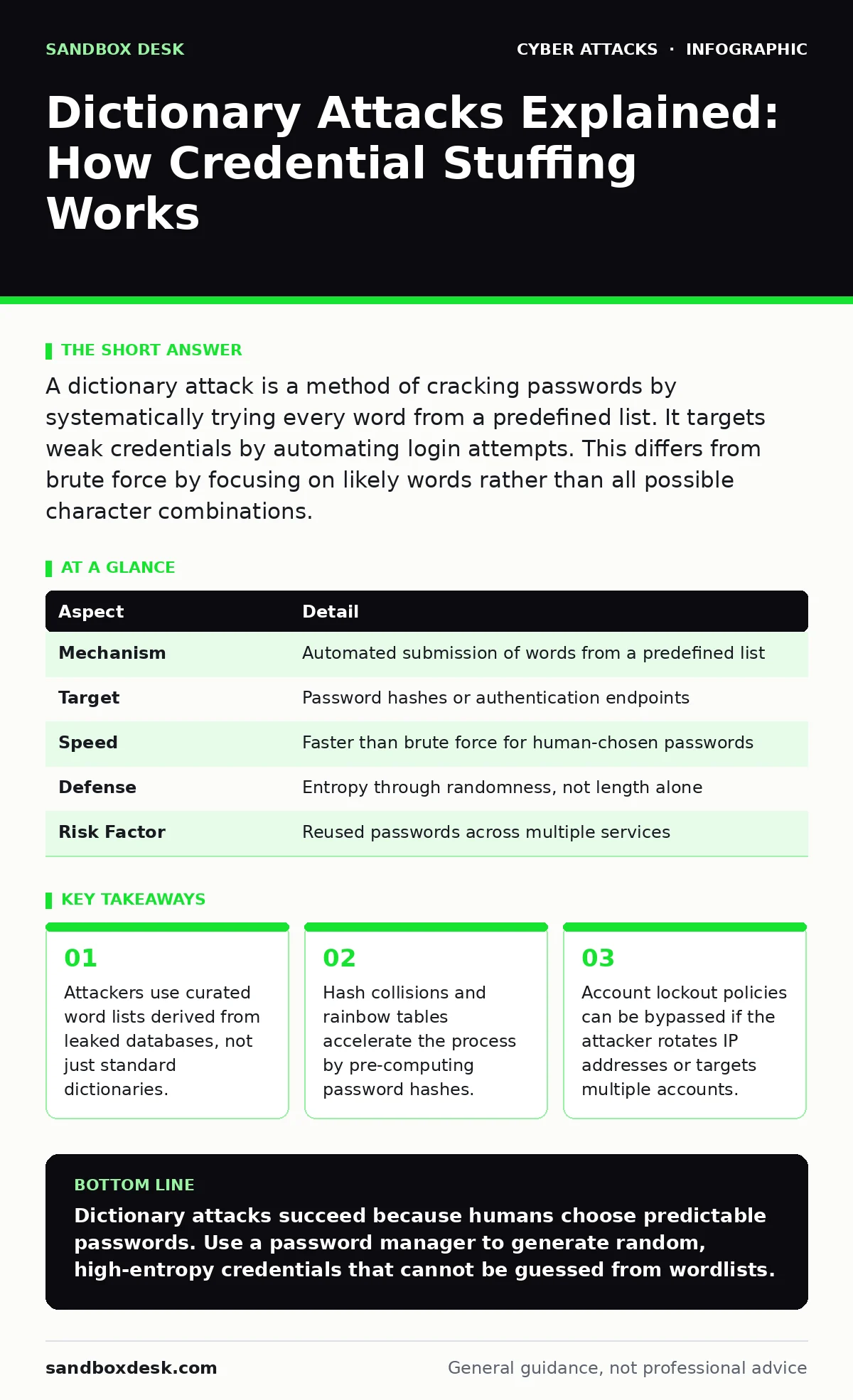
A dictionary attack is a method of cracking passwords by systematically trying every word from a predefined list. It targets weak credentials by automating login attempts. This differs from brute force by focusing on likely words rather than all possible character combinations.
The Logic of Predictable Language
Imagine a thief trying to open a safe. Instead of trying every combination of numbers, the thief tries dates, birthdays, and common sports scores. Dictionary attacks operate on this same principle of predictability. Human beings are poor at generating random strings. You choose words you can remember. Attackers know this. They build lists of likely choices and automate the guessing process.
| Aspect | Detail |
|---|---|
| Mechanism | Automated submission of words from a predefined list |
| Target | Password hashes or authentication endpoints |
| Speed | Faster than brute force for human-chosen passwords |
| Defense | Entropy through randomness, not length alone |
| Risk Factor | Reused passwords across multiple services |
How the Attack Unfolds
The attacker starts with a list. This list contains millions of words. It includes dictionary entries, common substitutions, and leaked credentials. The attacker sends these candidates to the target system. The system checks each candidate against the stored password hash. A hash is a fixed-length string generated from input data. If the hash of the guessed word matches the stored hash, the attacker has the password.
This process happens rapidly. Modern hardware can test billions of hashes per second. The attacker does not need to know your specific password. They only need a word you might have used. The attack succeeds when the intersection of your choice and their list occurs.
Beyond the Standard Dictionary
The term "dictionary" is misleading. Attackers do not use a physical book. They use dynamic wordlists. These lists are generated from previous breaches. They contain actual passwords used by real people. This makes them far more effective than generic word lists.
Attackers also apply rule-based mutations. They take a base word and transform it. They swap letters for similar numbers. They add common suffixes. They invert the case. This expands a small list into millions of variants. The attack covers the space of likely human behavior. It ignores the space of truly random strings.
Who Bears the Cost
Any system that relies on username and password authentication is vulnerable. This includes web applications, remote access protocols, and internal network services. The impact depends on the value of the account.
If the account is personal, the result is account takeover. The attacker accesses your data. If the account is corporate, the result is lateral movement. The attacker uses your credentials to move deeper into the network. They bypass perimeter defenses because they have valid identity proof.
This threat vector affects users at all levels. It is not limited to high-profile targets. Low-privilege accounts provide entry points. Once inside, the attacker escalates privileges. The initial breach is often invisible to monitoring tools because the login appears legitimate.
Common Variations and Techniques
Attackers adapt their methods to evade detection. One common variation is the hybrid attack. This combines dictionary words with brute force characters. It tests "password" followed by every possible 2-digit number.
Another variation is the pass-the-hash attack. The attacker does not crack the password. They steal the hash directly from memory or disk. They use the hash to authenticate to other systems. This bypasses the need to know the plaintext password. It works because many protocols accept the hash as proof of identity.
What People Usually Get Wrong
Many users believe complexity rules are enough. They add a special character and a number. This creates a predictable pattern. Attackers expect this. Their wordlists include these common transformations. Length without randomness is a false sense of security.
Another misconception is that salted hashes prevent these attacks. Salting adds random data to the password before hashing. It prevents the use of pre-computed rainbow tables. It does not stop an attacker from testing words in real-time. The attacker simply hashes the candidate word with the known salt and compares it.
Users also assume that unique passwords are safe. If you use a unique password that is still a common word, you are vulnerable. Uniqueness protects against credential stuffing. It does not protect against dictionary attacks on that specific service.
Reducing the Attack Surface
The most effective defense is high entropy. Entropy measures the unpredictability of the password. A long, random string of characters has high entropy. It cannot be guessed from a wordlist.
Use a password manager. It generates and stores complex passwords. You do not need to remember them. This removes the human element of predictability.
Implement multi-factor authentication. This adds a second layer of verification. Even if the attacker guesses the password, they cannot log in without the second factor. This neutralizes the credential compromise.
Integrating Detection and Response
Monitoring for dictionary attacks requires specific signatures. Look for repeated failed login attempts from the same source. Look for attempts against many different usernames. This indicates a sweep.
Intrusion detection systems can flag these patterns. They analyze traffic for anomalies. However, they must be tuned to avoid false positives. Normal user behavior can sometimes look like an attack.
Regular tabletop exercises help teams respond. They simulate a breach scenario. Teams practice identifying the attack and isolating the affected systems. This preparation reduces response time. It ensures that detection leads to action.
When an attack is detected, force password resets. Revoke active sessions. Check for lateral movement. Assume the attacker has other valid credentials. The initial compromise is rarely the end of the incident.
Key takeaways
- Attackers use curated word lists derived from leaked databases, not just standard dictionaries.
- Hash collisions and rainbow tables accelerate the process by pre-computing password hashes.
- Account lockout policies can be bypassed if the attacker rotates IP addresses or targets multiple accounts.
- Strong, random passphrases defeat dictionary attacks because they lack recognizable linguistic patterns.
Dictionary attacks succeed because humans choose predictable passwords. Use a password manager to generate random, high-entropy credentials that cannot be guessed from wordlists.
Frequently asked questions
How is a dictionary attack different from brute force?
Brute force tries every possible character combination. Dictionary attacks try only likely words and patterns. Dictionary attacks are faster for human-chosen passwords. Brute force is exhaustive but slow.
Can strong passwords stop a dictionary attack?
Yes, if the password is random and long. A random string has no linguistic pattern. It does not appear in any wordlist. The attacker must resort to brute force, which is computationally expensive.
Do salts protect against dictionary attacks?
Salts protect against pre-computed tables. They do not stop real-time guessing. The attacker computes the hash for each guess using the salt. Salts ensure that identical passwords have different hashes, but they do not increase entropy.
Is multi-factor authentication enough?
MFA significantly reduces risk. It prevents access even if the password is stolen. It does not prevent the attack from happening. The attacker still learns the password. You must still change the compromised credential.
How this guide was produced: written by the Sandbox Desk editorial team with AI assistance, checked against the public references listed below, and reviewed when the facts change. See our editorial policy or report an error.